3⁻ⁿ Groove and 2⁻ⁿ Groove
Human rhythm perception reveals its true nature most clearly when we feel we are playing freely, even if it seems random. For us Japanese speakers, even when we feel we are playing freely, the rhythms we produce always reveal specific mathematical laws. No matter how freely we feel we are playing, certain mathematical patterns always emerge, and they always converge on specific numerical patterns.
Of course, mathematical patterns also emerge when people outside Japan feel they are playing freely. But those patterns are multilayered and multidimensional, and they diverge into countless possibilities. Can Japanese people ever attain complete musical freedom?
When we observe the relationship between the mathematical laws of rhythm and language, we find that Japanese is aptly described by 2⁻ⁿ Rhythm, while English and other stress-timed languages are aptly described by 3⁻ⁿ Rhythm. Here I will examine 2⁻ⁿ groove and 3⁻ⁿ groove. Why do Japanese people alone converge on such patterns? And why do English speakers and speakers of other languages diverge into such a wide variety of patterns?
From Japanese 2⁻ⁿ Rhythm to English 3⁻ⁿ Rhythm
Musicians whose native language is Japanese are often described around the world as sounding square. Why is that? Because Japanese rhythm is 2⁻ⁿ Rhythm. By contrast, rhythms outside Japan are often said to be rounded and grooving. Why? Because most rhythms in the world are structured as 3⁻ⁿ Rhythm. What exactly are 2⁻ⁿ Rhythm and 3⁻ⁿ Rhythm? Let us begin there.
Because Japanese lacks final consonants, one syllable consists of two elements, onset consonant plus vowel, and rhythm is created by arranging these repeatedly like Lego blocks. As a result, it inevitably becomes duplets, quadruplets, eighths, sixteenths, and so on. In other words, its eighth-note-based organization is, strictly speaking, a 2⁻ⁿ Rhythm structure (1/2, 1/4, 1/8, 1/16…), and note displacement also converges on positions divisible by powers of 2. English, however, has final consonants, so one syllable consists of three elements, onset consonant plus vowel plus final consonant. When two or three syllables are assigned across individual notes while vowels are arranged at equal intervals, the result inevitably becomes ninth-note, twenty-seventh-note, or eighty-first-note structures. In other words, it becomes a triplet-based structure, strictly speaking a 3⁻ⁿ Rhythm structure (1/3, 1/9, 1/27, 1/81…), and note displacement also converges on positions divisible by powers of 3.
This is why Japanese people cannot intuitively grasp groove. Rather than asking why English music becomes 3⁻ⁿ, it is more essential to ask why Japanese music becomes 2⁻ⁿ. Most rhythms in the world are syllable-timed rhythms with final consonants. Japanese rhythm, which lacks final consonants, is the much stranger case.
When Japanese speakers try to perform the bouncing triplet-based 3⁻ⁿ Rhythm of swing, a certain stiffness remains, and the distinctive weighted bounce of triplets does not fully emerge. That is because in Japanese, which lacks final consonants, perceived rhythm inevitably converges on eighth-note, that is, duplet-based 2⁻ⁿ Rhythm.
As explained in Phonorhythmatology, when one syllable is assigned to one note, that note is divided into three, because English syllables contain three phonological elements. And as explained in Phonorhythmatology, when multiple syllables gather, they form a prosodic word, which is classified into three elements: onset syllable, nucleus syllable, and coda syllable. Therefore, when two or more syllables are placed on a single note, the result is repeated three-way subdivision. This is the basic principle of 3⁻ⁿ theory.
The World Is Made of 3⁻ⁿ Metres
As we saw in the chapter “The World Is Made of 3⁻ⁿ Metres,” music around the world, not only jazz, classical music, and folk music from post-medieval Europe but also folk music from many other regions, is often built on 3⁻ⁿ Metre. Some music may not appear to be triple metre on the surface, yet still has a triplet structure in its subdivision. Such pieces are generally written as 12/8 or 9/8. Because they are rhythms based on 3, I refer to them here as 3⁻ⁿ Metre.
There are many forms of 3⁻ⁿ Metre. Some have a triplet structure with omissions, as in shuffle. Some are layered into 3x3 = 9 beats = 9/8. Some are even triply layered into 3x3x3 = 27 beats.
In this way, music that grooves always has a rhythmic structure with 3 as a fundamental factor. Here, “base” means that 3 appears as a factor of the rhythm number (macrodivision x division x subdivision x microdivision = rhythm number).
The more factors of 3 a rhythm number contains, the stronger the groove becomes. This is, for now, only a hypothesis derived from observation. I call this the 3⁻ⁿ Groove Hypothesis. And the compositional theory that focuses on rhythms created on the basis of this hypothesis is called 3⁻ⁿ Groove Theory.
Why Does Groove Emerge When the Displacement Is a Fraction with a Power of 3 in the Denominator?
If you are a Japanese speaker reading this, you may be wondering, “Why do grooving rhythms become triple metre?” If you pursue that question far enough, it leads to the inverse question: “Why do Japanese speakers feel duple metre to be natural?”
To state the conclusion first, Japanese people feel duple metre to be natural because a syllable, or mora, consists of two elements: onset consonant and vowel. And why do people outside Japan feel triple metre to be natural? Because a syllable consists of three elements: onset consonant, vowel, and final consonant.
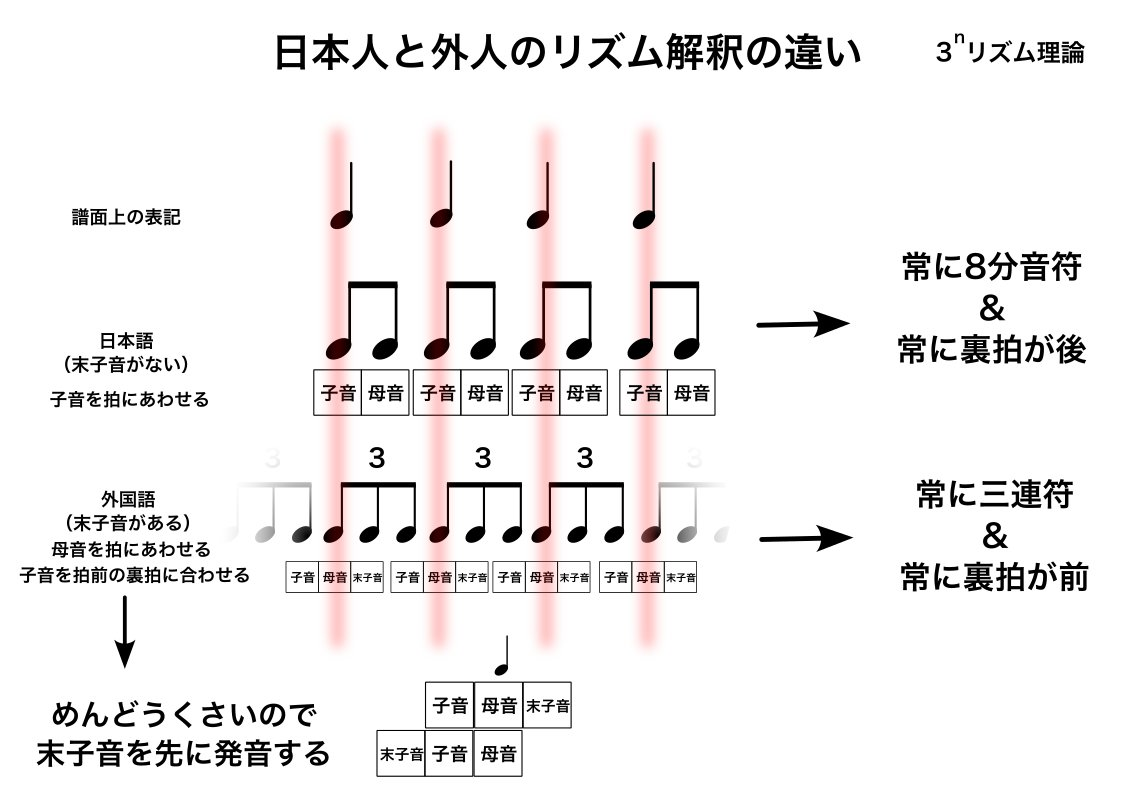
In other words, the question “Why is 3 easy to groove with?” is actually a very uniquely Japanese perspective. It can even be said that the more essential questions are “Why does 2 fail to groove?”, “Why is the number of phonological elements in Japanese syllables exceptionally two?”, and “Why does Japanese not groove?”
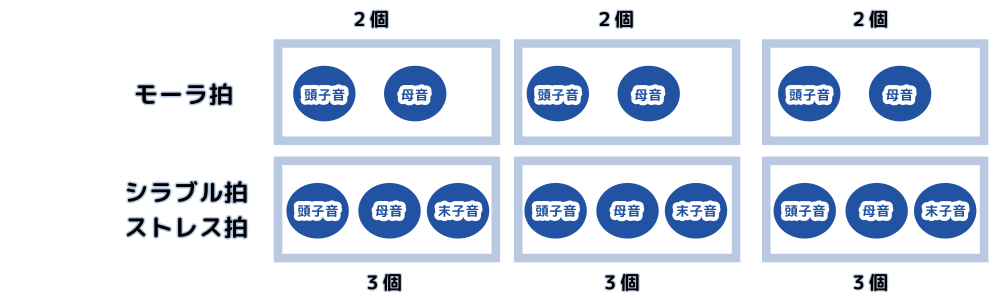
Because syllable-timed rhythm and stress-timed rhythm use syllables with three phonological elements, one note tends to be divided into three so that pronunciation can be assigned across it. And when singing more complex lyrics, this may also have led to the habit of further dividing those already divided notes into three, or bundling them in groups of three.
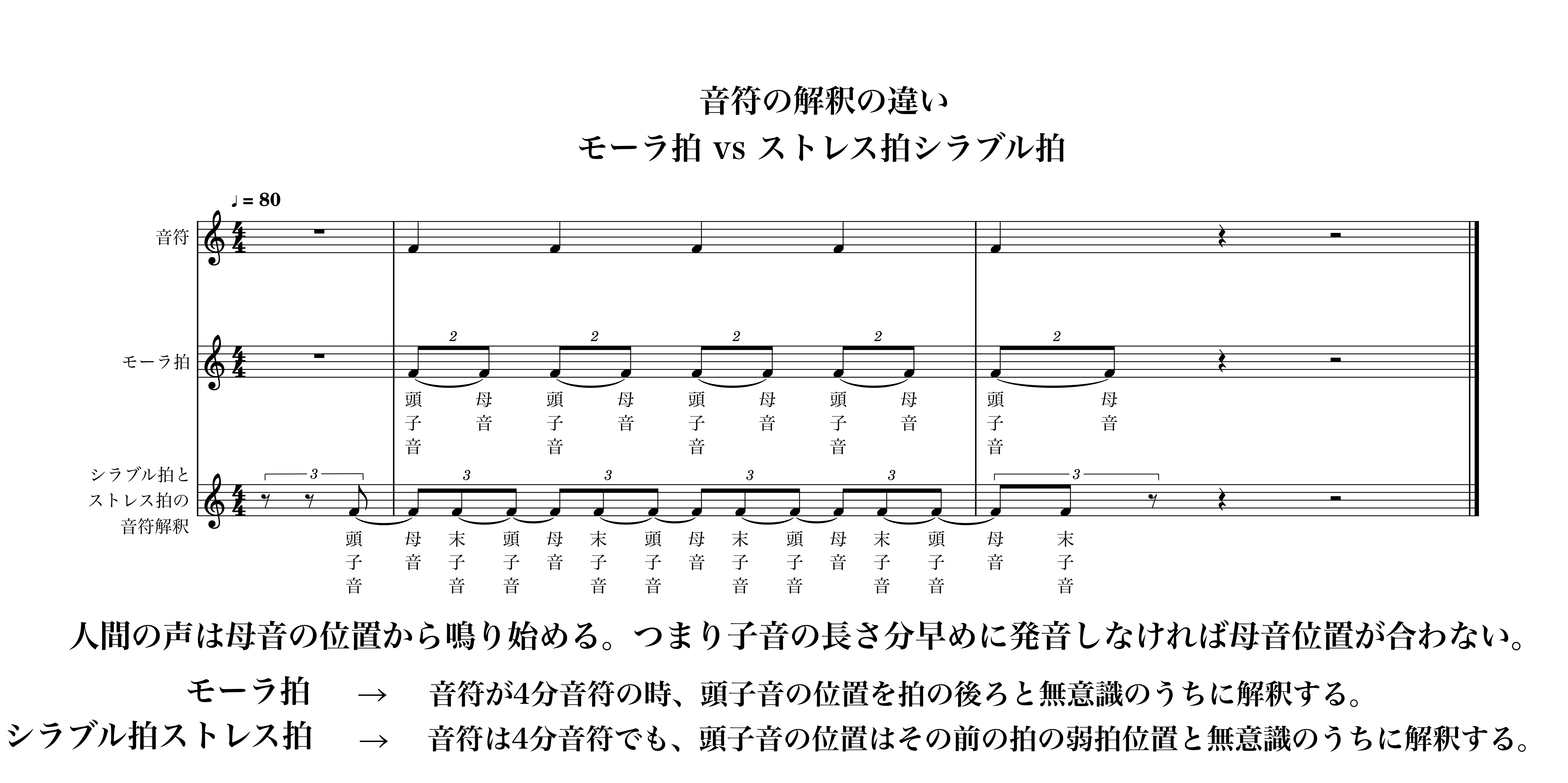
Thus, the theory that rhythms whose rhythm number contains powers of 3 as factors are easier to groove with is called the 3⁻ⁿ Hypothesis.
The Mystery of 0.037: An Experimental Demonstration of 3⁻ⁿ Groove Theory
It is well known that reproducing the nuance of jazz swing on a computer, such as in a DAW, is very difficult. The author confronted the difficulty of performing jazz properly within Japanese society while avoiding Japanese-style tatenori rhythm and still preserving a jazz-like rhythmic feel. This led to the sense that it was necessary to reproduce swing on a computer and perform solos over it. From there, an exploration began into how to realize an appropriate swing nuance in ordinary DAWs. Music notation software such as MuseScore3 has a timing-shift function. The author used this to conduct various experiments, and in the course of those experiments several interesting phenomena were observed.
The most intriguing finding was that when the timing nuance of swing was adjusted and optimized for groove, it often converged on the number 0.037. Groove also became strongest at multiples of 0.111, such as 0.111, 0.222, and 0.333. From this arose the hypothesis that timing displacement grooves most strongly when it takes the form of an arbitrary fraction whose denominator is a power of 3. This is the 3⁻ⁿ Groove Hypothesis.
The following example was actually auto-played in MuseScore3 after the timing had been adjusted using values such as 0.111 (1/9) and 0.037 (1/27).
Hypothesis That Gaelic and Black Church Rhythms Are Origins of Jazz
As the author investigated the 3⁻ⁿ Groove Hypothesis, the author predicted that the music at the roots of jazz would probably include 9-beat and 27-beat music. Such 9-beat and 27-beat music was indeed found in Black church music, one of the roots of jazz. It was also found in the folk music of the Gaelic people, a branch of the Celtic peoples in Scotland and Ireland.
From this came the further expectation that becoming familiar with the rhythms of Black church music and Gaelic folk music would help people understand groove.
Extending the Basic Unit of Multi-Layered Weak-Beat Precedence to 3
Up to now, when analyzing Multi-Layered Weak-Beat-Oriented Rhythm, we have done so using the two beat categories of strong and weak. If the 3⁻ⁿ Hypothesis is correct, then this number should originally be three.
| Position | Beat 1 | Beat 2 | Beat 3 | Beat 4 |
|---|---|---|---|---|
| Quarter Note | ◯ | ◯ | ◯ | ◯ |
| Strong/Weak | Strong | Weak | Strong | Weak |
Up to now, this is how we have analyzed it. But when we reconsider it in light of the 3⁻ⁿ Hypothesis, it seems the following analysis is more appropriate.
| Position | Beat 1 | Beat 2 | Beat 3 | Beat 4 | Beat 5 | Beat 6 |
|---|---|---|---|---|---|---|
| Quarter Note | ◯ | ◯ | ◯ | ◯ | ||
| Strong/Weak | Strong | Weak | Strong | Weak |
This corresponds to the rhythm pattern called “shuffle.”
Aretha Franklin - Cold, Cold HeartLet us do the same for eighth notes, replacing what had been only the two categories of strong and weak with swing eighth notes in triplets.
| Position | Beat 1 | Beat 2 | Beat 3 | Beat 4 |
|---|---|---|---|---|
| Quarter Note | ◯ | ◯ | ◯ | ◯ |
| Strong/Weak | Strong | Weak | Strong | Weak |
| Position | 1 | 2 | 3 | 4 | 5 | 6 | 7 | 8 |
|---|---|---|---|---|---|---|---|---|
| Eighth Note | ◯ | ◯ | ◯ | ◯ | ◯ | ◯ | ◯ | ◯ |
| Strong/Weak | Strong | Weak | Strong | Weak | Strong | Weak | Strong | Weak |
Up to now, this rhythmic construction had 2, that is, strong and weak, as its base. Let us now replace it with a rhythm based on the 3 of triplets, as follows.
| Position | Beat 1 | Beat 2 | Beat 3 | Beat 4 | Beat 5 | Beat 6 |
|---|---|---|---|---|---|---|
| Quarter Note | ◯ | ◯ | ◯ | ◯ | ||
| Strong/Weak | Strong | Weak | Strong | Weak |
| Position | 1 | 2 | 3 | 4 | 5 | 6 | 7 | 8 | 9 | 10 | 11 | 12 | 13 | 14 | 15 | 16 | 17 | 18 |
|---|---|---|---|---|---|---|---|---|---|---|---|---|---|---|---|---|---|---|
| Eighth Note | ◯ | ◯ | ◯ | ◯ | ◯ | ◯ | ◯ | ◯ | ◯ | ◯ | ◯ | ◯ | ||||||
| Strong/Weak | Strong | Weak | Strong | Weak | Strong | Weak | Strong | Weak | Strong | Weak | Strong | Weak |
And for the multilayer rhythm converted into triplets in this way as well, we apply weak-beat precedence in exactly the same way as in Multi-Layered Weak-Beat-Oriented Rhythm.
| Position | Beat 3 | Beat 4 | Beat 5 | Beat 6 | Beat 1 | Beat 2 |
|---|---|---|---|---|---|---|
| Quarter Note | ◯ | ◯ | ◯ | ◯ | ||
| Strong/Weak | Weak | Strong | Weak | Strong |
| Position | 3 | 4 | 5 | 6 | 7 | 8 | 9 | 10 | 11 | 12 | 13 | 14 | 15 | 16 | 17 | 18 | 1 | 2 |
|---|---|---|---|---|---|---|---|---|---|---|---|---|---|---|---|---|---|---|
| Eighth Note | ◯ | ◯ | ◯ | ◯ | ◯ | ◯ | ◯ | ◯ | ◯ | ◯ | ◯ | ◯ | ||||||
| Strong/Weak | Weak | Strong | Weak | Strong | Weak | Strong | Weak | Strong | Weak | Strong | Weak | Strong |
In ordinary notation, this becomes a rhythm close to 18/8.


But this is still not complete. Unlike the case where subdivision had only the two categories of weak and strong, triplets have three notes, so it is possible to carry tail alignment one stage further.
| Position | Beat 2 | Beat 3 | Beat 4 | Beat 5 | Beat 6 | Beat 1 |
|---|---|---|---|---|---|---|
| Quarter Note | ◯ | ◯ | ◯ | ◯ | ||
| Strong/Weak | Weak | Strong | Weak | Strong |
| Position | 2 | 3 | 4 | 5 | 6 | 7 | 8 | 9 | 10 | 11 | 12 | 13 | 14 | 15 | 16 | 17 | 18 | 1 |
|---|---|---|---|---|---|---|---|---|---|---|---|---|---|---|---|---|---|---|
| Eighth Note | ◯ | ◯ | ◯ | ◯ | ◯ | ◯ | ◯ | ◯ | ◯ | ◯ | ◯ | ◯ | ||||||
| Strong/Weak | Weak | Strong | Weak | Strong | Weak | Strong | Weak | Strong | Weak | Strong | Weak | Strong |
This completes tail-alignment optimization on the triplet grid.


If the above 3-based rhythm with double weak-beat precedence is auto-played, it sounds like this.
Table of contents
- Offbeat Count Theory
- Introduction
- What Are the Four Principles of Groove
- Why Are Japanese People Tatenori
- Which Comes First, the Strong Beat or the Weak Beat
- Phonorhythmatology
- A Letter to Mora-Timed Language Speakers
- Split Beat (Schizorhythmos) and Isolated Beat (Solirhythmos)
- What Is Metre
- Multi-Layered Weak-Beat-Oriented Rhythm
- Multidimensional Division Spaces
- Rhythm More Important Than Pronunciation
- The World Is Made of 3⁻ⁿ Metres
- 3⁻ⁿ Groove and 2⁻ⁿ Groove
- Distributed Groove Theory
- Weak-Beat Geocentrism and Strong-Beat Heliocentrism
- Introduction to Offbeat Count
- Rhythmochronic Competence and Sense of Rhythm
- Master English Listening with Offbeat Count
- Etudes for Mora-Timed Language Speakers
- Proper English Pronunciation
- Correct Pronunciation of Offbeat Count
- Multilayer Weak-Beat-Precedence Polyrhythm
- The Elements That Shape Rhythmic Nuance
- The Mechanism by Which Tatenori Arises
- Tatenori and the Perception of Movement
- The Psychological Problems Caused by Tatenori
