Phonorhythmatology
The rhythm of music performed by Japanese people is somehow different compared with music performed by overseas people. This difference occurs because overseas people recognize weak beats as coming before strong beats, while Japanese people recognize strong beats as coming before weak beats. This difference in recognition is born from the difference in rhythm recognition possessed by the language itself. This rhythm recognition is called in phonetics timed-rhythm.
The Three Main Timed Rhythms
The rhythm recognition of Japanese is called in phonetics mora-timed rhythm. And the rhythm recognition possessed by English is called in phonetics stress-timed rhythm. In addition, the rhythm recognition possessed by Spanish and French and so on is called in phonetics syllable-timed rhythm.
Many characteristics of syllable-timed rhythm (English) and syllable-timed rhythm (Spanish) are common. On the other hand, mora-timed rhythm (Japanese) has characteristics unique in the world that are completely different from both stress-timed rhythm and syllable-timed rhythm. In particular, Japanese is known as a language that has pure mora-timed rhythm.
| Stress-timed | Syllable-timed | Mora-timed |
|---|---|---|
| English | Spanish | Japanese |
| German | Italian | Kiribati |
| Russian | French | Slovak |
| Dutch | Korean | Luganda |
| Polish | Cantonese | Tamil |
| Arabic | Turkish | |
| Thai | Mandarin | |
| Lao | Telugu | |
| Norwegian |
Characteristics of Syllable-Timed Rhythm
It is said that most languages in the world are syllable-timed rhythm. The characteristic of syllable-timed rhythm is that pronunciation is composed of time units called syllables. Each syllable is pronounced with almost the same length. Syllables are a time unit almost the same as the mora described in the previous section, but the characteristic is that consonant clusters, diphthongs, and final consonants appear within one syllable. Also, there is the characteristic called liaison in which the final consonant connects to the next syllable. This will be described in detail later.
Characteristics of Stress-Timed Rhythm
This is a timed rhythm seen mainly in English and German. Most characteristics are common with syllable-timed rhythm, but there is a large difference in that syllable length is indefinite and expands and contracts. In stress-timed rhythm, syllables are divided into strong beats and weak beats (stress beats and non-stress beats), strong beats are arranged at fixed time intervals, and all weak beats that are not strong beats are appropriately distributed between strong beats, omitted, or dropped completely. This omission of weak beats is a large characteristic of stress-timed rhythm. This will be described in detail later.
Characteristics of Mora-Timed Rhythm
This is a timed rhythm seen almost only in Japanese, and it is said that Japanese is the only complete mora-timed-rhythm language. The characteristic of mora-timed rhythm is that pronunciation is composed of time units called morae. Each mora is pronounced with almost the same length. Morae are almost the same as the syllables described next, but the characteristic is that there are no final consonants or consonant clusters. When geminate consonants or final consonants are needed, each consonant is assigned a mora. This will be described in detail later.
The Principle by Which Japanese People Become Poor at English
The reason Japanese people are poor at English lies in the size of this gap in rhythm recognition. If Japanese people first learned languages based on syllable-timed rhythm such as Spanish or Italian, they should have been able to achieve the goal only by learning the difference between morae and syllables. However, when Japanese people learn English, they are forced to simultaneously acquire the dropping and omission of syllables in stress-timed rhythm while still not having acquired syllable-timed rhythm. Viewed theoretically, this is impossible.
What is important here is first to notice that mora-timed rhythm has distinctive characteristics, to learn the differences of mora-timed rhythm, and on top of that to first learn the basics of syllable-timed rhythm, and only when syllable-timed rhythm has been sufficiently acquired, it becomes necessary to learn the dropping and omission of syllables in stress-timed rhythm.
To leap directly and acquire stress-timed rhythm without passing through the stage of syllable-timed rhythm — this difficulty is at the root of the difficulty of acquiring English.
Rhythm Recognition Differs by Timed Rhythm
The rhythm recognition of Japanese is academically called mora-timed rhythm. Looking globally, Japanese is the only language that has mora-timed rhythm. On the other hand, the rhythm recognition of English is academically called stress-timed rhythm. Languages of stress-timed rhythm are not only English, but when viewed globally, there are many others besides English, such as Russian and German.
Details of Syllable-Timed Rhythm
Syllable-timed rhythm means the rhythm of languages in which each syllable is pronounced evenly with almost fixed length. Representative syllable-timed-rhythm languages include Spanish, Italian, French, and Thai. Let us look below at the mechanism of this syllable.
What Is a Syllable
A syllable is one of the important concepts of phonology. All words are composed of combinations of syllables.
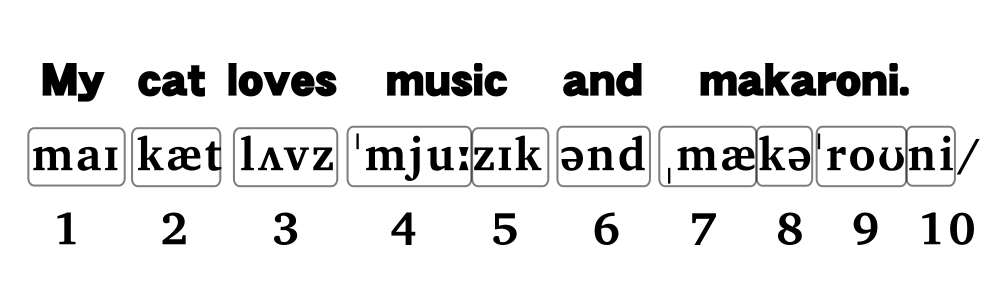
Structure of a Syllable
All syllables are composed of the three elements Onset, Nucleus, and Coda.
The nucleus and coda become the main body of the syllable. This main body is called the Rime.
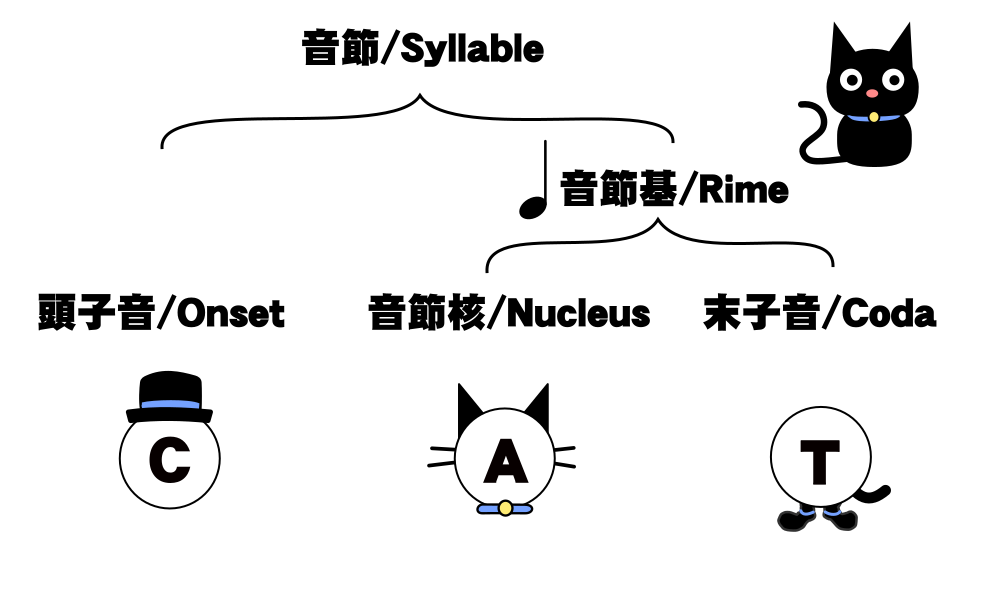
The Onset of a Syllable Does Not Disappear
The onset of the word Cat is C. If C disappears, it becomes the preposition At, which indicates position. In this case, this syllable has no onset. In English, even when there is no onset there like this, a special consonant called a glottal stop is often inserted there. This is called Glottal Stop Insertion.
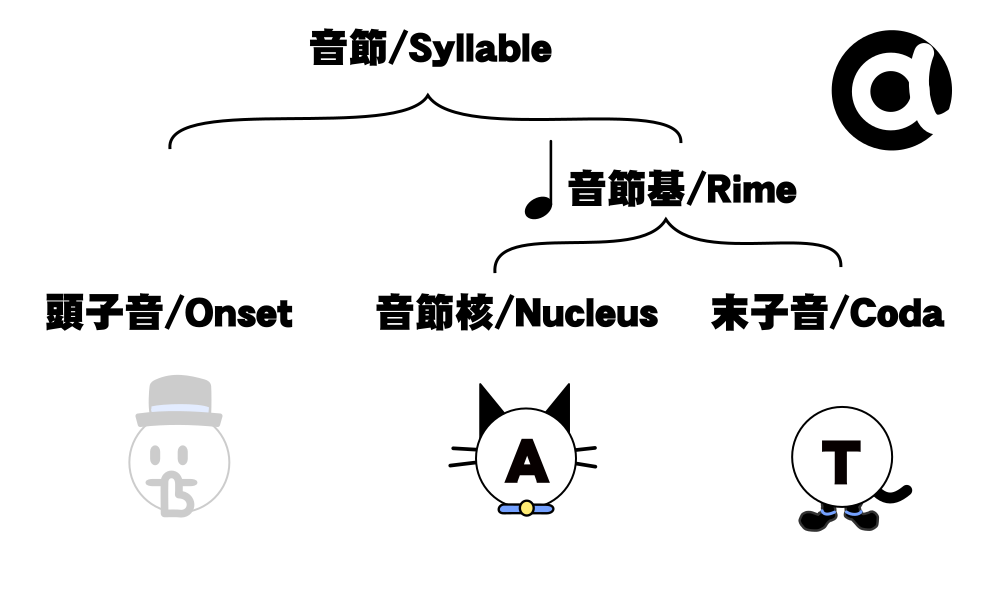
Native speakers are almost not conscious of glottal stop insertion. However, when Japanese people learn languages of syllable-timed rhythm or stress-timed rhythm such as English or Spanish, it is very important to be clearly conscious of this glottal stop insertion. There is a very clear reason for this. Let us look below at that reason.
The Rimes of Syllables Are Arranged at Equal Intervals
Rimes are basically pronounced at equal intervals. No matter how many consonants there are between rimes, the rimes are always pronounced at equal intervals.
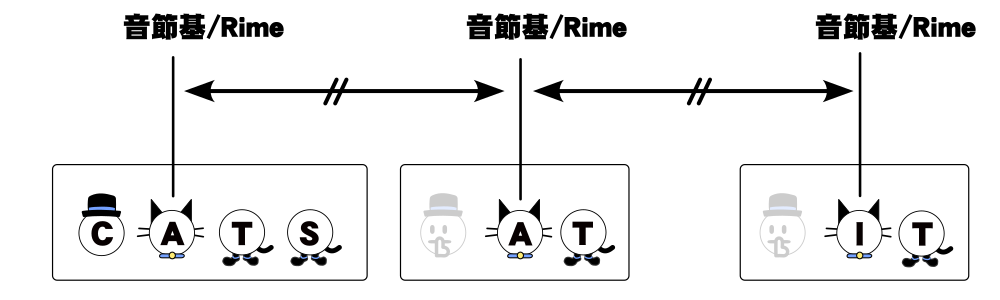
The Onset and Coda of a Syllable Are Arranged Between Rimes
Onsets and codas are distributed between rimes that are arranged at equal intervals. Even if the number of onsets and codas increases, the intervals of the rimes do not change.
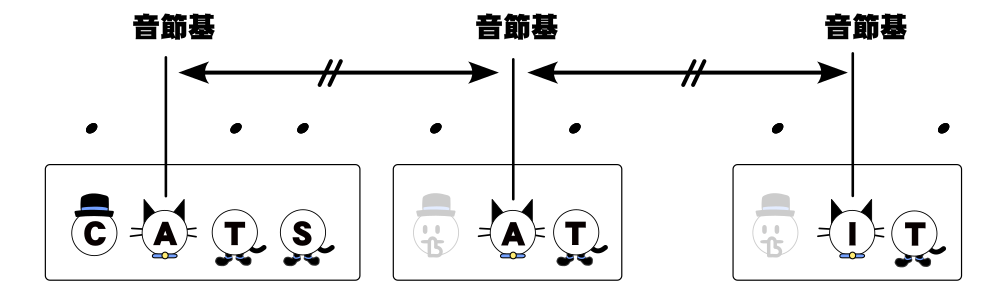
Strong Beats Are Placed on the Rimes of Syllables
When reading aloud, strong beats are placed on the rimes.
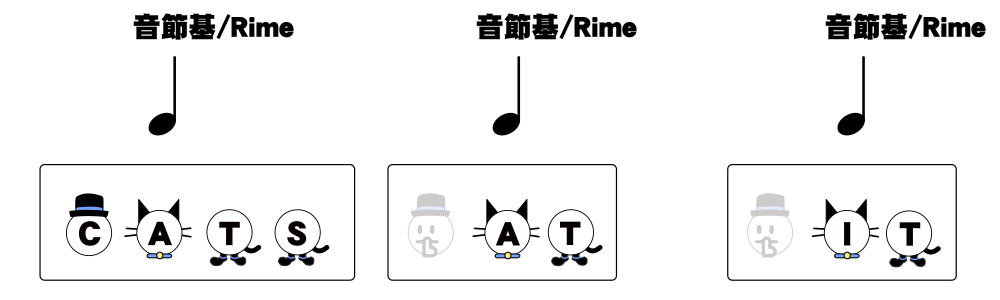
Weak Beats Are Placed on the Onset and Coda of a Syllable
Against the fact that the rime is a strong beat, the onset and the coda correspond to weak beats.
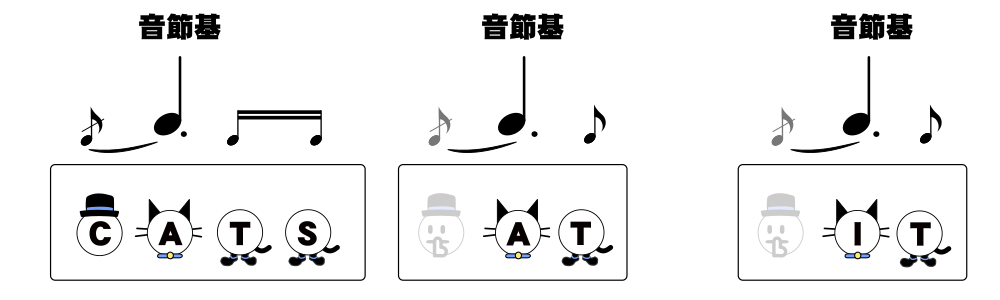
The Coda of a Syllable Fuses into the Onset = Linking
When two syllables continue, the coda of the earlier syllable is, as much as possible, grouped and pronounced as the onset of the next syllable. This grouping work is called resyllabification. And the phenomenon in which this final consonant is grouped into the onset and pronounced is called linking. It is no exaggeration to say that linking is the most important rule in learning English pronunciation.
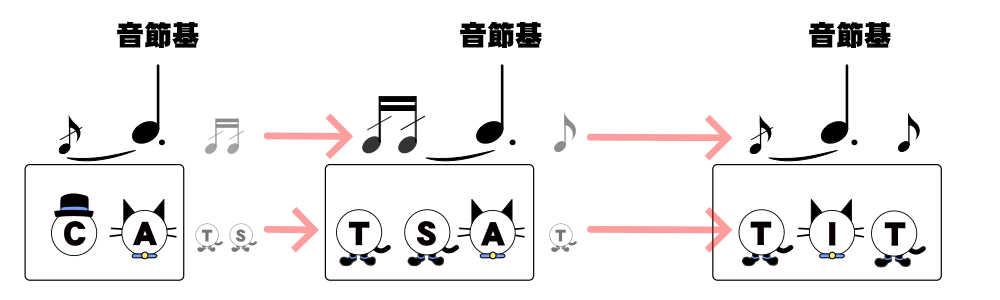
Syllables Have the Maximum Onset Principle (MOP=Maximum Onset Principle)
There is a rule that linking occurs as much as possible if it can occur. This is called the Maximum Onset Principle, or by taking the initials of the English notation “Maximum Onset Principle,” the MOP principle.
In this figure, hats indicate onsets, cats indicate nuclei, and shoes indicate codas.
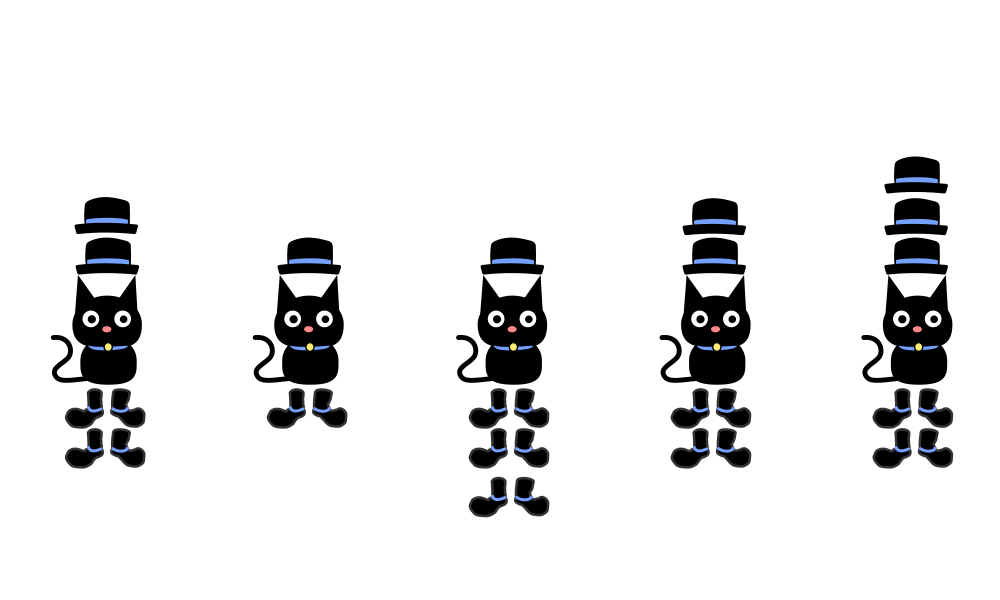
As in this figure, all codas are connected as much as possible to the next onset and grouped together in pronunciation. This is linking.
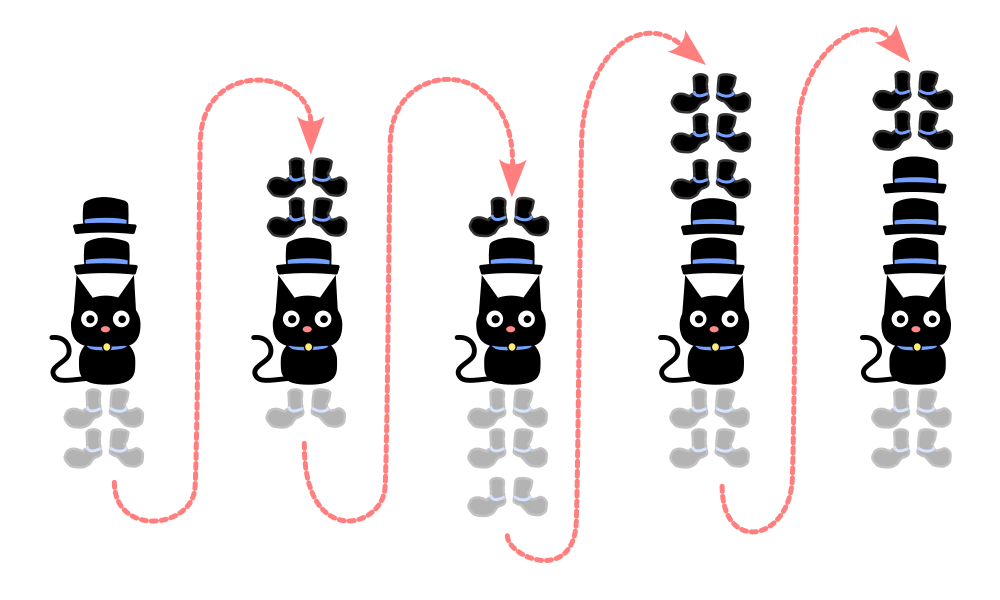
* Add actual examples.
Details of Stress-Timed Rhythm
Stress-timed rhythm is a form of rhythm recognition thought to have branched and developed from syllable-timed rhythm. Its basic properties are shared with syllable-timed rhythm, but there are several large differences that syllable-timed rhythm does not have. Both rhythms have beats that create a fixed sense of rhythm in pronunciation, but there is a large difference in how those beats are placed.
Difference Between Stress-Timed Rhythm and Syllable-Timed Rhythm
As we saw in the previous section, syllabic beats have onset consonants, syllable bases, and final consonants. Stress beats follow all of these syllabic-beat rules except for one large exception. That exception is the equal spacing of syllables.
Syllable-timed rhythm has the rule that all syllables are placed at equal intervals, but stress-timed rhythm has the additional rule that among syllables, only the syllables that have a stress beat are arranged at fixed time intervals. The other syllables are called unstressed beats, and are packed between stress beats and stress beats. At this time, so as not to break the equal spacing of the stress beats, they are greatly abbreviated and shortened. Depending on the case, they drop completely. This omission of unstressed beats in stress-timed rhythm is exactly the large difference from syllable-timed rhythm, and it is the largest characteristic of stress-timed rhythm.
This stress-timed rhythm can be thought of, as a developed form from the previously mentioned syllable-timed rhythm, as having a temporally flexible structure that makes greater rhythm/tempo expansion and contraction possible. In other words, by placing the main axis of the beat on the places that should be emphasized (= stress beats), it becomes possible to make complex arrangements of the non-stress beats, and by this, musical effects such as ornament notes and anacrusis can be given. The musical depth given by the structure of this stress-timed rhythm produces the diversity of expression in poetry and song that is unique to stress timing. And this rhythm on the language side is also giving large feedback to music.
The characteristics of stress-timed rhythm include the following.
- Stress beats are placed at each fixed time interval.
- Multiple unstressed beats are distributed so as to fill the gaps between stress beats.
As a result, the following laws hold.
- A stress beat always becomes a vowel.
- Consonants are always included in unstressed beats.
- Unstressed beats have both consonants and vowels.
- Vowels have both strong beats and weak beats.
Difference Between Mora-Timed Rhythm and Stress-Timed Rhythm
As we saw in the previous section, the beat-rhythm structures of syllable-timed rhythm and stress-timed rhythm are basically common. However, stress-timed rhythm has a characteristic that syllable-timed rhythm does not have = stress beats (accent). In other words, when one looks at English stress-timed rhythm from the Japanese mora-timed rhythm, the differences of both the characteristics of syllable-timed rhythm and the characteristics of stress-timed rhythm appear to be mixed together at the same time. This is one reason why it becomes difficult for Japanese people to understand English.
If Japanese people had first studied Spanish instead of first studying English, Japanese people would probably have been able to acquire Spanish without confusion to the degree of English. When Japanese people study English, it should have been enough merely to learn firmly the difference between mora-timed rhythm and syllabic beats, and to properly master syllable-timed rhythm.
When Japanese people study English, after firmly learning the difference between syllable-timed rhythm and mora-timed rhythm, they need to learn stress-timed rhythm, which is the developed form of syllable-timed rhythm. However, in the present educational system, Japanese learners of English end up learning stress-timed rhythm all at once at the same time without even having time to firmly acquire syllable-timed rhythm. This is impossible in principle.
In Stress Timing, the Length of Syllables Changes
In stress-timed rhythm, the length of syllables is not fixed, and expands and contracts depending on whether there is an accent or not. This is a unique characteristic possessed only by stress-timed rhythm, which neither syllable-timed rhythm nor mora-timed rhythm has.
Ignoring the characteristics of syllable-timed rhythm and looking at the difference in rhythm between mora timing (Japanese) and stress timing (English), it looks as though the length of the morae of mora-timed rhythm is expanding and contracting. This appears typically in the English-accented way Americans often get when they speak Japanese: “Wataashiwaa? Niihonngugoo’uuoo? Hanaashimasuu!” Americans have the habit of pronouncing so as to align non-stress beats short with stress beats as the standard, and therefore they cannot align all beats evenly.
This becomes clear when one observes how Japanese names change in pronunciation in English. The following is a scene from the English-dubbed version of Akira.
【縦乗りの起源】頭にアクセントが置かれる日本語の名前を英語ネイティブの人たちが読むと、しばしば2つ目の位置にアクセントが移動しますが、逆もまた然りです。
— 岡敦/Ats🇯🇵 (@ats4u) September 26, 2022
しばしば2番め以降にアクセントが置かれる英語のリズムを日本話ネイティブの人が読むと全アクセントが頭に移動します。
【英語版アキラ pic.twitter.com/fJHnZgu5cb
In stress-timed rhythm, there is a rule that syllables (morae) on which accent is placed are pronounced longer than other syllables (morae). For this reason, “Takashi” changes to “Takaaashi,” and “Akira” changes to “Akiiira.” On the other hand, because the ta of Takashi is on a weak beat, there is a tendency for the syllable length to become short, as if lightly added, like “t’Kaaashi.” Depending on the case, this syllable may drop and not be pronounced. The length of syllables expands and contracts: this is the first characteristic of stress-timed rhythm.
In other words, the reverse is also true. When Japanese people speak English, it becomes a Japanese accent like “Aaaiii, suuupiikuu, iiinnguuriiisshuu.” To Japanese people, this feels very clear and easy to hear, but from the viewpoint of people who speak English, because there is no omission of syllables required for stress-timed rhythm and many unnecessary syllables are mixed in, it is felt as very hard-to-hear pronunciation.
In English, the distinction between stress beats and non-stress beats must originally be made clear, and the positions of the stress beats must be arranged periodically. However, because Japanese has the habit of pronouncing all beats evenly with the same length, it becomes impossible to distinguish stress beats and non-stress beats, and pronunciation that can be interpreted as English can no longer be made.
In Stress Timing, Accented Syllables Are Pronounced at Equal Intervals
In stress timing, the length of syllables is not fixed and expands and contracts depending on the position of the accent, but these accented syllables are pronounced as equally spaced as possible, and syllables without accent become short, and in some cases are omitted, while being distributed appropriately between accented syllables. This is a characteristic unique to stress timing that neither syllable timing nor mora timing has.
| Example sentence | Number of syllables |
|---|---|
| Boys play games. | 3 |
| The boys play games. | 4 |
| The boys will play games. | 5 |
| The boys will be playing games. | 6 |
| The boys will be playing the games. | 7 |
Here, the bold-written Boys play games is pronounced as accented (stress beats). In other words, these syllables are pronounced at equal intervals. And the other functional words (function words = auxiliaries and pronouns) are pronounced while being distributed between accented syllables as unaccented (non-stress beats).
Please confirm the actual sound in the following video.
In Stress Timing, Unaccented Syllables Are Omitted
In stress-timed rhythm, unaccented (unstressed) syllables are often omitted in various forms.
Common Cases of Vowel Omission
Cases in which vowel omission often occurs include the following.
| Reason | Example | Explanation |
|---|---|---|
| Function words (Function words) |
to, for, and, of, at | /tə/, /fər/, /ən/, /əv/, /ət/ |
| Prefixes (Prefixes) |
com-, con-, de-, re-, in- | compact /ˈkɒmpækt/ vs. compact /kəmˈpækt/ |
| Suffixes | -tion, -ous, -al, -ity, -ive | Reduced in rhythm: dangerous → /ˈdeɪndʒərəs/ |
| Second/third syllable in multisyllabic words | America → /əˈmɛrɪkə/ | Very frequent in polysyllables |
Examples of Vowel Omission
| Word | Before change | After change | Explanation | |
|---|---|---|---|---|
| banana | /baˈnaːna/ (Wolof) | /bəˈnænə/ (English) | Single vowel becoming schwa /ə/ | |
| happy | /ˈhæpiː/ | /ˈhæpi/ | /iː/ becomes /ɪ/ or /i/ (happy vowel) | |
| influence | /ˈɪnfluəns/ | /ˈɪnflʊəns/ | /uː/ becomes /ʊ/ | |
| going | /ˈɡoʊɪŋ/ | /ˈɡəʊɪŋ/ → /ˈɡəɪŋ/ → /ˈɡɪŋ/ | Diphthong simplification | |
| Canada | /ˈkænədə/ | /ˈkænədə/ | Short vowel /æ/ becoming schwa /ə/ | |
| support | /sʌˈpɔːrt/ | /səˈpɔːt/ | Short vowel /ʌ/ becoming schwa /ə/ | |
| family | /ˈfæməli/ | /ˈfæmli/ | Vowel deletion | |
| probably | /ˈprɒbəbli/ | /ˈprɒbli/ | Vowel deletion | |
| chocolate | /ˈtʃɒklət/ | /ˈtʃɒklɪt/ | Vowel deletion | |
| roses | /ˈroʊzɪz/ | /ˈrəʊzəz/ | /ɪ/ becoming schwa /ə/ |
Three Forms of Vowel Omission
In stress-timed rhythm, unaccented (unstressed) syllables are shortened, contracted, and omitted.
- Weakening (mainly the shortening of vowels = called schwa)
- Contraction
- Omission
By this rule, accented syllables (stress beats) become able to be pronounced at equal intervals.
1. Weakening (Vowel Reduction):
Vowels in unaccented (non-stress beat) syllables change into /ə/, the most frequent vowel in English, often called schwa.
| Word | Before change | After change | Example |
|---|---|---|---|
| to | /tuː/ | /tə/ | I want to go. → “wanna go” |
| of | /ʌv/ | /əv/ or /ə/ | A cup of tea. → “cup’v tea” |
| and | /ænd/ | /ən/, /n/ | You and me. → “you’n me” |
What Is Centralization
The moving of a vowel closer to the schwa vowel /ə/ is called centralization. Concretely, it refers to the position of the tongue, at the time of pronouncing the vowel, moving from the front or back of the oral cavity to the center (= mid-tongue position). This refers, in stress-timed-rhythm languages, to vowels in unaccented syllables weakening and changing into ambiguous sounds.
- Vowels are classified by the horizontal position of the tongue (front/back) and the vertical position (high/low) when pronounced.
- Centralization means that these positions converge toward the central vicinity (mid-central).
- As a result, vowels approach more “ambiguous” sounds, for example sounds like the schwa vowel /ə/.
2. Contraction (Contractions):
Words necessary as grammar are contracted so that stress beats can line up at fixed intervals.
| Before contraction | After contraction | Example |
|---|---|---|
| I am | I’m | I’m fine. |
| He will | He’ll | He’ll come soon. |
| They are | They’re | They’re nice. |
| I would have gone | I’d’ve gone | I’d’ve gone if I could. |
🗣️ “I’d’ve” can be said to be an interesting example in which three syllables’ worth are all contracted and contracted into one accented syllable.
3. Omission:
Unaccented (non-stress beat) syllables completely drop in casual situations or when speaking fast.
| Careful Speech | Casual Speech | Note |
|---|---|---|
| Did you eat yet? | Didja eat yet? | “Did you” → “Didja” |
| What are you doing? | Whatcha doin’? | “What are you” → “Whatcha” |
| I’m going to go now. | I’m gonna go now. | “going to” → “gonna” |
| I want to do it. | I wanna do it. | “want to” → “wanna” |
| Don’t you know? | Doncha know? | “Don’t you” → “Doncha” |
The Relationship Between Stress Beats and Syllabic Beats Is Recursive Recursive Prosodic Equivalence Principle (RPEP)
Stress beats and syllabic beats have a recursive relationship.
What Is Recursion
Recursion means that the structure of the whole matches the structure of a part of it.

In this manga, recursive self-referentiality is expressed, in which its own situation itself is made into manga.
Such recursive structures appear in every place in the world.

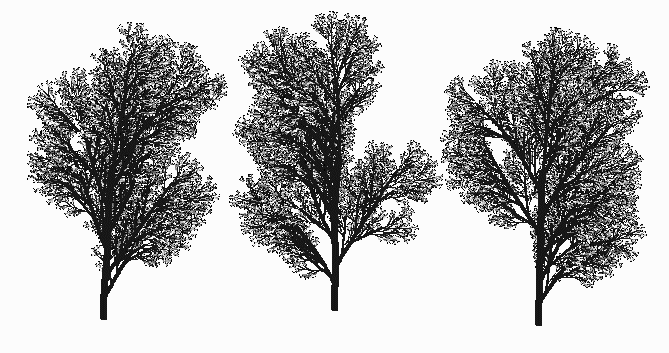




For a detailed explanation of recursion, please refer to online explanations and the like.
Stress beats have this same recursive structure.
The Recursive Structure of Stress Beats and Syllabic Beats
We have seen that syllabic beats have the elements onset consonant, syllable nucleus, and final consonant.
And we have seen that, by the Maximum Onset Principle (MOP=Maximum Onset Principle), final consonants are grouped into onset consonants and pronounced.
This same structure also exists in stress-timed rhythm.
The structure of syllabic beats described above also holds with respect to stress beats.
When the accents of stress beats (that is, beats with stress and beats without stress) are analyzed, a structure emerges in which a stressed syllable that becomes the nucleus is placed in the center, and unstressed syllables are before and after it. This structure has conventionally been explained in English phonological analysis by hierarchical models such as binary-tree structures. The multilayered weak-beat axis theory proposed in this paper proposes a new viewpoint: the analysis method of syllabic beats can be used for stress beats recursively as it is. In this book, this is called Recursive Prosodic Equivalence Principle (RPEP). And the MOP principle applied to stress beats is here called MPOP (Maximum Prosodic Onset Principle).
In this theory, the rhythmic structure of syllables in syllable-timed rhythm is not replaced by a binary-tree structure of stress versus non-stress, but rather the same structure as syllabic beats is recursively expressed in dimensions of different layers.
And furthermore, it explains that this recursive structure is recursively applied as it is to the rhythm of music played in stress beats.
Furthermore, we will see that, in musical rhythm, this is recursively applied as it is infinitely to sixteenth notes, eighth notes, quarter notes, half notes, and so on.
Structure of the Prosodic Word of Stress Beats
In Recursive Prosodic Equivalence Principle (RPEP), the syllables within a word are classified according to the position of the accent.
A syllable with accent within a word is called a nucleus syllable.
All syllables before the nucleus syllable within a word are called onset syllables.
All syllables after the nucleus syllable within the prosodic word in a word are called coda syllables.
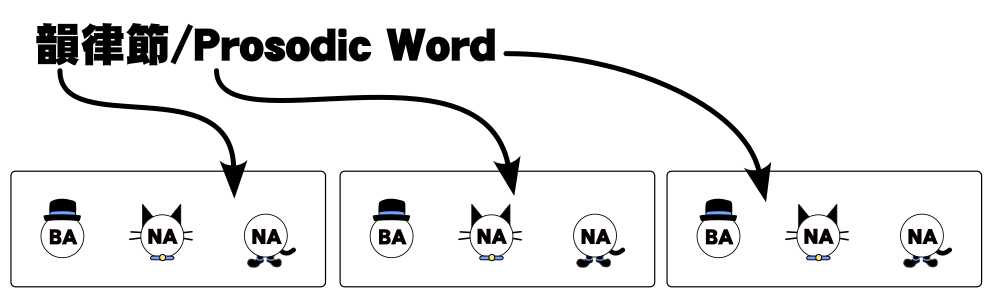
This group of several syllables is called a prosodic word.
A prosodic word generally becomes equal to a word. However, it may cease to match when the law called reprosodification introduced later is applied.
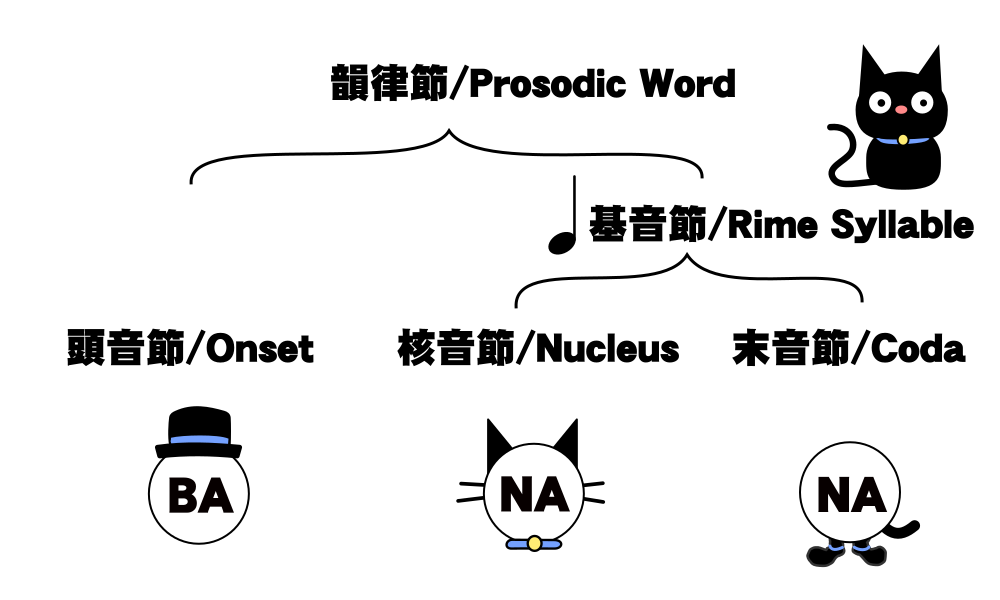
All prosodic words are composed of the three elements Onset syllable, Nucleus syllable, and Coda syllable.
The nucleus syllable and coda syllable become the main body of the prosodic word of stress beats. This main body is called the rime syllable.
In Stress Timing, Prosodic Words (Words) Are Pronounced as the Basic Unit
A prosodic word generally becomes equal to a word. However, it may cease to match when the law called reprosodification introduced later is applied. Let us see this below.
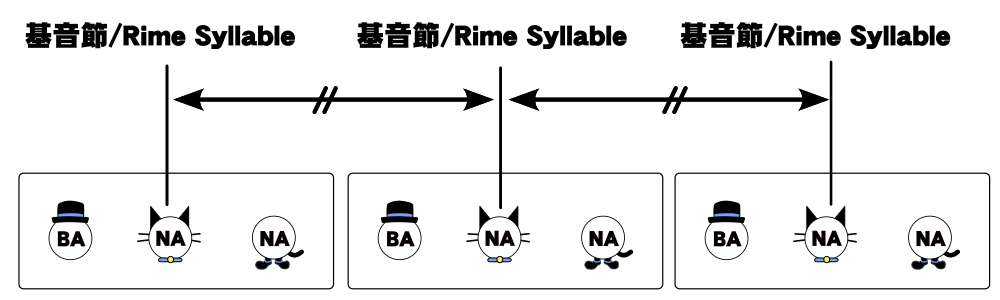
In Stress Timing, Rime Syllables Are Arranged at Equal Intervals
They are pronounced at equal intervals in rime syllables. Regardless of the number of syllables between rime syllables, rime syllables are always arranged at equal intervals.
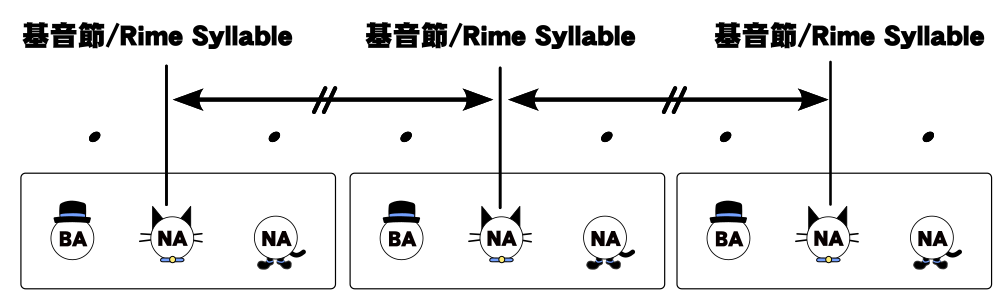
In Stress Timing, Onset Syllables and Coda Syllables Are Arranged Between Rime Syllables
Onset consonants and coda consonants are distributed between rime syllables and rime syllables arranged at equal intervals. Even if the number of onset syllables and coda syllables increases, the interval of rime syllables does not change.
In Stress Timing, Strong Beats Are Placed on Rime Syllables
When reading aloud, strong beats are placed on the rime syllables.
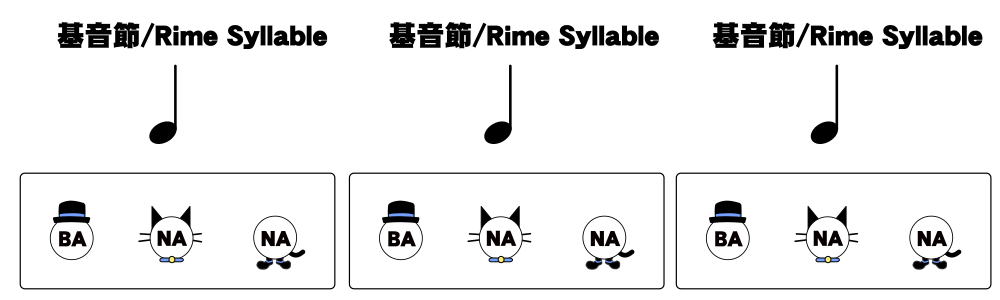
In Stress Timing, Weak Beats Are Placed on Onset Syllables and Coda Syllables
Against the fact that rime syllables are strong beats, onset consonants and coda consonants correspond to weak beats.
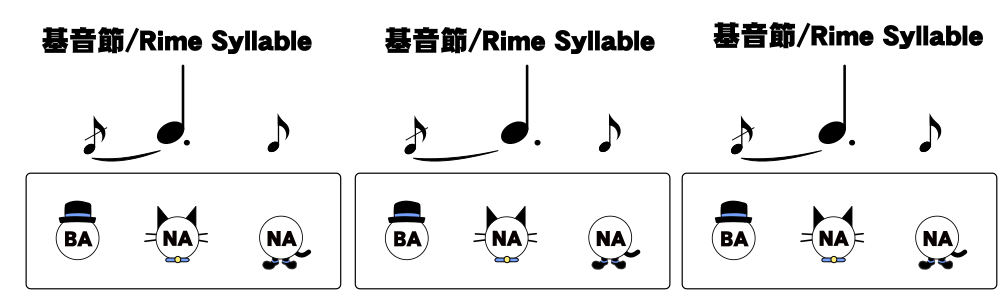
In Stress Timing, Reprosodification Occurs in Which Coda Syllables Fuse into Onset Syllables
When two syllables continue, the final consonant of the earlier appearing syllable is, as much as possible, grouped and pronounced as the onset consonant of the next syllable. This grouping work is called reprosodification. And the phenomenon in which this coda syllable is grouped into the onset syllable and pronounced is called syllable linking.
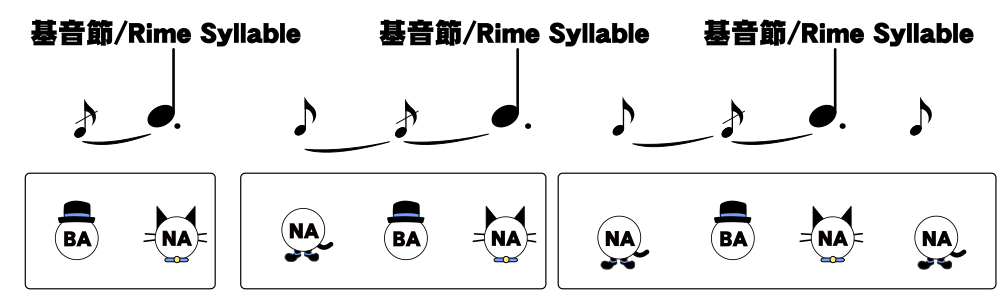
Stress Timing Has the Maximal Onset Syllable Principle = the MPOP Principle
We learned that, in syllabic beats, final consonants are grouped and pronounced as onset consonants as much as possible. We also saw that this law is called the Maximum Onset Principle (MOP=Maximum Onset Principle).
And in stress-timed rhythm, which is also derived from syllable-timed rhythm, just as in syllabic beats, all Maximum Onset Principle phenomena that occur in syllabic beats occur in the same way.
Furthermore, in stress-timed rhythm, exactly as the Maximum Onset Principle (MOP=Maximum Onset Principle) is applied to all phonemes in syllabic beats, the Maximum Prosodic Onset Principle (MPOP=Maximum Prosodic Onset Principle) is applied to all syllables.
In other words, syllable linking has the rule that, if possible, it occurs as much as possible. This is called the Maximum Prosodic Onset Principle, or by taking the initials of the English notation “Maximum Prosodic Onset Principle,” the MPOP principle.
In this figure, hats indicate onset syllables, cats indicate nucleus syllables, and shoes indicate coda syllables.
As in this figure, all coda syllables are connected as much as possible to the next onset syllables and grouped together in pronunciation. This is syllable linking.
* Add actual examples.
Details of Mora-Timed Rhythm
Moraic beats have characteristics completely different from syllabic beats and stress beats.
Main Characteristics of Moraic Beats
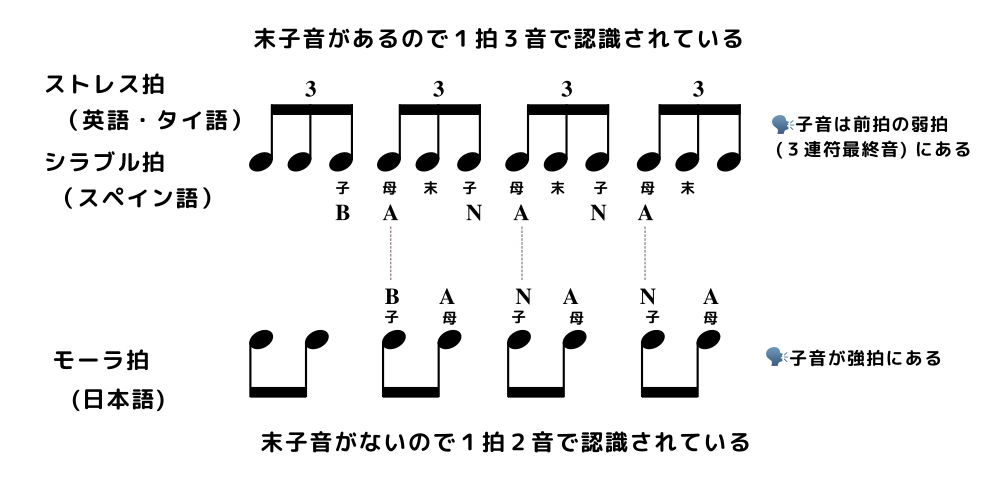
The rhythm of Japanese is academically classified as mora-timed rhythm. Mora-timed rhythm is defined as being pronounced not in the unit called a syllable syllable but in the special unit called a mora syllable. When the structure of this mora syllable is compared with the syllable syllable, many fundamental differences exist. Japanese mora-timed rhythm mainly has the following characteristics.
- Pronunciation is segmented every fixed time, and this one sound is called a mora.
- Morae are mainly composed of vowels and consonants and do not have final consonants.
If the difference between mora timing (Japanese) and syllable timing (English) is summarized briefly, it becomes as follows.
- In moraic beats, consonants are always after the beat (syllable base).
- In syllabic beats, consonants are always before the beat (syllable base).
And when we investigate further, we can see that differences of recognition like the following exist.
- Moraic beats do not distinguish consonants and vowels.
- Because many continuous complex consonant clusters appear in syllabic beats (English), the position of consonants is always kept in mind when pronouncing, but because consonants in moraic beats (Japanese) are short and simple, in most cases that consonant position is not kept in mind.
- Moraic beats have no final consonants.
- In syllabic beats, because consonants alone can be pronounced independently, it is of course not rare for a consonant to come at the end of a syllable. However, in moraic beats (Japanese), even for final consonants appearing in loanwords, one independent mora is assigned to that consonant alone. In other words, in moraic beats, final consonants cannot exist.
- Moraic beats have no consonant clusters.
- For consonant clusters, a vowel is attached to each consonant and one mora is assigned.
- Moraic beats have short consonants.
- → Vowels and morae are the main thing, and consonants are not important.
- → The number of consonants is small.
- Moraic beats are conscious only of vowels and cannot be conscious of consonants.
- → Vowels and morae are the main thing, and consonants are not important.
- → The number of consonants is small.
| Moraic beats | Syllabic beats | |
|---|---|---|
| Distinguish consonants and vowels | No | Yes |
| Final consonants | No | Yes |
| Consonant clusters | No | Yes |
| Consonants | Short | Long |
| Conscious of consonants | No | Yes |

As a result, the difference like the figure given first appears between moraic beats and syllabic beats.
Below, let us look in detail at the difference between mora-timed rhythm and syllable-timed rhythm.
Morae Have No Final Consonants
The largest difference when mora syllables are compared with syllable syllables is that they have no final consonants. Mora syllables have no final consonants: this is the greatest characteristic of mora-timed rhythm. Starting from the fact that mora syllables have no final consonants, mora syllables produce properties completely different from syllable syllables. Let us look below.
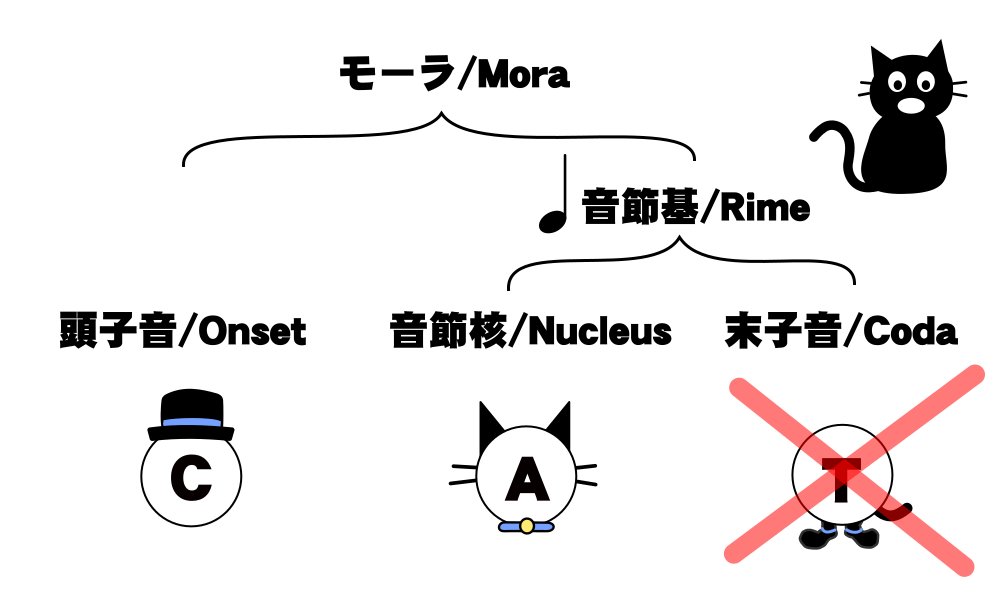
The Onset Consonant of a Mora Is Included in the Syllable Base
In syllable syllables, the onset consonant is not included in the syllable base. But in mora syllables, the onset consonant is included in the syllable base. This is the second large characteristic of mora syllables.
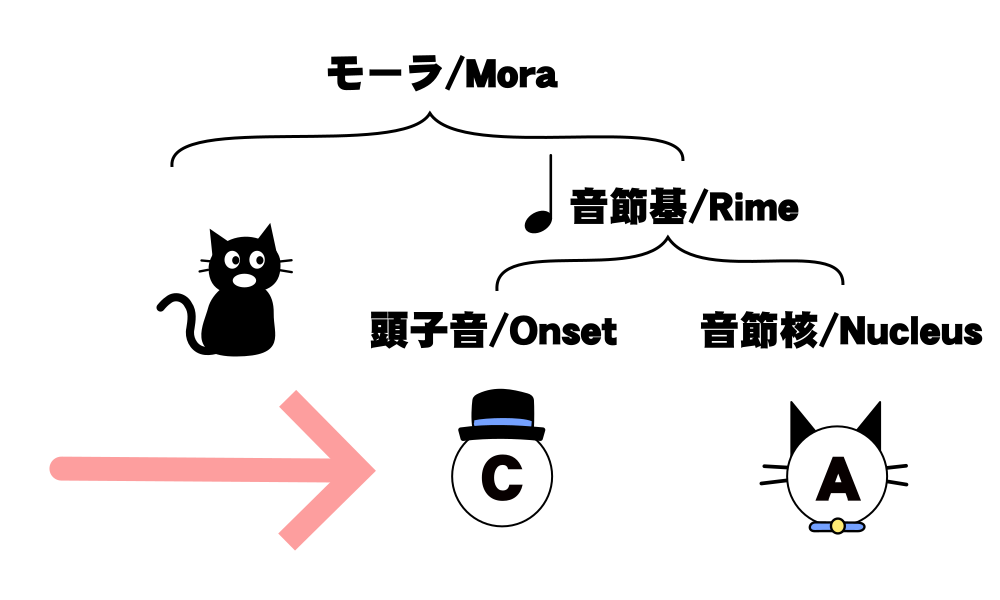
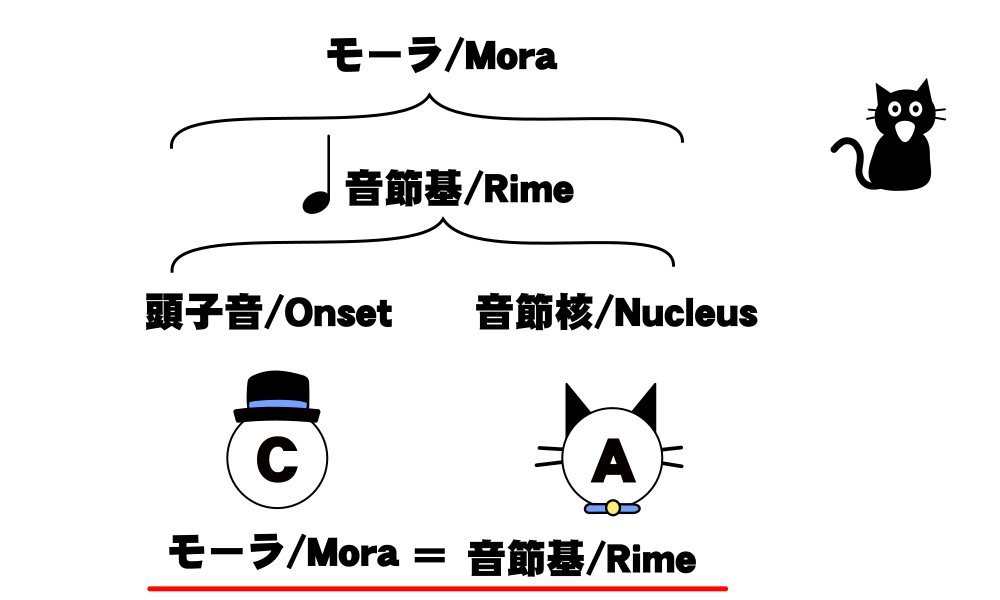
The Mora and the Syllable Base Have the Same Length and Are Not Distinguished
In syllable syllables, the onset consonant and syllable nucleus are independent from each other, but in mora syllables, because the onset consonant is included in the syllable nucleus and there is no final consonant, as a result the syllable nucleus and the syllable become the same length and there is no distinction between them.
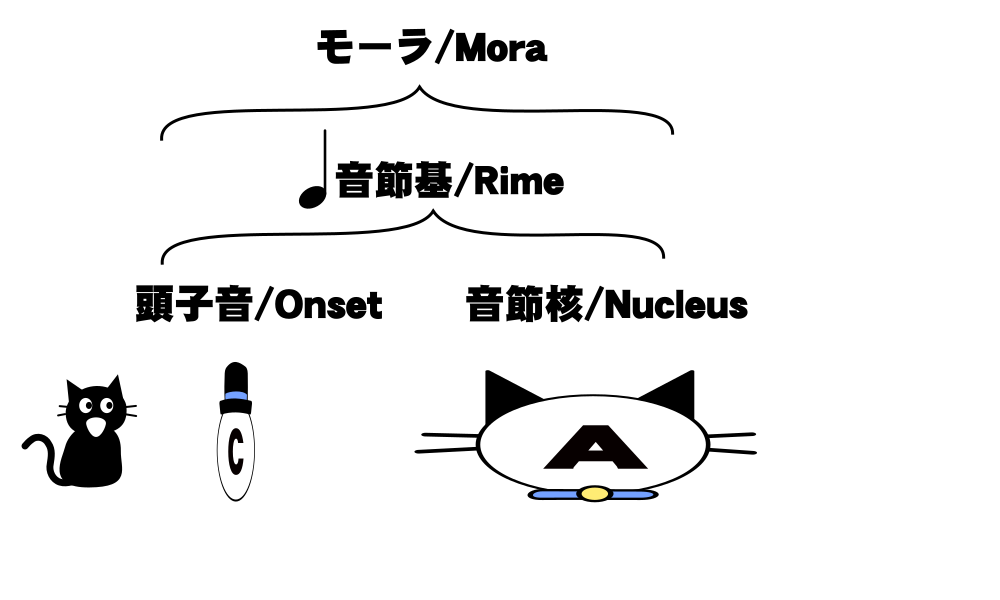
The Onset Consonant of a Mora Is Very Short
Japanese consonants (mora timing) have the characteristic of being extremely short compared with the consonant length of languages of syllable timing and stress timing.
This is something almost impossible to be conscious of when one speaks only Japanese, which is a vowel-dominant language, but generally in languages other than Japanese, consonants are as long as vowels.

This is a famous photograph of the American politician Mr. Trump. It is a photograph from which one can see that he is right now trying to say a word beginning with F by pronouncing the onset consonant F long. In this way, in English and other languages, consonants can be pronounced long. This contrasts with Japanese, where if one tries to say fu long, it becomes “fuuuu—” and only the vowel u remains.
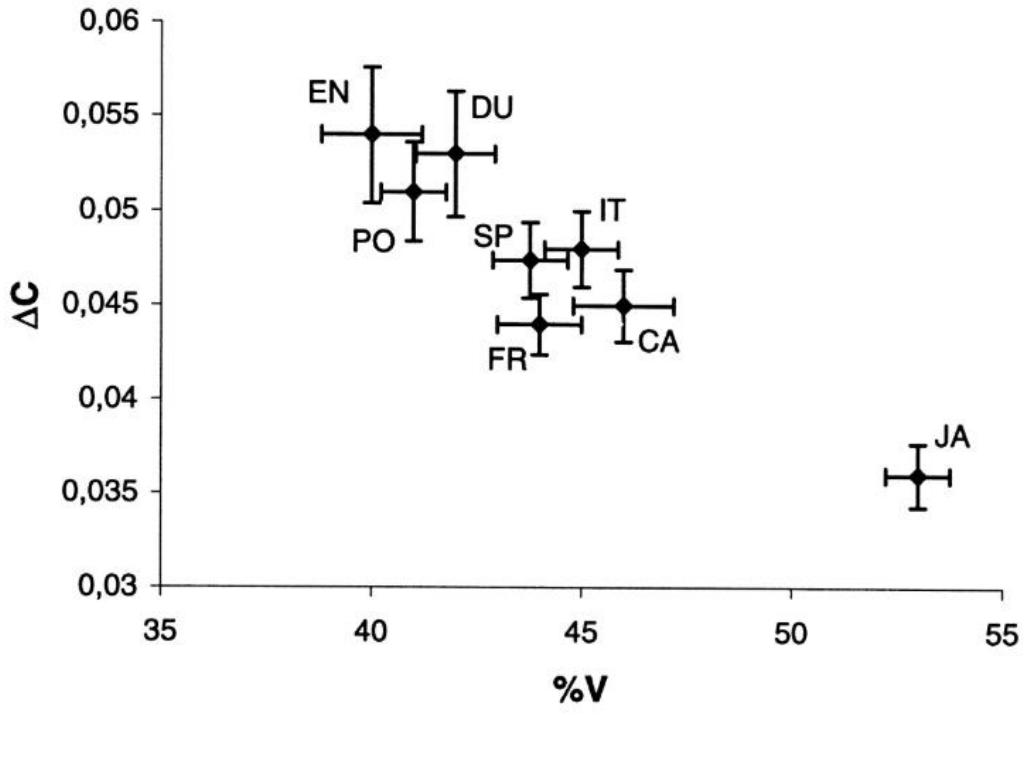
Cited from: Rhythmic Similarities between Language and Music: A Case Study of Jazz and Bluegrass Musicians - Udi Wahrsager’s Thesis. This paper is a master’s thesis titled “Rhythmic Similarities between Language and Music,” and compares jazz and bluegrass performers. (By Udi Wahrsager)
This graph shows that the vertical axis = AC represents the average consonant length, and the horizontal axis = %V represents the average percentage of vowel length. From here, one can see that only Japanese has strikingly long vowels and strikingly short consonants. In particular, one can clearly see that among eight languages, the only language whose vowel length exceeds 50% is JA = Japanese.
The Onset Consonant of a Mora Disappears
In syllable syllables, because the onset consonant is independent from the syllable nucleus, and because the syllable base is placed in the syllable nucleus, even if the onset consonant disappears, the position of the syllable nucleus does not change. But in mora syllables, because the onset consonant is included in the syllable base, if the onset consonant disappears, the syllable base expands by that amount. This is the third characteristic of mora-timed rhythm.
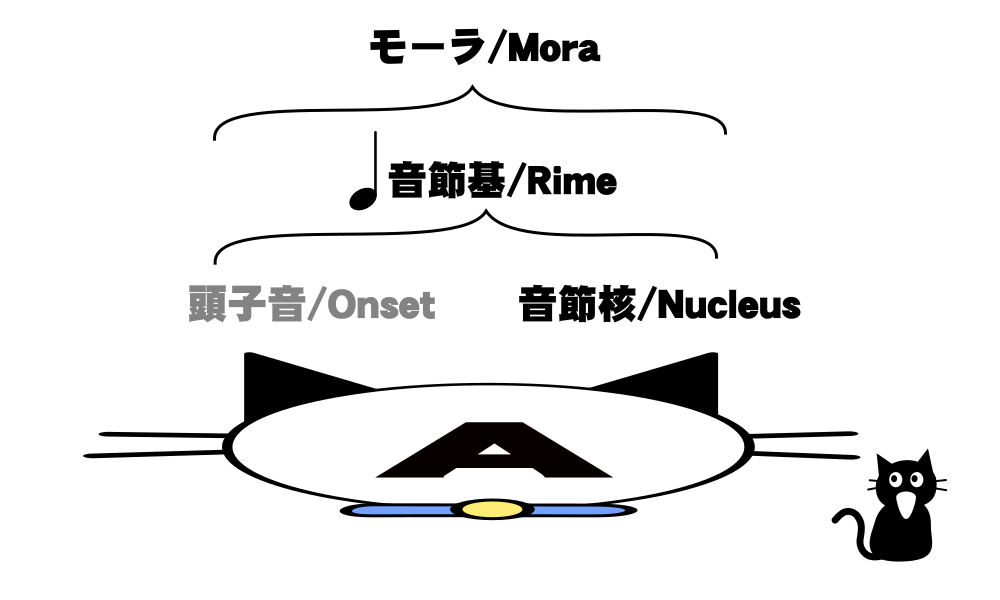
Morae Have the Minimum Onset Principle (MiOP = Minimum Onset Principle)
We have seen that, in syllable syllables, final consonants are connected as much as possible to the onset consonant of the next syllable and pronounced together. The same is true in stress-timed rhythm, which shares rules with syllabic beats. However, in mora timing, a completely different rule is applied here.
In moraic beats, onset consonants are pronounced separated apart as much as possible.
Moraic beats do not have final consonants. If there were final consonants, in order to avoid the final consonant combining with the next onset consonant, that final consonant makes a new syllable (mora) without a vowel and is pronounced as the onset consonant there. Also, moraic beats do not have consonant clusters. When consonant clusters appear, each consonant makes its own independent syllable (mora) and is pronounced as the onset consonant there.
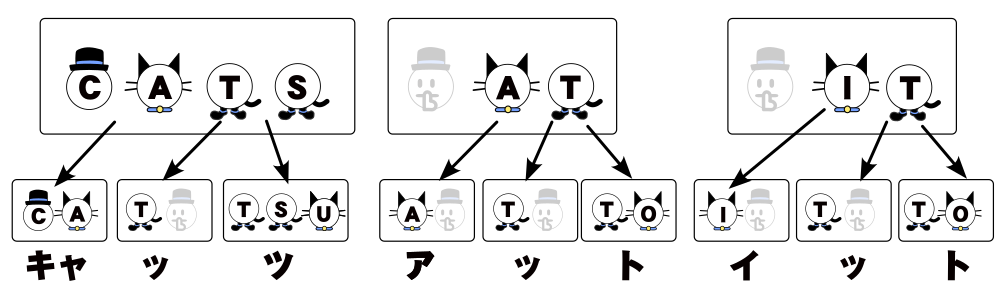
In this way, in mora-timed rhythm, onset consonants and final consonants are pronounced so as to become independent and separate apart as much as possible. This is the exact opposite property of the Maximum Onset Principle (MOP=Maximum Onset Principle) possessed by syllable-timed languages and stress-timed languages. This property is here called the Minimum Onset Principle (MiOP = Minimum Onset Principle).
The Difference Between Morae and Syllables Is the Difference in the Front-Back Relationship of Strong Beats and Weak Beats
The difference between moraic beats and syllabic beats is concentrated in whether the onset consonant (weak beat) is before the syllable base (strong beat) or after it.
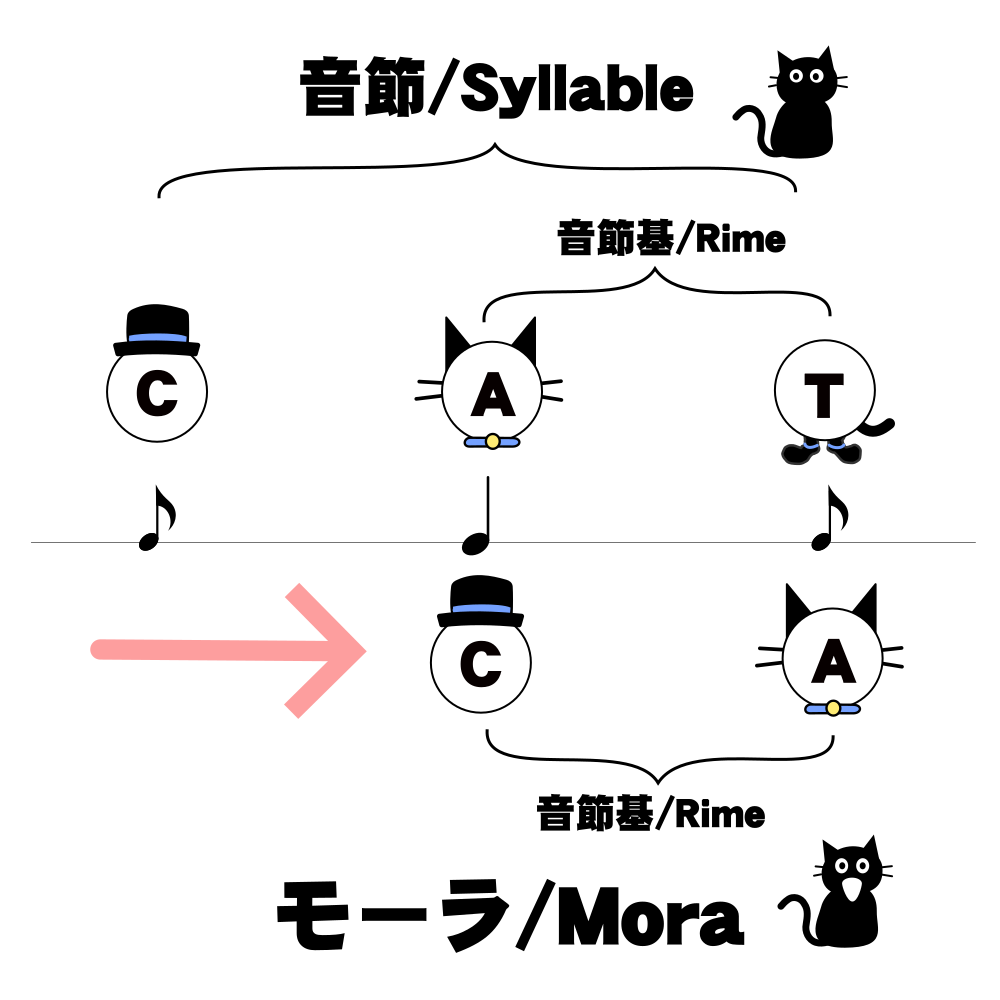
People who speak syllable-timed-rhythm languages recognize the weak beat (onset consonant) before hearing the strong beat (syllable base) that comes at fixed intervals.
By contrast, people who speak mora-timed-rhythm languages recognize the weak beat (onset consonant) after hearing the strong beat (syllable base) that comes at fixed intervals.
This distinction of whether the weak beat (onset consonant) is recognized as before or after with respect to the strong beat (syllable base) is here called Phonotemporal Ordering Axis.
The fact that people who speak syllable-timed-rhythm languages / stress-timed-rhythm languages recognize the weak beat (onset consonant) as being before the strong beat (syllable base) is here called Leading-Consonant Phonotemporal Ordering.
The fact that people who speak mora-timed-rhythm languages recognize the weak beat (onset consonant) as being after the strong beat (syllable base) is here called Following-Consonant Phonotemporal Ordering.
In other words, with Leading-Consonant Phonotemporal Ordering, consonants are anticipating the syllable nucleus, and it can be said that consonants play the role of starting the vowel. This is called Multi-Anchored Syllable Initiation.
And with Following-Consonant Phonotemporal Ordering, there is nothing anticipating the syllable nucleus, and it can be said that the consonant or vowel that appeared first plays the role of starting the syllable nucleus. This is here called Mono-Anchored Syllable Initiation.
Thus, does the syllable nucleus start alone, or do multiple preceding onset consonants start the syllable?
Multi-Anchored Syllable Initiation leads to the larger concept of Split Beat (Schizorhythmos).
Mono-Anchored Syllable Initiation leads to the larger concept of Isolated Beat (Solirhythmos).
As for Split Beat (Schizorhythmos) and Isolated Beat (Solirhythmos), we will look more closely in the chapter Schizorhythmos and Solirhythmos.
This feeling possessed by syllable-timed-rhythm languages that weak beats exist before strong beats is a very mysterious and hard-to-grasp feeling for people who speak languages of mora-timed rhythm, who recognize weak beats as being after strong beats.
When people who speak a mora-timed-rhythm language as their first language try to acquire, through training, the rhythm of a syllable-timed-rhythm language as a second language, it is not rare that it takes ten years, and in some cases close to twenty years.
Offbeat Count Theory is a practice method born as the result of considering, with attention to how people whose native language is this mora-timed rhythm can most efficiently acquire syllable-timed rhythm and the stress-timed rhythm introduced next as second languages.
Table of contents
- Offbeat Count Theory
- Introduction
- What Are the The Nine Principles of Groove?
- Why Are Japanese People Tatenori
- Which Comes First, the Strong Beat or the Weak Beat
- Phonorhythmatology
- A Letter to Mora-Timed Language Speakers
- Split Beat (Schizorhythmos) and Isolated Beat (Solirhythmos)
- What Is Metre
- Multi-Layered Weak-Beat-Oriented Rhythm
- Multidimensional Division Spaces
- Rhythm More Important Than Pronunciation
- The World Is Made of 3⁻ⁿ Metres
- 3⁻ⁿ Groove and 2⁻ⁿ Groove
- Distributed Groove Theory
- Weak-Beat Geocentrism and Strong-Beat Heliocentrism
- Introduction to Offbeat Count
- Rhythmochronic Competence and Sense of Rhythm
- Master English Listening with Offbeat Count
- Etudes for Mora-Timed Language Speakers
- Proper English Pronunciation
- Correct Pronunciation of Offbeat Count
- Multilayer Weak-Beat-Precedence Polyrhythm
- The Elements That Shape Rhythmic Nuance
- The Mechanism by Which Tatenori Arises
- Tatenori and the Perception of Movement
- The Psychological Problems Caused by Tatenori
