Tatenori and the Perception of Movement
Native speakers of Japanese have a distinctive rhythmic habit. That is what I call tatenori. Up to this point, I have analyzed what tatenori is, defined it, considered how to avoid falling into it, and gone further to ask how one can groove more deeply. But correcting tatenori is not easy. Even in the shortest cases it takes years to overcome, and in long cases it can take more than a decade.
Japanese people also have a distinctive walking habit: they cannot smoothly avoid moving objects. This is a problem that is barely recognized by Japanese people themselves, but from the perspective of people overseas it stands out very clearly. Here I will call this Path Overlap. Like tatenori, this trait is very difficult to correct, and more than that, it is extremely difficult even to become conscious of the walking style itself. Overcoming this problem likewise requires many years.
Offbeat Count Theory proposes the hypothesis that these phenomena arise because language rhythm is deeply involved in how moving cognition perceives time. In other words, to cure tatenori, one must deeply introspect on how one recognizes one’s own movement and then reform that recognition.
In the previous chapter, Split Beat (Schizorhythmos) and Isolated Beat (Solirhythmos), we saw that language rhythm can be divided into two types: Split Beat (Schizorhythmos) and Isolated Beat (Solirhythmos).
Japanese has the very unusual rhythmic structure of mora-timed rhythm. Because Japanese people speak that language as their mother tongue, the language’s pronunciation structure produces a characteristic bias in the cognition that governs their behavior. Here I call this distinctive rhythmic-cognition type Isolated Beat (Solirhythmos).
This Isolated Beat (Solirhythmos) causes both tatenori, in which hearing a weak beat prevents one from recognizing the strong beat, and Path Overlap, in which one cannot smoothly avoid moving things. That is the theme of this chapter.
This Japanese Isolated Beat (Solirhythmos) can also explain many other strange Japanese habits. In this chapter, I want to present the perspective that the mora-timed rhythm of Japanese, that is, Isolated Beat (Solirhythmos), governs Japanese behavior in many different situations without Japanese people even noticing it.
What Is Path Overlap?
There is a behavioral pattern found only among Japanese people: Japanese people do not avoid moving things at all. This was one of the first things I noticed when I returned to Japan after years of wandering abroad.
What follows is a hypothesis drawn from my own personal observations and experiences as the author. It would require a great deal of verification to determine whether this hypothesis is truly correct. In that sense, it lacks rigor, because it is not based on objectively quantified data.
Even so, there are things I only began to notice because my own perceptions changed dramatically before and after my twelve years of wandering abroad. I believe I became able to notice them because I learned to switch between a Japanese mode of perception and an overseas one.
When multiple perspectives are layered together, they should bring interesting facts to light. Even if something begins as personal experience, I believe it can still have a certain value.
And I also came to realize that this is by no means merely my personal memoir. In fact, it is a very common topic among non-Japanese residents of Japan speaking in English. In other words, it is something that people other than Japanese have already noticed. These observations can be found concretely in writing on the internet, on social media, forums, and similar places. Even if such opinions are not quantified, one can at least say that there is a certain bias in Japanese cognition, and that it gives non-Japanese people a certain persistent sense of unease.
The trait that people around the world know, but that only Japanese people fail to notice about themselves, is this: it is very difficult to pass a Japanese person in a corridor without almost colliding with them. While traveling abroad, I walked through many kinds of crowds, and whenever I encountered someone who failed to pass smoothly and nearly collided with me, that person was always Japanese. At first I thought it might be my imagination, but the recurrence was so strong that, while walking through crowds every day, I would encounter it once or twice a day.
If I moved right, they moved right. If I moved left, they moved left. They would always dodge in the same direction one beat late, which made it impossible to pass each other smoothly.
After that, I became interested and started observing this uniquely Japanese behavior pattern as it surfaced in overseas crowds. Then I realized that this was in fact a comparatively well-known Japanese habit overseas.
The Japanese Path Overlap That Only Japanese People Do Not Notice
歩行者同士の進路被り解消システム pic.twitter.com/2aFqVw2eQY
— テコまる (@tecomalupepepe) May 10, 2024
The video above is Mr. Tekomaru’s “Path Overlap Resolution System.” Almost everyone has experienced the common problem of repeatedly overlapping paths with someone in a corridor and nearly colliding. But I came to realize that this is in fact a distinctively Japanese problem.
When people overseas walk through crowds, what they pay the most attention to is not colliding with others. A crowd contains all kinds of people, including dangerous ones such as pickpockets, thieves, and drunks, and because no one knows what kind of unpredictable threat may be present or where, people develop the habit of unconsciously choosing a route that does not block anyone else’s path. As a result, situations in which two people face off or nearly collide are rare to begin with.
Japanese people, however, do not have this habit of avoiding in advance. Because they do not even cognitively register routes that cut across the paths that overseas pedestrians would automatically avoid, they unconsciously choose courses that cross in front of others. That makes face-to-face near-collisions far more likely.
In other words, overseas pedestrians rarely end up face to face, whereas Japanese people often do. And once they do, a new problem appears: they cannot dodge in the direction opposite to the other person. If the other person moves right, they are drawn into moving right as well, and almost collide. If the other person moves left, they are drawn into moving left in exactly the same way. In the end, they always dodge in the same direction one beat late, so they keep almost colliding and cannot pass each other. Moreover, this characteristically happens two or three times in a row.
In countries where pedestrians move far faster than in Japan, this style of walking can easily become dangerous. This Japanese habit stands out very clearly. Yet very few Japanese people seem to notice it.
My First Encounter with Path Overlap
The first time I noticed this phenomenon was on a sidewalk in Bangkok, Thailand. The sidewalks on Sukhumvit Road are narrow because they are lined with food stalls and street shops, and large numbers of tourists from all over the world walk there in all directions. Yet the pedestrians on those sidewalks skillfully avoid one another, and collisions are mysteriously rare. If they realize they will not be able to pass cleanly, one of them will step aside in advance and wait for the other to pass, duck into a recess in the walkway, or pull in a shoulder to let the other person through. They walk the street while communicating quickly and smoothly through motion.
But every so often, while walking there, I would almost collide with someone who moved right the moment I moved right, or moved left the moment I moved left, always dodging in the same direction one beat late. When I looked up, I realized that the person who had moved in the same direction was Japanese.
At first I repeatedly checked whether it might be my imagination, but the recurrence was so strong that I gradually became aware that whenever I thought, “Here comes someone who dodges one beat late,” that person was Japanese with almost one-hundred-percent certainty.
That was my first encounter with Japanese Path Overlap. As part of the survival skills I developed while wandering abroad, I can roughly distinguish Teochew, Hainanese, Lao, Malay, Thai, and similar ethnic groups, yet not a single one of them exhibited this Path Overlap. Part of the reason is that they are already dodging in directions that prevent Path Overlap from arising in the first place.
Airports, Where Path Overlap Is Easy to Observe
I became even more strongly aware of Japanese Path Overlap after returning to Japan.
I am from Kamata in Tokyo, which is close to Haneda Airport, so I walk there almost every day. At Haneda there is Terminal 3, where international flights arrive and depart, and Terminals 1 and 2, which are mainly domestic. In other words, it is an ideal place to compare how Japanese people walk with how foreigners walk.
Before the COVID pandemic, around 2020, there was a tourism boom from China, and Terminal 3 was constantly overflowing with large numbers of Chinese tourists. Terminal 3 was packed with people, yet, strangely enough, people hardly collided with one another. By contrast, Terminals 1 and 2 are wider, easier to walk through, and not crowded in the same way, yet Path Overlap still occurs there. This, too, is highly reproducible: every time I go to the airport, Path Overlap occurs several times without fail.
From around 2023 onward, Terminal 3 became a mixed domestic-and-international terminal, turning it into a place where Japanese people and foreigners walk together. That gave me even more opportunities than before to compare the difference in how they move. Whenever someone approaches as if diving straight into my personal space, or closes in by cutting across the space right in front of my nose, that person is always Japanese. Almost no one else walks the way Japanese people do.
Path Overlap, Well Known Among People Overseas
When I point this out in Japan, I am often met with the objection, “That is just your imagination.” It is not my imagination. There may not be quantified numerical data, but the complaint that “Japanese people do not avoid others around them” is one of the complaints that long-term foreign residents of Japan very typically begin to voice.
Overseas, openly criticizing the habits of people from a specific country carries the risk of being interpreted as discriminatory, so such complaints are not usually expressed loudly and directly. More often, they are voiced quietly and somewhat indirectly. In other words, unless you know the indirect ways these things are expressed in English, it is difficult to find them on the internet.
So I tried investigating how one might say, in English, that “Japanese people do not avoid others.”
How To Say Path Overlap in English
In Japanese, I usually describe it with the phrase “Japanese people do not avoid others.” But when I say this to Japanese people, I have observed that I have never once met a Japanese person who actually understands what I mean from that Japanese phrasing alone. That makes me suspect that the phrase itself may not really be common Japanese after all.
So then, how would one say “Japanese people do not avoid others” in English?
| English | Approximate colloquial meaning |
|---|---|
| People stop abruptly without checking behind them. | They just suddenly stop without looking behind them… |
| They drift into others’ paths as if unaware of shared space. | They cut across other people’s paths as if they do not see the space around them. |
| Apologies are automatic but unreflective — a social reflex, not awareness. | They apologize automatically, but it feels reflexive rather than considerate. |
| Eye contact and prediction are rare, as if each person is moving through a private tunnel. | They move as if they are in their own private tunnel, without watching or predicting |
| English | Literal meaning | Loose paraphrase |
|---|---|---|
| People stop abruptly without checking behind them. | They suddenly stop without checking behind them. | They just suddenly stop without looking behind them… |
| They drift into others’ paths as if unaware of shared space. | They cut into others’ paths as if unaware that space is shared. | They cut across other people’s paths as if they do not see the space around them. |
| Apologies are automatic but unreflective — a social reflex, not awareness. | Their apologies are almost automatic, mere social habit without awareness. | They apologize automatically, but it feels reflexive rather than considerate. |
| Eye contact and prediction are rare, as if each person is moving through a private tunnel. | They avoid eye contact and do not anticipate what lies ahead, as if in a private tunnel. | They move as if they are in their own private tunnel, without watching or predicting |
Complaints That People Overseas Do Not Usually Say Directly to Japanese People
If you search the internet using these expressions, you can find all kinds of complaints about Japanese people.
- Do pedestrians, cyclists, and drivers in Japan have any sense of spatial awareness?
- The lack of awareness and consideration for others is baffling and infuriating.
- They stop abruptly without checking behind them.
- One moment you are walking normally, and the next you have to make a full-speed evasive move just to avoid a collision.
- They cut into other people’s paths as if walking across an empty field.
- Groups block the entire sidewalk and walk as if it were their own private passageway.
- On sidewalks they do whatever they want, as if they were walking around inside their own house.
- They move as if inside their own private tunnel, without looking around or predicting danger.
- My hypothesis is this: because society makes people devote excessive attention to intimate, family-like relationships, doing that all day leaves them with no cognitive room for the outside world, and they start expecting others to read their feelings for them.
- What is the psychology behind the “butsukari-otoko”? (Men who shoulder-check people)
- Japanese people seem to lack spatial awareness to an unbelievable degree.
- Apologies are automatic and without reflection: not awareness, but a social reflex.
- I could not find that exact phrasing quoted directly, but the same idea appears in comments such as: “I was walking hand in hand with my partner when some guy shoulder-checked us… It is like they are not really looking where they are going.”
- Rant: Elderly People
- Why do elderly people in Tokyo have zero spatial awareness???
- No, honestly, it is everyone, regardless of age.
- Rant about Japanese physical and mental unawareness
- I realized I am utterly fed up with how bad people’s spatial awareness is.
- At last I was able to put into words what I hate most about Japan: the fact that people’s spatial awareness is so bad that it is infuriating.
- I realized I am utterly fed up with how bad people’s spatial awareness is.
- Spatial Awareness among pedestrians, cyclists and drivers - does it exist?
- The lack of awareness and consideration for others is both baffling and infuriating.
- They stop abruptly without checking behind them.
- One minute you’re strolling along, and the next, you’re forced to execute a high-speed manoeuvre just to avoid a collision.
- They drift into others’ paths as if unaware of shared space.
- Groups of people will huddle together, blocking entire sections of the sidewalk like it’s their personal runway.
- It’s like the sidewalks are a free-for-all, with people just wandering around like they’re in their living rooms.
- Eye contact and prediction are rare, as if each person is moving through a private tunnel.
- My pet theory is that society requires people to be so hyper-attuned to their innermost social circle … after a whole day … you’ve just done with the outside world and have decided that the world can start reading your mind for a change.
- What’s the psychology behind butsukari-otoko? (Guys who shoulder barge people)
- It is unbelievable… Japanese people seem to have a serious lack of spatial awareness.
- Apologies are automatic but unreflective — a social reflex, not awareness.
- While explicit quote not found in these exact words, the sentiment appears in comments like: “I was walking hand in hand… and one guy shoulder-checked us… It’s like they just aren’t looking where they are going.”
- Rant: elderly people
- Why do elderly people in Tokyo have 0 sense of spatial awareness???
- Let’s be honest, it’s most people.
- Ranting about physical and mental unawareness in Japan
- I realize that people’s spatial awareness is just infuriating
- Out of just pure frustration and sudden realization in how to define what I least like about Japan, I realize that people’s spatial awareness is just infuriating.
- I realize that people’s spatial awareness is just infuriating
Japanese people are often said to belong to a culture of consideration, and Japanese people often harshly criticize foreigners by saying things like “People overseas cannot read the air” or “People overseas are inconsiderate.” But in fact, it becomes clear that people overseas often hold exactly the same impression of Japanese people that Japanese people claim to hold of them.
Japanese Path Overlap Between Cars and Pedestrians
Overseas, it is not unusual to see pedestrians and cars with very different speeds moving through the same space. Even with many cars passing through, people are still able to cross the road.
And here too, after returning to Japan, I noticed that it is often difficult to pass safely relative to cars. I felt that people were communicating on the assumption that pedestrians would pass in front of the car.
In environments like the video above, where all pedestrians and vehicles are moving at or above a certain speed, the strongest unspoken rule is understood to be passing behind the other party. That is precisely why people are able to cross large roads without colliding.
In the video above as well, an American unfamiliar with the situation is crossing a road in Vietnam. The American’s movement may not be perfectly smooth, but even so, he is able to perceive the unspoken rule that governs the situation and make the crossing.
In Japan, however, when a car sees someone crossing the road, it is common for the car to slow down or stop and induce the pedestrian to pass across the front of the car’s nose. I actually think this is dangerous. It is safer to pass after the car has gone through. If the pedestrian passes before the car, the car creates blind spots, increasing the risk of collision with a small vehicle or motorcycle emerging from a place the pedestrian cannot see.
Yet in Japan, the standard reaction is to expect the pedestrian to pass in front of the car.
The Distinctively Japanese Way of Perceiving Car Movement When Crossing Roads
I used to work as a truck driver. In my teens, I also worked as a motorcycle courier, riding all over the Kanto region every day. In other words, I have spent a long time driving vehicles.
When I was wandering abroad, I also needed regular transportation, so I rode a small motorbike there as well. That was another place where I noticed differences in how people move.
When riding at close to 100 km/h on a large four-lane highway in a provincial Thai city, I would sometimes see elderly people or children calmly crossing the road. They would step into the roadway as if they had not even noticed that a motorbike was coming. Yet I came to realize that there was no need to stop in such situations.
If they stepped into the roadway, I would instead ride in a direction that looked almost as if I were heading toward them. Why? Because they would continue advancing at the same speed, so by the time my vehicle reached the point where they had been, they would already be more than five meters ahead. In this way, we could pass one another without either side stopping.
The reverse is also true. When crossing a major road, if I kept moving at a constant speed without stopping, the motorbike rider would read my movement in advance and ride toward the side from which we could pass each other smoothly.
People Avoiding Motorbikes Riding on the Sidewalk
In Thai cities, the sidewalks are often fairly wide, but they usually also have large numbers of motorbikes running along them. These are called motorbike taxis, and they shuttle passengers between stations and street corners. Because they transport people, they move according to rules different from those of ordinary cars. The main roadways, with their complicated lane rules like highway interchanges, are inconvenient for motorbikes carrying passengers from corner to corner, so they avoid the roadway and ride on the sidewalk instead. Even on sidewalks, the bikes move at considerable speed. Naturally, there are also many pedestrians there. The need for motorbikes and pedestrians to pass each other safely is therefore extremely high.
The most basic rule for walking safely is to keep moving at a constant speed without stopping and to avoid pointless zigzagging, so that your path is easy for others to predict. Of course, the same is required on the motorbike side as well: the rider must clearly signal the intended direction of travel, and the basic principle is to move at a constant speed in a constant direction rather than making frequent course changes through weaving.
Naturally, communication between motorbikes and pedestrians about which side each will avoid toward is also extremely important. Pedestrians may indicate the direction in which they will move by the way they pull their shoulders, while motorbikes may indicate it by using their blinkers. In both cases, it matters to make one’s intended direction explicit. But if one signals an avoidance direction that is unrealistic in light of the other party’s trajectory, the other party will not be able to avoid in time.
Because this kind of unspoken rule exists, collisions between motorbikes and pedestrians on Bangkok sidewalks are astonishingly rare considering the sheer volume of traffic.
“Large numbers of working people walking on the sidewalk do not carelessly block the path of high-speed motorbikes.”
The most basic manner of safe walking is to consider the other party’s route and walk while predicting where that person or vehicle will be a few seconds later.
Differences in Japanese Time Perception Revealed by the Way People Walk
After going abroad, walking on Bangkok sidewalks full of fast-moving motorbikes, then returning to Japan and walking through Kamata Station surrounded by countless people who did not avoid others at all, I thought about the difference in their movements and arrived at the following idea.
Let us imagine a pedestrian standing by a roadside tree along a major road, with a car driving down that road. The pedestrian is about to cross. The car appears on the pedestrian’s right and quickly travels toward the left.
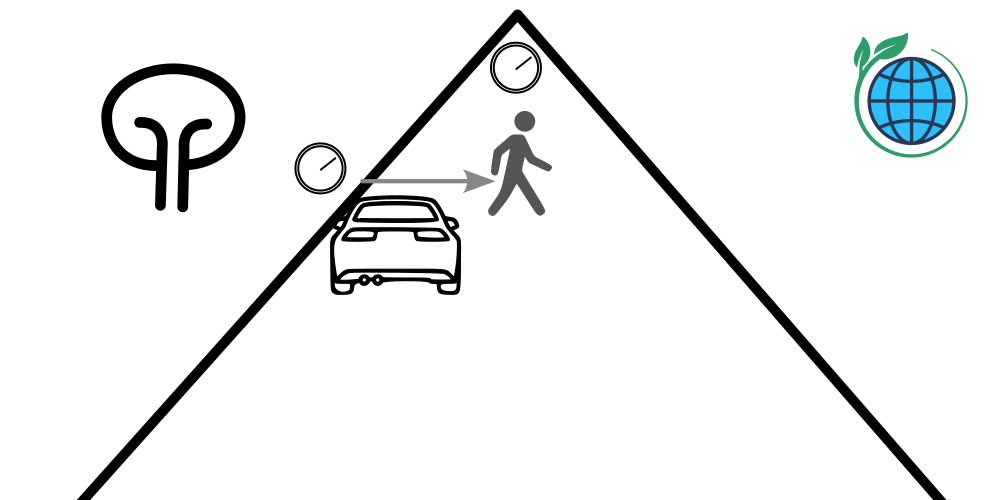
In Thailand, because the pedestrian is walking at a constant speed, the driver predicts that by the time the car reaches the tree, the pedestrian will already have reached the middle of the road. The driver then chooses a course based on that predicted future position. In other words, the car alters its course so as to pass behind the pedestrian. As a result, the two can pass each other without either having to stop.
In Japan, by contrast, the car tries to alter its direction based on the pedestrian’s position at that very instant. Since the pedestrian is on the left, the car turns toward the right. But because the pedestrian is moving from left to right, by the time the car reaches the tree, the pedestrian has already arrived on the right side. In other words, they are forced into a near-collision and have to stop.
If we abstract this difference, we can restate it as follows:
- When passing an approaching person or car, or when crossing a street through which many cars and people are flowing,
- Japanese people judge based on the car’s position at that instant.
- Thai people judge based on the predicted future position of the pedestrian, inferred from the movement that will occur before reaching that point.
Differences in the Perception of Movement Seen When Crossing Roads
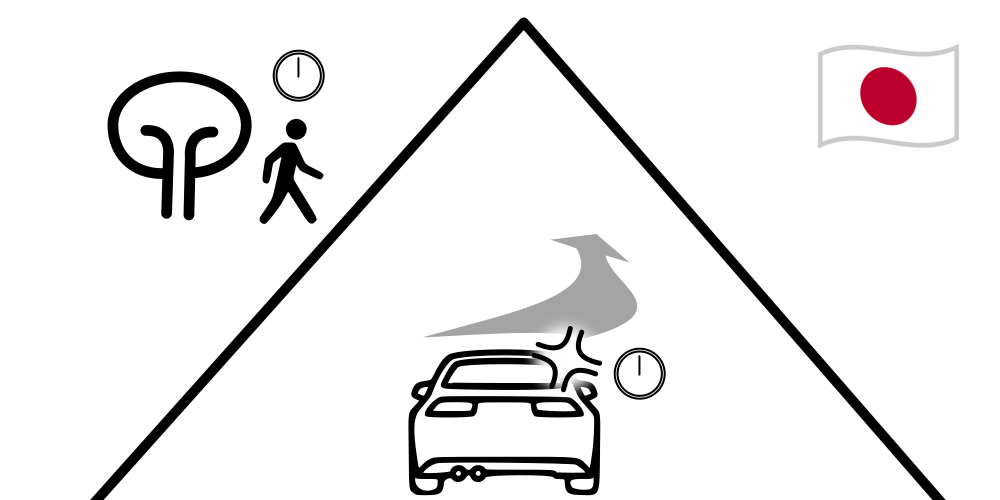
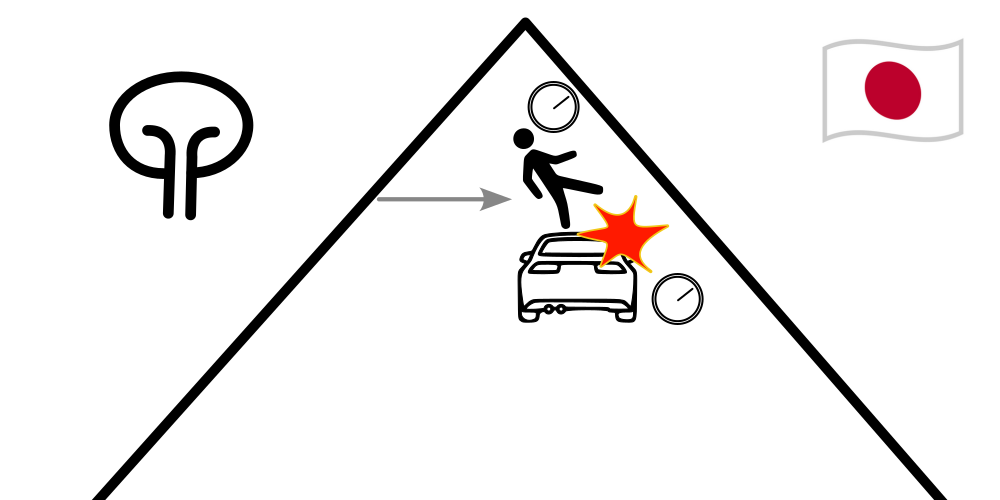
If we illustrate the difference in movement perception seen when crossing roads, it would look like the following.
In Other Countries
Here is the case of crossing a road overseas.
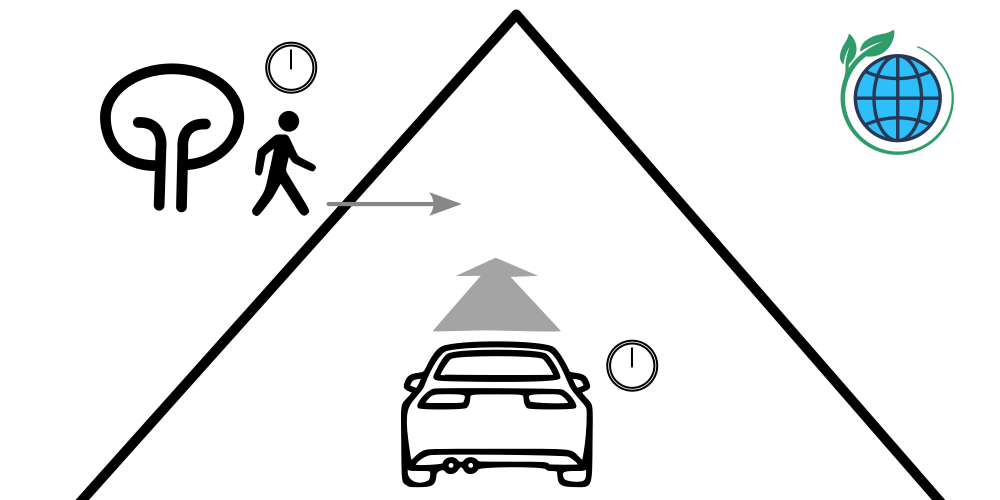
When crossing, one predicts the future position from the present movement and reacts to that predicted point.
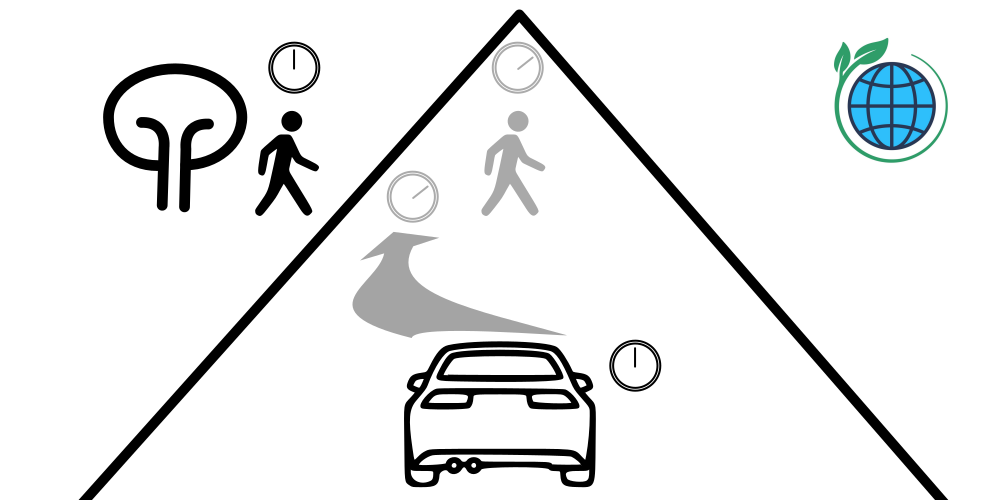
They pass each other successfully.
In Japan
Here is the case of crossing a road in Japan.
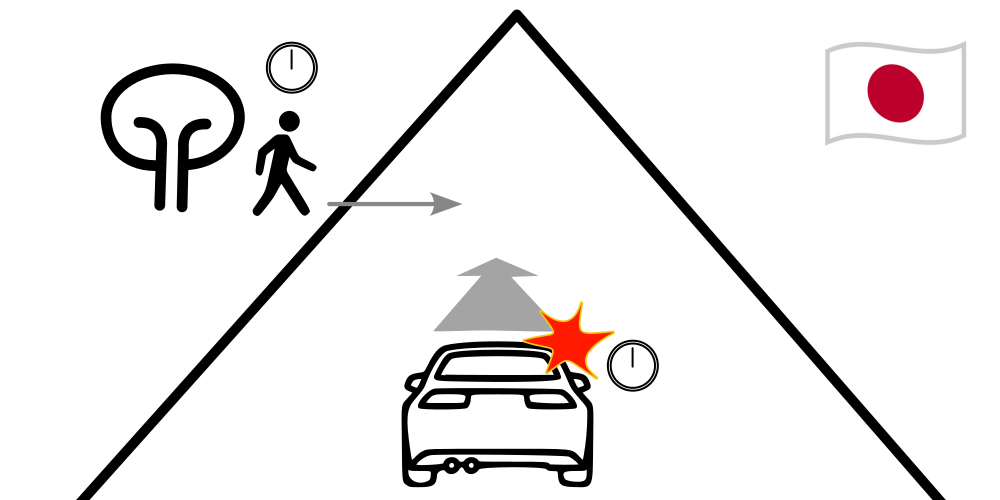
One simply reacts to the current position.
They collide.
The Characteristics of Japanese Time Perception
From these observations, we can say the following: Japanese people begin action by reacting to some trigger that has already occurred in the present, whereas people overseas predict a near-future expected position from the current trajectory of movement and begin action toward that expected position.
Why is this important? Because in musical performance, this difference appears so strongly in rhythmic communication with other performers that it is no exaggeration to call it fatal.
Differences in Japanese Time Perception in Musical Performance
Up to this point, we have examined the difference in Japanese time perception when crossing roads. Exactly the same thing happens in musical performance. That is tatenori.
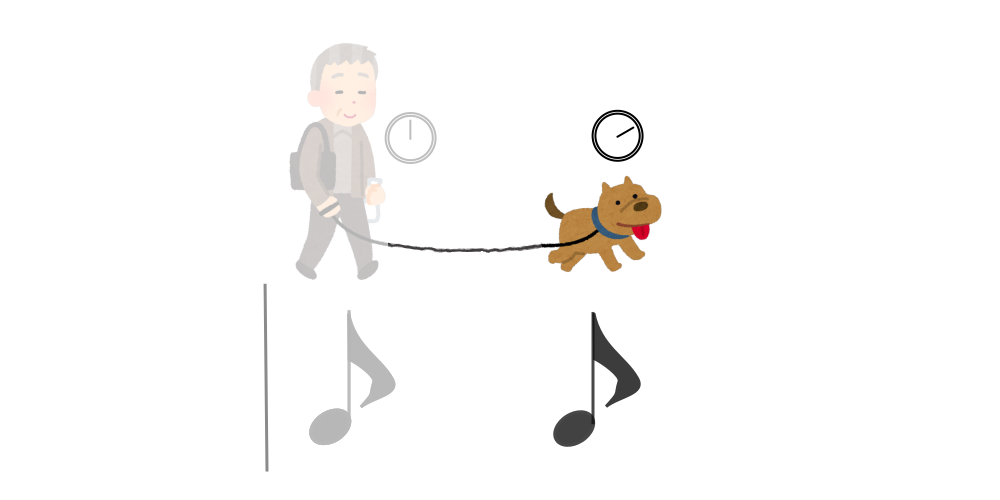
When you ask people who groove what good rhythm is, they often say that in good rhythm, “the weak beat comes first.” And they say that bad rhythm is when “the weak beat comes later.”
However, most people probably perceive rhythm in the state where “the weak beat comes later,” have never experienced any other mode of perception, and therefore cannot understand what the difference is.
The statement “I hear the weak beat first” suggests that the person is predicting the position of the strong beat that comes next. Only because the next strong beat is already present in the mind can the weak beat be perceived as being before it.
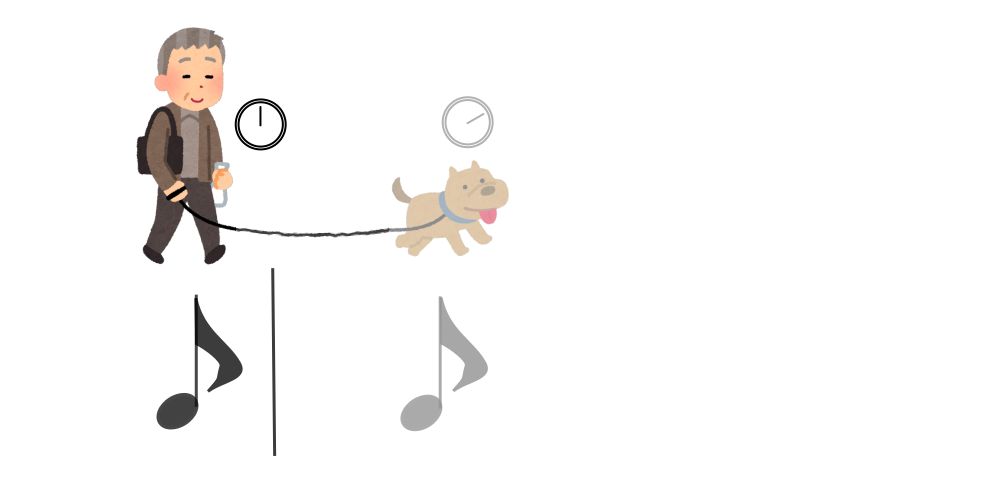
By contrast, the statement “I hear the weak beat later” suggests that the person is not predicting the position of the next strong beat. Precisely because that person thinks, “Once I hear the strong beat, I can strike the weak beat afterward,” the weak beat is perceived as being behind it.
The Essence of the Difference in Time Perception
In this way, the essence of the habits observed in behavior can be abstracted as a difference between two modes of recognition: a mode that predicts the future and acts toward that predicted point, and a mode that acts by taking an already-occurred past event as its trigger.
This difference in the recognition of order bears a strong resemblance to the Split Beat (Schizorhythmos) and Isolated Beat (Solirhythmos) discussed in the previous chapter.
Reference: Schizorhythmos and Solirhythmos
These modes of recognition are essentially the same. In other words, perhaps the essence of these differences in how people recognize order in movement is influenced by the way order is recognized in language rhythm. I call the hypothesis that a person’s native-language rhythm pattern affects that person’s temporal perception in behavior Temporal Ordering from Prosody (TOP).
Temporal Ordering from Prosody (TOP)
The hypothesis that the language rhythm of a person’s native language shapes that person’s cognitive way of recognizing order is called Temporal Ordering from Prosody (TOP). It is the hypothesis that the beat rhythm possessed by a language, whether mora-timed, syllable-timed, or stress-timed, affects not only the recognition of musical rhythm, but also the recognition of temporal order and even the perception of movement.
Proactive Temporal Ordering
Among the kinds of time recognition we have seen so far, I will call the mode that predicts the future and acts toward that predicted point Proactive Temporal Ordering.
Proactive Temporal Ordering corresponds to Proactive Divisionism (PD), as discussed in Schizorhythmos and Solirhythmos.
Syllable-timed rhythm, stress-timed rhythm, weak-beat precedence, Tail Alignment, Weak-Beat Anchoring Axis, people who dodge in the opposite direction, and so on all correspond to Proactive Temporal Ordering.
Reactive Temporal Ordering
Among the kinds of time recognition we have seen so far, I will call the mode that acts by taking an already-occurred past event as its trigger Reactive Temporal Ordering.
Reactive Temporal Ordering corresponds to Reactive Appendism (RA), as discussed in Schizorhythmos and Solirhythmos.
Mora-timed rhythm, strong-beat precedence, Head Alignment, Strong-Beat Anchoring Axis, people who dodge in the same direction, and so on all correspond to Reactive Temporal Ordering.
Proactive-Reactive Temporal Ordering Axis (PRTOA)
Here, I will call the framework that divides human temporal-order recognition into the two axes of Proactive Temporal Ordering and Reactive Temporal Ordering Proactive-Reactive Temporal Ordering Axis (PRTOA).
Proactive Divisionism (PD)
This is the concept in music theory corresponding to Proactive Temporal Ordering. By anticipating what is about to happen and dividing space and time in advance, it forms the four yokonori components of the The Nine Principles of Groove: Weak-Beat Precedence, Weak-Beat Anchoring Axis, Tail Alignment, and 3⁻ⁿ Rhythm. It forms rhythm based on Cooperative Groove.
Reactive Appendism (RA)
This is the concept in music theory corresponding to Reactive Temporal Ordering. It begins action using some already-occurred event as a trigger and forms the four tatenori components of the The Nine Principles of Groove: Strong-Beat Precedence, Strong-Beat Anchoring Axis, Head Alignment, and 2⁻ⁿ Rhythm. It forms rhythm based on solo groove.
Prosodic Ordering Bias
Here I call the cognitive bias in order recognition produced by the rhythm of a person’s native language Prosodic Ordering Bias.
There are three types: Moraic Ordering Bias, Syllabic Ordering Bias, and Accentuated Ordering Bias, which are explained next.
Moraic Ordering Bias
Here I call the Prosodic Ordering Bias specific to mora-timed languages, that is, Japanese, Moraic Ordering Bias. It corresponds to Reactive Temporal Ordering.
Syllabic Ordering Bias
It is observed in syllable-timed and stress-timed languages, such as English and Spanish, and is expected to be associated with Proactive Temporal Ordering.
Accentuated Ordering Bias
Here I call the Prosodic Ordering Bias seen in typical cases such as English and Russian Accentuated Ordering Bias. It is expected to be observed in association with Proactive Temporal Ordering.
Proactivity Horizon Index
A metric for quantifying the range of proactive prediction. It measures the extent to which one perceives and acts in advance of the next event.
People Who Move by Predicting the Future and People Who React to the Past
Weak-beat precedence / strong-beat precedence in musical rhythm and the movement recognition of people crossing roads share the same underlying structure: they involve predicting a future position (time) and acting in relation to that predicted position (time).
1. Explaining Rhythmic Sense Through Bodily Movement
If we use the act of trying to avoid a car while crossing a roadway as an example, the difference between Proactive Temporal Ordering (the sense of weak-beat precedence = offbeat-leading sense) and Reactive Temporal Ordering (the sense of strong-beat precedence = onbeat-leading sense) becomes very clear. Let us imagine a scene in which a car appears from the left and speeds away toward the right.
2. The Difference Between People Who Collide and People Who Do Not
In the case of a person who collides (the sense of strong-beat precedence):
A person who tends to collide judges the situation simply on the basis of the car’s position at that moment. Seeing that the car is currently on the left, that person instinctively tries to dodge toward the right. But because the car is moving rightward faster than the person assumes, the moment the person moves right, they enter the car’s path and collide.
In the case of a person who does not collide (the sense of weak-beat precedence):
By contrast, a person who does not collide does not merely look at the car’s current position, but acts by predicting its future position, that is, where the car will move next. At first this may seem counterintuitive, but such a person deliberately moves toward the left, where the car is now. Why? Because by the time that person reaches that point, the car has already passed off to the right, making movement toward the left safer. In this way, by accurately predicting the car’s trajectory, one can avoid collision.
3. Characteristics of the Sense of Strong-Beat Precedence
People who have the sense of strong-beat precedence are paying attention to what has already happened (the previous beat). They try to play their own beat only after measuring a fixed span of time from a past beat they have already observed. As a result, in terms of felt time, they are always located “behind” the reference event.
But in actual musical performance, tempo naturally fluctuates. Even if one measures a perfectly fixed interval from a past beat, that interval will not necessarily coincide exactly with the position of the next beat. Therefore, people with the sense of strong-beat precedence generally find it difficult to maintain a steady tempo.
4. Characteristics of the Sense of Weak-Beat Precedence
People who have the sense of weak-beat precedence observe what has already happened and use it as the basis for predicting what will happen next (the next beat). They predict the position of the next beat, prepare their own beat in advance, and are always positioned “ahead of” the reference event within the timeline they perceive.
Even if tempo is constantly fluctuating in real musical performance, people with the sense of weak-beat precedence can make fine adjustments to their timing by continually comparing the predicted beat position with the actual beat position that occurred. Through this continuous cycle of prediction and adjustment, it becomes possible to maintain a stable, steady tempo.
Strong and weak beats are not limited to quarter notes. Even when viewed in eighth notes, odd-numbered beats are strong beats and even-numbered beats are weak beats. In this way, multiple systems of strong and weak beats always coexist simultaneously across multiple note values. And performance is carried out with the sense of being “ahead of” these multiple weak beats.
Case Study: A Person You Almost Collide With
One day, in the relatively uncrowded Kamata Station just before the last train, I encountered one of those serial one-beat-late same-direction dodgers, and although I was already irritated, my frustration finally exploded.
If we organize what happened at that time in chronological order, it looks like this:
- I spot someone about seven meters ahead who will collide with me if we continue as we are.
- I slow down and check the direction the other person is moving in.
- I want to adjust my direction so as to pass behind the other person’s route, based on the direction they appear to intend.
- -> This secures a safety margin for passing.
- -> With this preliminary movement, I have already signaled to the other person which side I will avoid toward.
- The other person makes no preliminary movement.
- I change direction and complete a major course adjustment so as not to cut across the front of the other person.
- Only here does the other person recognize that I am taking evasive action.
- Only here does the delayed “I must not inconvenience society” principle activate.
- The other person hurriedly begins evasive action and turns in the same direction I already chose.
- -> This is after I have already taken evasive action.
- Same-direction dodge occurs.
- The other person panics.
- Irritated, I change direction again.
- The other person’s “I must not inconvenience the other person” principle activates.
- The other person hurriedly changes direction.
- Another same-direction dodge occurs.
- I explode in anger.
Strictly speaking, the other person has already failed at the task of passing in the corridor before any of the later confusion begins, because the precondition, “secure a safety margin by watching the other person’s direction and adjusting so as to pass behind their path,” was never satisfied. The cause of every later delay in avoidance is the same.
All other countermeasures one might imagine for passing each other are ineffective.
- Keep moving forward and only change direction without stopping.
- -> At the last moment, the other person may dodge the opposite way and crash into you.
- Do not avoid at all and just keep going forward.
- -> Very often they simply do not notice and collide without avoiding.
- Just stop completely.
- -> The other person also stops. Nobody can move forward.
In the end, smooth passing becomes impossible.
- They do not give any signal that lets the other person anticipate their next action.
- Even if such a signal is given, they are not watching for it.
- They always begin action by taking what has already happened as the trigger.
At the core of these behaviors lies Reactive Temporal Ordering.
This, I believe, is what gives rise to the Four Conditions of Anti-Groove:
- strong-beat precedence
- Strong-Beat Anchoring Axis
- Head Alignment
- 2⁻ⁿ Rhythm
In other words, is not Reactive Temporal Ordering the essence underlying all the behavior of a tatenori person?
- Tatenori when running
- Tatenori when walking
- Tatenori when sitting
- Tatenori when standing
- Tatenori when dancing
- Tatenori when singing
- Tatenori when playing jazz
- Tatenori when playing classical
- Tatenori when playing blues
There is a certain sluggishness to it, a lack of vitality. One cannot dance. It is not enjoyable. It does not communicate to others.
Might Reactive Temporal Ordering not have been the cause of all of these things?
Tatenori Governs Every Aspect of Japanese Behavior
Up to this point, we have observed the phenomenon that people with Reactive Temporal Ordering, that is, people who begin action by taking what has already happened as a trigger, cannot dodge one another in opposite directions.
So far we have looked at the recognition of order within comparatively short spans of time, such as three or four seconds. Here we will see that exactly the same thing can be observed in much larger flows of time as well: three or four hours, three or four months, or three or four years.
When there is some triggering event and one acts in response to it, Reactive Temporal Ordering ultimately produces the two following biases in recognition:
- the start time can be perceived
- the end time cannot be perceived
The Timing of Strong Beats Is Accurate, but the Timing of Weak Beats Is Not
People with tatenori characteristically cannot clap alternately in a pair.This is also a very good way to determine whether a person’s temporal-ordering orientation Proactive-Reactive Temporal Ordering Axis (PRTOA) is Proactive Temporal Ordering or Reactive Temporal Ordering.
When two people clap alternately, one must predict where the other person will clap and then clap at exactly the midpoint in time. Human rhythm always contains deviation. One must predict where the other person’s clap will land, continually adjust for the gap between the predicted position and the actual result, and then predict the midpoint from there before clapping. This task essentially requires the time perception of Proactive Temporal Ordering.
By contrast, a person whose recognition is based on Reactive Temporal Ordering acts in response to the other person’s actual clap and performs the task of clapping after a fixed amount of time from that past actual position. But with this mode of recognition, the person cannot compare the actual position with the predicted position in order to think about where their own clap ought to be, and therefore cannot correct their own position appropriately.
Because they cannot keep the spacing between their own clap positions constant, they cannot keep the tempo constant. As a result, phenomena occur in which the clap positions accelerate endlessly, decelerate endlessly, or collapse onto one another because the midpoint cannot be maintained. I call this Alternating Clap Breakdown.
This too can be understood as an example of Reactive Temporal Ordering in which the start position (the strong beat) can be perceived, but the end position (the weak beat) cannot.
The Starting Point of a Melody Is Accurate, but the Ending Point Is Not
Melodies composed by Japanese people have a clear characteristic: they begin on beat 1 of measure 1 and seem to have no ending. Yet for Japanese people this remains completely unconscious, and therein lies the problem: they cannot perceive it at all.
This too shares the characteristics of Reactive Temporal Ordering.
Meeting Start Times Are Accurate, but Ending Times Are Not
This corresponds, for example, to Japanese commuting time.
It is often said that Japanese people are punctual. But the punctuality of Japanese people applies mostly to starting times; they are hardly ever accurate about ending times. Might this too not be a bias in recognition produced by Japanese Reactive Temporal Ordering?
There is no clear proof of this.
However, there is an interesting linguistic expression.
In English, a state in which positions are offset from one another in an alternating pattern is called staggered. For example, a rhythm like the alternating clapping mentioned above is called a staggered rhythm.
And the Japanese expression jisa shukkin is rendered in English as staggered work hours. Anyone who speaks Japanese will probably know that staggered work hours have never really taken root in Japan.
The Japanese inability to stagger in rhythm: beneath it lies the essence of Reactive Temporal Ordering, namely the inability to determine one’s own timing proactively.
The Starting Point of the Beat Is Accurate, but the Ending Point of the Beat Is Not
When Japanese drummers play any rhythm, the hi-hat, snare drum, and bass drum all line up in exactly the same position, and the rhythm loses its interest. Rhythm inherently contains deviation, and that deviation is the basis of rhythmic interest. Yet Japanese people cannot perceive that deviation. This too is a cognitive bias related to Reactive Temporal Ordering.
Because they can recognize only the passage of time relative to something that has already happened, they cannot recognize variable time itself. This too can be thought of as a concept related to Reactive Temporal Ordering.
日本人のドラマーは一般的に音が小さい ─── それは和製ジャズマンにとっては良いことと思われているけども、それは断じて間違っている。
— 岡敦/Ats🇯🇵 (@ats4u) December 4, 2022
外国のドラマーの演奏を聴くとその音の大きさに驚く。本当に目一杯叩いている。だけど他の楽器の音をかき消すこともなく、普通に綺麗に聴こえる。
何故か。
Japanese People Getting into Trouble with Revolving Payment Plans
There is a credit-card payment method called ribo-barai, or revolving payment. It is a system in which the monthly payment amount stays constant, and only the completion date keeps getting pushed back.
There is a theory that only Japanese people frequently get into trouble with revolving payment plans. The credibility of this theory is unclear. However, in light of Reactive Temporal Ordering, it is easy to predict how one might recognize the start of payment while failing to recognize the end of payment.
This theory still needs future verification, but it is worth paying attention to as a related phenomenon.
Summary
Another important Japanese custom is the habit of valuing milestones and junctures. Might this not have arisen as the result of humbly reflecting, as Japanese people, on Reactive Temporal Ordering?
I am often criticized for “criticizing Japanese culture too much,” but perhaps I am merely pointing out something entirely ordinary for Japanese people: that we should value milestones and junctures.
As a Japanese person, I believe I have clarified the essence of this Japanese problem of Reactive Temporal Ordering: the inability to recognize the endpoint.
I, the author, sincerely hope that this insight will serve as a foundation for conveying the excellence of Japanese culture to the world and supporting the further development of Japanese culture.
Table of contents
- Offbeat Count Theory
- Introduction
- What Are the The Nine Principles of Groove?
- Why Are Japanese People Tatenori
- Which Comes First, the Strong Beat or the Weak Beat
- Phonorhythmatology
- A Letter to Mora-Timed Language Speakers
- Split Beat (Schizorhythmos) and Isolated Beat (Solirhythmos)
- What Is Metre
- Multi-Layered Weak-Beat-Oriented Rhythm
- Multidimensional Division Spaces
- Rhythm More Important Than Pronunciation
- The World Is Made of 3⁻ⁿ Metres
- 3⁻ⁿ Groove and 2⁻ⁿ Groove
- Distributed Groove Theory
- Weak-Beat Geocentrism and Strong-Beat Heliocentrism
- Introduction to Offbeat Count
- Rhythmochronic Competence and Sense of Rhythm
- Master English Listening with Offbeat Count
- Etudes for Mora-Timed Language Speakers
- Proper English Pronunciation
- Correct Pronunciation of Offbeat Count
- Multilayer Weak-Beat-Precedence Polyrhythm
- The Elements That Shape Rhythmic Nuance
- The Mechanism by Which Tatenori Arises
- Tatenori and the Perception of Movement
- The Psychological Problems Caused by Tatenori
