Etudes for Mora-Timed Language Speakers
This chapter explains phonology-based training methods that Ats Oka has empirically found effective.
Stress-Timed Rhythm from the Perspective of Mora-Timed Rhythm
The following video is the hit song Swag Surfin’, which became popular in the U.S. hip-hop scene around 2010. This song strongly reflects African American pronunciation, that is, roughly a Southern U.S. dialect. When speakers of mora-timed languages listen to this song, a phenomenon occurs in which they perceive all of the syllables as shifted by one position and therefore cannot hear them as correct English pronunciation.
In this song, the rhythmical placement of every word is arranged so that the weak beat comes first, through syllable-timed Maximum Onset Principle (MOP) and stress-timed-rhythm Maximum Prosodic Onset Principle (MPOP). However, speakers of mora-timed languages who have Minimum Onset Principle (MiOP) cannot understand this weak-beat precedence and instead perceive it as strong-beat precedence, so a phenomenon occurs in which they interpret all of the syllables as shifted by half a syllable.
Interpreting Stress-Timed-Rhythm Pronunciation through Mora-Timed Rhythm
If the opening part of this song’s lyrics is interpreted through mora-timed rhythm, it sounds as though it is saying “メナガテッスウェーッグ”. In stress-timed rhythm, however, it is interpreted as man, I got that swag. The difference in interpretation can be shown as follows.
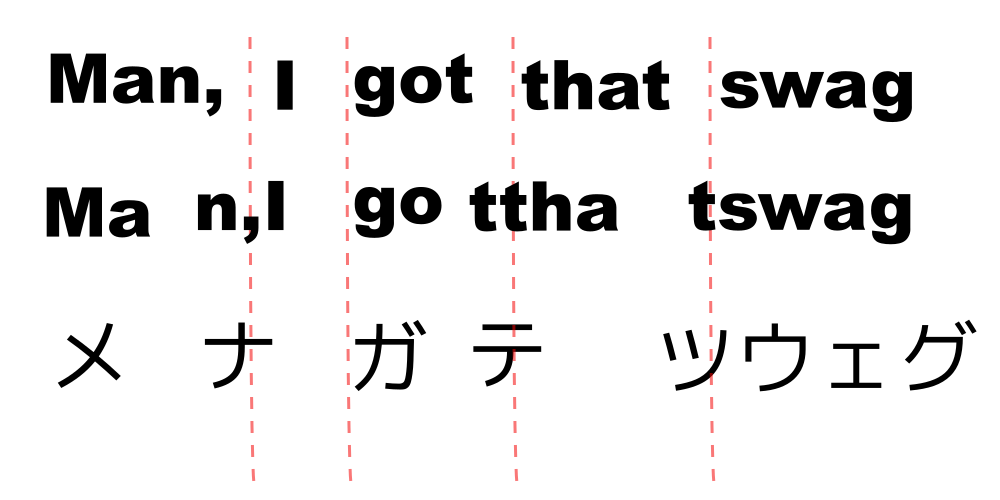
The correspondence table for the mismatch that occurs here is as follows.
| English Syllable Interpretation | Syllable | Syllable | Syllable | Syllable | ||||||||
|---|---|---|---|---|---|---|---|---|---|---|---|---|
| English Pronunciation | Consonant | Vowel | Consonant | Consonant | Vowel | Consonant | Consonant | Vowel | Consonant | Consonant | Vowel | Consonant |
| Japanese Pronunciation Interpretation | Consonant | Vowel | Consonant | Vowel | Consonant | Vowel | Consonant | Vowel | - | |||
| Syllables Interpreted in Japanese | Syllable | Syllable | Syllable | Syllable | - | |||||||
In this way, because mora-timed rhythm has no final consonants, confusion arises with the onset consonant of the next syllable. From the viewpoint of stress-timed rhythm, we can see that mora-timed interpretation recognizes speech in a form shifted by one third of a syllable per syllable.
A Method for Training Final Consonants in Mora Beats That Lack Them
What speakers of mora-timed languages need in order to hear stress-timed languages is to distinguish final consonants properly and correct their perception so that this one-third shift does not occur. In other words, it is effective to practice separating the final consonant of each syllable. This means dividing the pronunciation of each Japanese mora into three parts and practicing being clearly aware of the hidden final consonant inside the mora and its connection to the onset consonant of the next syllable.
Example: 七夕花火にカンパーイ
タナバタ・ハナビニ・カンパーイ
↓↓↓
- ターン
- ナーブ
- バート
- ターハ
- ナーブ
- イーン
- イーク
- アーン
- パーイ
To explain concretely what is happening here, if Tanabata is written in Roman letters it becomes TA NA BA TA. If each vowel is linked to the consonant of the next letter, it becomes TAN/NAB/BAT/TAH. In other words, “ターン”, “ナーブ”, “バート”, and “ター”. In this way, each mora is divided into three parts and the final consonant is isolated. Doing this serves as training to get used to the recognition of final consonants required for stress-timed and syllable-timed rhythm.
In order to pronounce the onset consonant of the next mora smoothly, an implicit final consonant appears at the back end of the mora in question. The important point is to become clearly aware of this unconsciously produced implicit final consonant. In English, the following onset consonant does not cause the final consonant to change. In Japanese, however, it changes because speakers are not conscious of it. Getting used to this difference is important.
In the example above, the final item that became “ターハ” turns into “ター” because in the full phrase above Tanabata is followed by Hanabi, which begins with Ha, whereas when Tanabata appears alone there is no following character, so it ends as just “ター”.
Let us look at another example.
Example: かささぎの わたせる橋におく霜の 白きを見れば夜ぞふけにける
カササギノ・ワタセルハシニ・オクシモノ・シロキヲミレバ・ヨルゾフケニケル
↓↓↓
- カース
- サース
- サーグ
- ギーン
- ノーウ
- ワーット
- タース
- セール
- ルーフ
- ハース
- シーン
- イーオ
- オーク
- クース
- シーム
Table of contents
- Offbeat Count Theory
- Introduction
- What Are the The Nine Principles of Groove?
- Why Are Japanese People Tatenori
- Which Comes First, the Strong Beat or the Weak Beat
- Phonorhythmatology
- A Letter to Mora-Timed Language Speakers
- Split Beat (Schizorhythmos) and Isolated Beat (Solirhythmos)
- What Is Metre
- Multi-Layered Weak-Beat-Oriented Rhythm
- Multidimensional Division Spaces
- Rhythm More Important Than Pronunciation
- The World Is Made of 3⁻ⁿ Metres
- 3⁻ⁿ Groove and 2⁻ⁿ Groove
- Distributed Groove Theory
- Weak-Beat Geocentrism and Strong-Beat Heliocentrism
- Introduction to Offbeat Count
- Rhythmochronic Competence and Sense of Rhythm
- Master English Listening with Offbeat Count
- Etudes for Mora-Timed Language Speakers
- Proper English Pronunciation
- Correct Pronunciation of Offbeat Count
- Multilayer Weak-Beat-Precedence Polyrhythm
- The Elements That Shape Rhythmic Nuance
- The Mechanism by Which Tatenori Arises
- Tatenori and the Perception of Movement
- The Psychological Problems Caused by Tatenori
