Why Are Japanese People Tatenori
This is an article considering the mystery that any musician whose native language is Japanese will surely experience at least once — “Why do Japanese people not groove?” During this consideration, it makes clear that the reason Japanese people do not groove is equal to the reason Japanese people cannot hear English. It reveals the true nature of “tatenori” lurking in the Japanese language and Japanese music, and considers its influence and limits scientifically and culturally.
What Is Tatenori
What is tatenori? It is an existence that cannot be seen at all. However, tatenori is always there. It exists even at this very moment as you are now reading this text. Tatenori is an invisible existence, but even now, right now, you are indeed seeing tatenori. Tatenori is like the air that is always there. And just as one cannot live if there is no air, when tatenori disappears, a person cannot live. A person encounters tatenori from birth, and then dies without noticing the existence of tatenori, remaining unaware of the existence of tatenori.
However, tatenori always defines our actions. We are always bound by tatenori.
Whether or not you notice tatenori is up to you. Whether you live out your life without noticing the existence of tatenori as you are, or notice tatenori and live in a world of fierce truth as if set on fire. That depends on your choice.

It is like the red capsule and the blue capsule that appear in the movie The Matrix. Of course, it is also possible to live without noticing tatenori as it is. If here you chose to notice tatenori, what would happen? … By noticing tatenori, one gains great freedom, and at the same time comes to live in a world with great risks.
Here let me explain what becomes impossible when one is tatenori.
- English listening
- English conversation
- All other conversation abilities in languages other than Japanese
- Breaking through the wall of the world in classical performance activities
- Breaking through the wall of the world in jazz performance activities
- Breaking through the wall of the world in the IT industry
- Breaking through the wall of the world in business
- Breaking through the wall of the world in martial arts
- Breaking through the wall of the world in racing
- Breaking through the wall of the world in the general sports world of ball games such as soccer
- It may perhaps include breaking through the wall of “Tokyo” rather than “the world.”
If you want to live in a world with big dreams… if you think so, noticing tatenori will become a big chance.
Would you not like to break through the wall of the world and become a great human being? — Of course, that is not compulsory.
Even if you are not interested in breaking through the wall of the world, but feel a little interested in what tatenori is… such a person is also fine.
There is a theory and a practical practice method for noticing this tatenori, becoming independent from tatenori, and acquiring the ability to live even without tatenori.
I would like to introduce that method here. I will explain it step by step.
The Influence Tatenori Gives
Tatenori is a concept expressing a subtle and serious deviation in the sense of rhythm that is peculiar to people whose native language is Japanese. Tatenori cannot be sensed by the people whose native language is Japanese themselves. However, this deviation causes various problems in all kinds of situations such as music, language, and bodily sensation. It always makes people all over the world feel that “something is strange,” but that feeling of discomfort is very difficult to express in words, and it keeps making people all over the world feel vaguely unsettled.
Tatenori may seem at first glance to be a trivial problem. However, even though people whose native language is Japanese are completely unaware of it, it has a deep influence on Japanese people’s bodily movement, recognition of time, musical performance, English pronunciation, and even communication as a whole.
Originally, “tatenori” was a jazz term in Japan. It is a term expressing a rhythm that does not swing, and literally points to a way of performing rhythm as if “stepping on the beat vertically.” When playing an instrument and so on, it is a concept expressing the tendency to divide the beat extremely accurately, place the center of gravity on the on-beat, and mechanically align the timing. At first glance it may seem to be an accurate and serious method of performance, but in genres of music such as jazz, funk, and soul, the unique “undulation” and “feel” become hard to arise. This lack of a sense of undulation is “tatenori.”
On the other hand, here I would like to call a person who is not tatenori yokonori.
This tatenori actually has various influences in every aspect other than music as well.
- One cannot hear English and other foreign languages.
- One cannot pronounce English and other foreign languages in a form that is conveyed to the other party.
- → It becomes the cause of the phenomenon of not grooving when singing rap.
- When performing improvised music, one cannot skillfully predict the contents of the co-performer’s performance.
- → It becomes the cause of the phenomenon of not grooving.
- When performing improvised dance, one cannot skillfully predict the movements of the co-performer.
- → It becomes the cause of the phenomenon of not grooving.
- In martial arts and the like, one cannot skillfully intuitively predict the enemy’s movements.
- In sports such as soccer and basketball, one cannot skillfully intuitively predict the movements of enemies, allies, the ball, and so on.
- When walking in the street overseas, one becomes more likely to collide with people.
- → One becomes more likely to become involved in crime overseas.
Is such a thing really happening? I will explain it with concrete examples.
Tatenori as a Blind Spot
What Is Ba Dum Tss
In English there is an onomatopoeia often used as an idiomatic expression called “ba dum tss.” It is a sound like the following.
バダムツー(英語での「ちゃんちゃん」のような効果音) Credit : https://t.co/1pMfDuY1S3 pic.twitter.com/qdcGm8P81M
— 岡敦/Ats🇯🇵 (@ats4u) May 31, 2025
Ba dum tss is very popular, and if you look on the internet you can find many examples.
【 Ba Dum Tss / バダムツー 】 ─── 日本人はこのリズムを必ず聴き間違える。このリズムを何故日本人は、必ず聴き間違えるのか。そこに日本人の縦乗りの最も根本的な原理を観察することができる。#オフビートで思考する語学 pic.twitter.com/IWibkjxhj3
— 岡敦/Ats🇯🇵 (@ats4u) May 2, 2025
This rhythm is played immediately after something funny happens.
バダムツーの実際に実践で使われている例:Credit : https://t.co/9YyvfCjSX1 pic.twitter.com/NBE4a3FB7d
— 岡敦/Ats🇯🇵 (@ats4u) May 31, 2025
In Japanese, this is often translated as “chan-chan.”
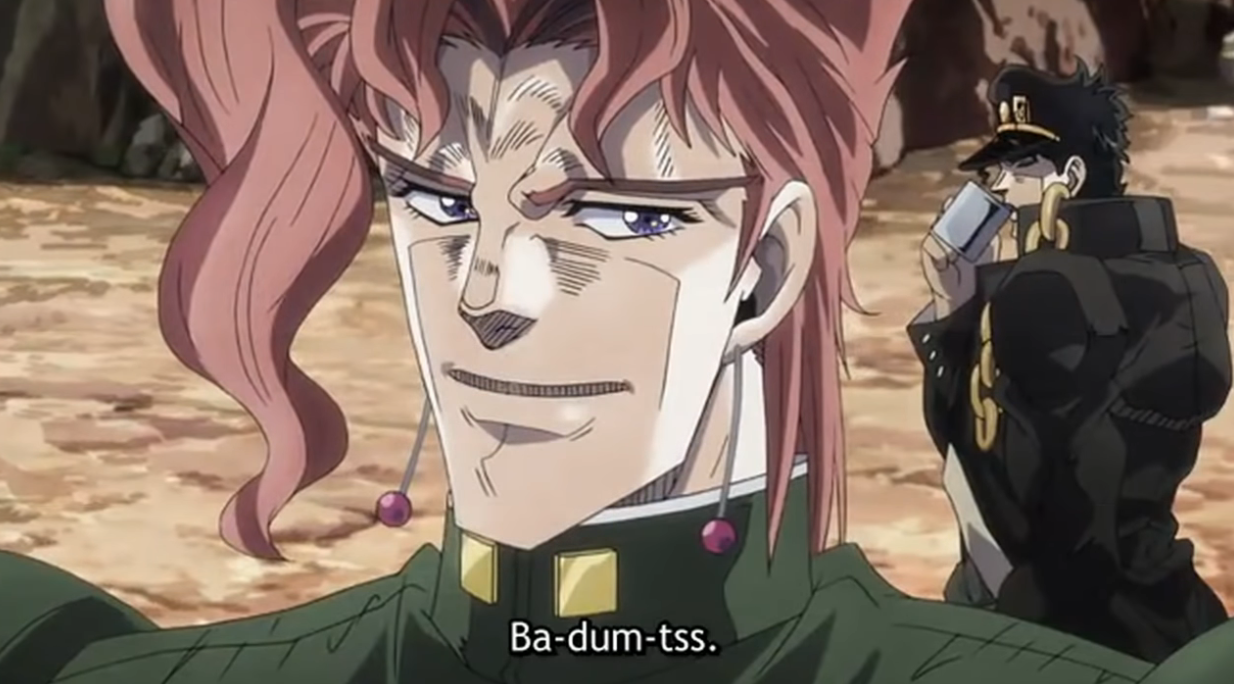
This is in a position like Japanese chan-chan, and is used as a sound effect at the end of a comedy skit and so on.
日本の「ちゃんちゃん」は英語で ba dum tss と翻訳されている。ジョジョの不思議な冒険「マニッシュ・ボーイ」Credit : https://t.co/hRYKOraxdq pic.twitter.com/Oym4ZIsLUD
— 岡敦/Ats🇯🇵 (@ats4u) May 31, 2025
If you are a person who has received musical training and can read and write notation, you may have heard it in the following way.

However, originally it should be notated as follows.

Difference in Rhythm Interpretation
If one performs jazz with the former interpretation, it should become as follows.
バダムツーの縦乗りでの解釈 #オフビートで思考する語学 https://t.co/KN5gMaKMdE pic.twitter.com/TCvZoJEMqw
— 岡敦/Ats🇯🇵 (@ats4u) May 29, 2025
If one performs jazz with the latter interpretation, it becomes as follows.
バダムツーの横乗りでの解釈 #オフビートで思考する語学 https://t.co/KN5gMaKMdE pic.twitter.com/C5x0FYgXLk
— 岡敦/Ats🇯🇵 (@ats4u) May 29, 2025
Here a large difference is found in rhythm recognition between people whose native language is Japanese and those whose native language is not.
Difference in Musical Interpretation Born from Difference in Rhythm Interpretation
Please look at the following example.
【モーラ拍リズムの言語(日本語)を母語として話す人が聴き取れないリズム】 16分音符1つが弱起として入っている基本リフパターン ─── マイケル・ジャクソンのヒューマン・ネイチャー Live at Wembley 1988 Credit : https://t.co/eQ1e6WjElH pic.twitter.com/mBAaWxTeSj
— 岡敦/Ats🇯🇵 (@ats4u) May 31, 2025
This song is Michael Jackson’s hit song “Human Nature.” At the beginning of this song Michael Jackson sings “chiichiki chiichiki,” but how did everyone reading this article hear this rhythm?
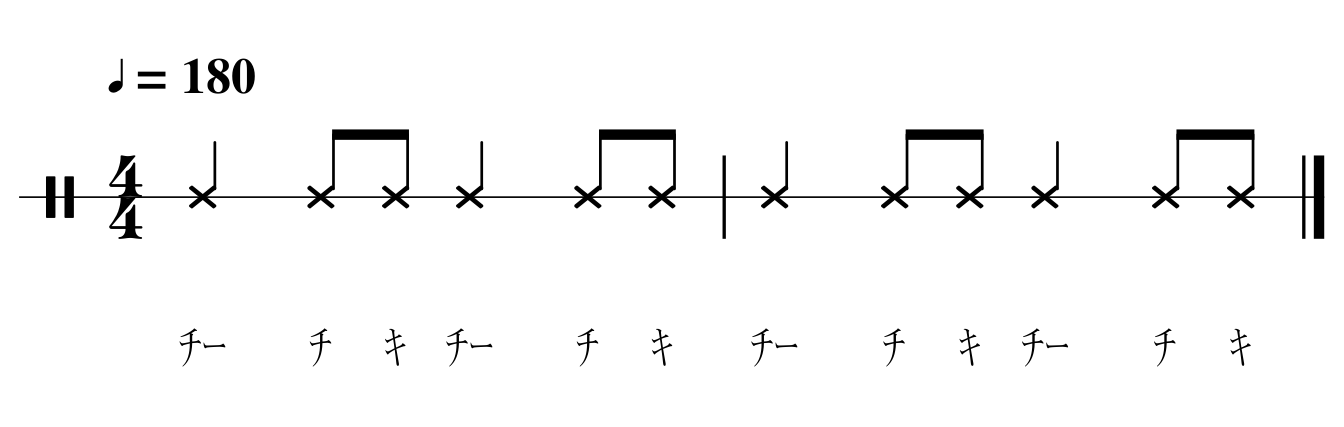
Was it not interpreted in this way? However, soon after the song begins it becomes clear that this interpretation is wrong — in fact it is as follows.
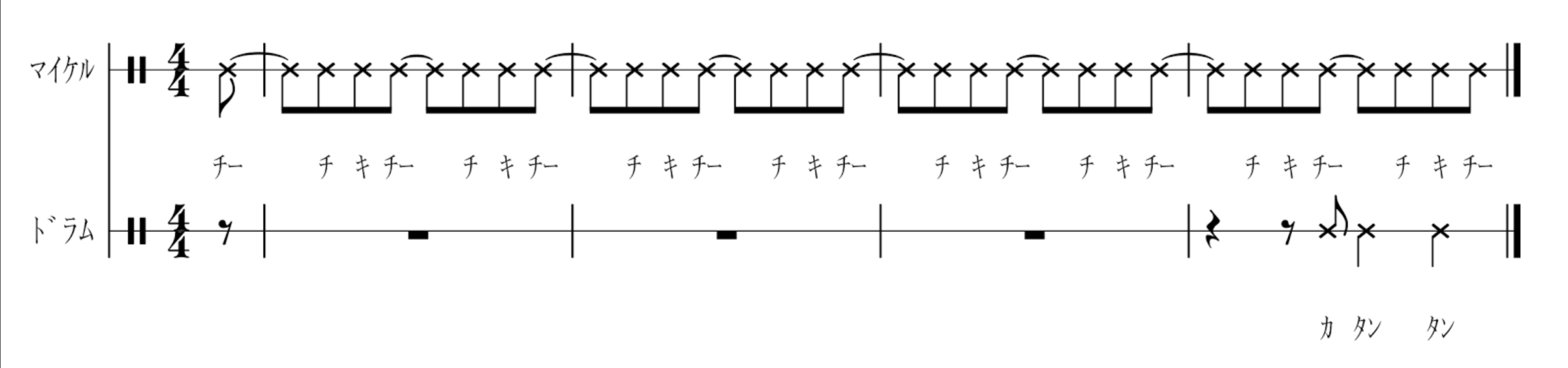
In this way, the rhythm begins in a form shifted by one eighth note.
What can be understood from here is that the moment a person whose native language is Japanese hears a sound, they naturally recognize it as an on-beat eighth note, whereas foreigners naturally recognize it as an off-beat eighth note.
This may look like a trivial thing. However, there is a large blind spot here.
Difference in Language Interpretation Born from Difference in Rhythm Interpretation
This blind spot is exactly the reason why people whose native language is Japanese become unable to hear English. Please look at the following video. This is the theme song of the movie High School Musical (2006). In this video, the points missed by native speakers of Japanese are expressed by animation.
【日本人のリズムの盲点】映画ハイスクール・ミュージカルの音楽にはオフビートから始まるリズムが現れます。
— 岡敦/Ats🇯🇵 (@ats4u) May 25, 2023
日本人には1拍目表拍から文章を解釈しその前にある音を全て無視するという性質がある為、そこに音があることに気付きません。
その地点を見える化しました。#オフビートで思考する語学 pic.twitter.com/qpvR56b6tG
The lyrics are as follows.
We're all in this together
Once we know that we are, we're all stars
And we see that
In this way, when melody begins with momentum from a position before the starting point, preceding the starting point of the bar, this is called in the terminology of music theory an anacrusis.
Please pay attention to the fact that this first we’re is pronounced as an anacrusis. This anacrusis is the blind spot of native speakers of Japanese.
Here, I would like to call a rhythm interpretation that does not presuppose the existence of an anacrusis tatenori. And in contrast to this tatenori that does not presuppose the existence of an anacrusis, I call a rhythm interpretation that presupposes the existence of an anacrusis yokonori.
In this song, only the first part is an anacrusis and it is a very short anacrusis, so it may be that not all meaning becomes incomprehensible. However, in English poetry it is not rare that all of the lyrics are anacrusis. When that happens, the phenomenon actually occurs in which all sounds cannot be heard.
その後、リハンナが2007年に Don’t Stop the Music でマイケルジャクソンのママセイママサーママクサを素材にしたリフを使ったことで、ママセイママサーママクサは更に広く知られる様になりました。
— 岡敦/Ats🇯🇵 (@ats4u) April 14, 2023
Credit : https://t.co/4XdSx8kHp0 pic.twitter.com/BGQnWLvpzp
The lyrics in this chorus part are all composed as anacrusis.
I wanna take you away
Let's escape into the music, DJ, let it play
I just can't refuse it, like the way you do this, keep on rockin' to it
Please don't stop the, please don't stop the music
The lyrics were line-broken by bar units, and the boundaries of the sentences were shown with colors.
I wanna take you
away Let's escape into the
music  DJ, let it
play  I just can't  re-
-fuse it,  like the way you
do this, keep on rockin'
to it Please don't stop the, please don't stop the
music
The lyrics are completely within the range of junior-high-school English. However, in this way, the phenomenon occurs that the whole sentence becomes impossible to understand because the position of the sentence boundary changes due to the anacrusis.
This is exactly the true reason why native speakers of Japanese become unable to understand English.
No matter how much one practices the pronunciation of R, no matter how much one practices the pronunciation of TH, because the method of rhythm interpretation is different, everything becomes impossible to understand. As long as there is a difference in rhythm interpretation, all of the efforts of Japanese people return to water bubbles.
And the fact that the position of the sentence boundary changes because of this anacrusis occurs especially conspicuously in American English, which is strongly influenced by African languages.
And this difference in linguistic rhythm interpretation is exactly the true cause of why Japanese people’s performance does not groove.
Rhythm Interpretation Differs by Language
The following song was a song that was popular in Thailand around 2014.
It fit the sensibility of the Thai music scene at that time in 2014 and became explosively popular, but it was not by Thai musicians. This is a song called “A Minha Amiga Fran (A Friend Named Fran)” by a Sao Paulo musician named Mc Jair Da Rocha. He is not a globally famous musician, but for some reason it became a hit in Thailand.
How did you hear the lyrics of this song? In the chorus part of this song it repeatedly says “woka woka” and it is very catchy, and we surely interpreted these lyrics naturally as “woka woka.” However, in fact, in Thailand this song is called กาโว กาโว (kawo kawo). If you search with the keyword kawo kawo, you can find many Thai remix versions.
The same sound that Japanese people naturally hear as woka woka is naturally interpreted by Thai people as kawo kawo — this phenomenon gives a large suggestion concerning the interpretation of pronunciation and rhythm. Here, in the Thai interpretation, one can see that kawo, where “ka” comes first, is interpreted on the premise of an anacrusis (a melody that begins before the head of the bar). And in the Japanese interpretation, one can see that it is interpreted on the premise of a strong onset, where “wo” comes first (a melody that begins after the head of the bar).
In other words, it can be observed from here at least that linguistic rhythm interpretation in pronunciation differs greatly depending on the language.
Ethnic music is deeply tied to the language of the ethnic group. Japanese ethnic music (ondo and enka) does not have an anacrusis (anacrusis/Auftakt), but Thai ethnic music does have an anacrusis. It seems that what is important first is to notice the existence of differences in rhythm interpretation by language.
It should be noted that in the middle chorus of this song, because the lyrics repeatedly say louca in Portuguese (crazy in English), if one considers which of the Thai interpretation (kawo) and the Japanese interpretation (woka) matches the Portuguese interpretation, it can be said that the Japanese interpretation is more correct.
However, it is necessary to note the point that while Thai people are in most cases able to communicate with people of the English-speaking world and the Latin-speaking world even with absolutely no prior knowledge, Japanese people are unable to communicate with people of the English-speaking world and the Latin-speaking world even when they have studied prior knowledge for a long period.
Those Thai people can pronounce back by parrot repetition the words they hear even in an unknown language they know nothing about. However, because Japanese people miss many pronunciations, they cannot pronounce them back by parrot repetition — the essence of the reason why Japanese people become poor at English is hidden here.
When Thai people are corrected, “It’s not kawo, it’s woka!”, they can immediately switch their pronunciation interpretation — if Japanese people were corrected in the same way, “This is not woka, it’s kawo!”, could they immediately switch their interpretation to “kawo”? The answer is NO. Here one can observe the mysterious nature of Japanese.
Tatenori and Mora-Timed Rhythm
Tatenori can be said to be a certain kind of lack in the sense of rhythm possessed only by people whose native language is Japanese. Tatenori is not merely a problem of individual qualities or musical taste. In fact, tatenori is a structural phenomenon that occurs because of the pronunciation structure of Japanese. The recognition of rhythm in Japanese is academically called mora-timed rhythm.
What Is Mora-Timed Rhythm
Mora-timed rhythm refers to the pronunciation recognition method in which people whose native language is Japanese naturally recognize pronunciation by dividing it into constant lengths as “a-i-u-e-o.” These pronunciation elements divided into constant lengths are called morae. Mora — this is natural for people who speak Japanese, but in fact it is said that if one searches worldwide, Japanese is the only language that has this mora-timed rhythm.
The majority of languages around the world have rhythm recognition called stress-timed rhythm or syllable-timed rhythm. For example, Spanish, French, Italian, Chinese, and Korean are classified as syllable-timed rhythm, and English, Russian, German, Arabic, Thai, and Lao are classified as stress-timed rhythm.
What Is Syllable-Timed Rhythm
Syllable-timed rhythm is a kind of rhythmic structure seen in many languages, and refers to a pronunciation structure in which linguistic phonemes are divided into units called “syllables,” and each syllable is pronounced with almost the same length without distinction of strength and weakness. In this rhythm, there is no rhythm based on “strong beats and weak beats” as in English, and its feature is that the rhythm is composed simply by the number of syllables. Because of this, it can also give the impression that the whole utterance is mechanically marked evenly.
What Is Stress-Timed Rhythm
Stress-timed rhythm means that stress beats, that is, emphasized syllables, appear at fixed time intervals, and syllables not emphasized by stress are pronounced briefly and evenly divided between the stress beats. (reference) For example, suppose one pronounces fourteen, fifteen, sixteen. At that time, teen is always pronounced with emphasis at the same interval of time. However, even though four | fif | six each have different numbers of phonemes as fo, fif, siks, they are always pronounced with time distributed within the same length range. This is stress-timed rhythm.
What is called here a certain kind of sense of rhythm lacking in Japanese people = yokonori is the sense of rhythm naturally possessed by people who speak languages based on stress-timed rhythm or syllable-timed rhythm as their native languages.
What Is Groove
【言語とリズム】カマラ・ハリスの「ザ・パッセージ・オヴ・タイム」という演説に合わせてジャズを演奏したら、それに同調したネット上のミュージシャンがドラムやベースをつけたものらしいです。
— 岡敦/Ats🇯🇵 (@ats4u) September 23, 2024
90年代のジョン・スコフィールドとジョー・ロヴァーノの音楽みたいです。 #オフビートで思考する語学… pic.twitter.com/CuW5Q3XaOF
At present, much of the popular music widely loved around the world has its source in American jazz. Blues was born from jazz, and blues eventually developed into R&B and rock and roll, and further branched into diverse musical genres in the present age such as rock, hard rock, and heavy metal. In other words, at the foundation of these pop musics, the rhythm of jazz is still beating continuously.
And that rhythm of jazz, if one dares to say so, is a form of expression deeply tied to the pronunciation and intonation of American English that could be likened to American haiku. If haiku is a condensation of the “rhythm of words” of Japanese, then jazz is a condensation of the “rhythm of words” of American English.
Just as haiku is a poetic form born from the mora-timed rhythm of Japanese, jazz is a poetic form rooted in the stress-timed timing of American English. Even if on the surface they look different, both are deeply tied to the rhythmic structure and phonological system of their respective languages. Jazz is the bodily expression of the rhythm and intonation of American English. In that sense, jazz is an expressive culture that can also be called the “American-English version of haiku.”
In other words, the true nature of groove, the most important element in these pop musics, is this very rhythm of American English.
The Handicap of Having Japanese as One’s Native Language
The reason Japanese speakers have difficulty acquiring this groove is that this difference in language rhythm unconsciously affects bodily sensation. From the viewpoint of people who speak languages with stress-timed rhythm (almost all people on earth other than Japanese), it is clearly and distinctly observable that something that should clearly be there is not there. However, Japanese people, who from the beginning do not have the concept of stress-timed rhythm, cannot even share the recognition itself that something should have been there. In other words, the awareness itself that rhythm is missing is missing. This difference in rhythmic sensation is extremely large, and because of this difference in sensation, communication between Japanese people and everyone else is made decisively difficult. The other party’s “feeling of discomfort itself” does not exist on this side. This is the largest mismatch in intercultural communication.
And this difference in pronunciation structure is deeply intertwined with Japan’s education, defeat in war, postwar history, high economic growth, and historical and psychological backgrounds such as the uniquely Japanese psychology of “amae,” producing various problems.
Comparison of Tatenori and Yokonori
Below are tatenori and yokonori theorized and made to be performed mechanically according to the theory.
Comparison of Tatenori and Yokonori Part 1
Comparison of Tatenori and Yokonori Part 2
Comparison of Tatenori and Yokonori Part 3
- In the case of yokonori
- The bass notes and accompaniment chords always sound alternately
【コード進行の先取りについて】 pic.twitter.com/nqrVkVIhNy
— 岡敦/Ats🇯🇵 (@ats4u) February 23, 2022
- In the case of tatenori
- The bass notes and accompaniment chords always sound at the same time
【縦乗りの例】全拍がオンビートを起点にして演奏されている。全く同じ音楽、全く同じベースライン、全く同じコード進行でもリズムが縦乗りだとこういう風に響く ─── これが縦乗りだ。 pic.twitter.com/OArl8tpUWf
— 岡敦/Ats🇯🇵 (@ats4u) February 24, 2022
Comparison of Tatenori and Yokonori Part 4
7イレブンで買い物したら、ものすごい縦乗りのヒューマンネーチャー(マイケル・ジャクソンの曲)がBGMに掛かっていた。あまりに凄かったので、家に帰って譜面に起こしてみた。こんな感じだった。
— 岡敦/Ats🇯🇵 (@ats4u) March 17, 2018
前半4小節がオリジナル。後半4小節が縦乗りバージョン。 pic.twitter.com/Vl9s9DWgh8
People of Yokonori Notice Tatenori Immediately
When people whose native language is Japanese, who do not have this sense of rhythm, perform or compose, a distinctive lack of sense of rhythm remains in their works. This lack is something very clear and distinct when viewed by a person who has that sense of rhythm. This lack always gives a certain discomfort to people whose native language is something other than Japanese.
【音無しで手を叩くだけでわかる横乗りと縦乗り】
— 岡敦/Ats🇯🇵 (@ats4u) December 11, 2024
1. 裏拍が先行している
2. 拍の多層構造がある
3. 動きが尻合わせで配置されている
どんなに海外で高度な横乗りを会得しても、横乗りと縦乗りの違いをはっきり区別しない限り日本帰国と同時に縦乗りに戻ってしまいます。#オフビートで思考する語学 pic.twitter.com/j0lB7w9RT4
Even if they dance, traces remain by which one can immediately tell that it is the movement of Japanese people. Even if it is a VTuber image and one cannot tell from appearance that that person is Japanese, characteristics can be seen from the movement alone by which one can tell that person is Japanese. Even if in choreography it is in a state where outsiders cannot see that it is completely Japanese, characteristics remain by which one immediately knows it is Japanese choreography.
Whether walking, running, singing, dancing, playing guitar, beating drums, playing piano, performing classical music, or performing jazz, in everything, whatever they do, traces of the Japanese lack of recognition remain.
The problem is that people who do not have this sense of rhythm cannot in the first place recognize the lack of the sense of rhythm they have.
People of Tatenori Do Not Notice Tatenori
The problem is that a person who does not have this sense of rhythm cannot in the first place recognize that the sense of rhythm he has is itself lacking. In other words, he cannot even recognize that there is a difference between one who has a certain sense of rhythm and one who does not have a certain sense of rhythm. Because they do not have the sense of rhythm, people who do not have the sense of rhythm unconsciously choose only things that do not have that sense. And people who have that sense of rhythm clearly recognize this bias. However, people who do not have the sense of rhythm cannot recognize that bias itself.
The peculiar blind spot in the sense of rhythm possessed only by people whose native language is Japanese — that is tatenori.
Tatenori Can Be Clearly Quantified
When one transcribes a song made by a tatenori person, features can be seen by which one can clearly point it out as such. For example, because songs made by tatenori people do not have anacrusis, the notes are always arranged biased to the left, like left-aligning text in a word processor. On the other hand, when one transcribes a song made by yokonori (a person who is not tatenori), often the notes are arranged biased to the right, like right-aligning text in a word processor. In this way, tatenori is by no means merely something sensory, but something that can be quantified and observed clearly in a visible form.
There Are Things People of Tatenori Cannot See
People of tatenori have many rhythm patterns that they cannot recognize. The problem is that people of tatenori cannot recognize the existence itself of the rhythms that they cannot recognize. Among such things, there are concrete rhythm patterns that people of tatenori mishear with high reproducibility. In Offbeat Count Theory, those rhythm patterns are also mentioned.
There Are Things People of Tatenori Cannot Do
People of tatenori have the characteristic that, on the principle of time recognition, “they cannot clap alternately with two people.” Perhaps they may be able to clap alternately in time with a metronome. However, they cannot clap alternately with an inaccurate human being. This is called here Alternating Clap Breakdown.
However, when the other party is a human, because human rhythm has subtle fluctuations, there arises the need to respond flexibly to those fluctuations. In other words, in order to continue matching rhythm alternately, a more complex sense of time is required, namely “feeling the fluctuations of the other party while adjusting one’s own timing.” — In this scene where human beings perform alternating clapping with each other, a phenomenon can be observed in which the difference in time recognition can be clearly observed.
People of tatenori, by the principle of time recognition, find it very difficult to keep distance from a pulse sounding at fixed intervals and maintain a state of not being simultaneous, and as a result it is observed as the phenomenon that immediate rhythmic exchange between human beings — that is, actions such as clapping alternately — cannot be done.
On the other hand, although people of tatenori cannot clap alternately, they can immediately clap simultaneously in time with irregular hand claps. This is rather an ability characteristic of tatenori people and an act that cannot be done by people other than tatenori people.
This may seem like a trivial thing… However, in rock, jazz, classical, and funk alike, it must be noted that rhythms in which two performers alternately produce sounds repeatedly appear. At the very foundation of Western music appears the rhythm of alternately performing bass drum and snare drum. In particular, modern popular music of American origin always has this rhythm appearing.
Problems Caused by Tatenori
If One Is Tatenori, One Cannot Hear Yokonori Music
The most conspicuous problem when a tatenori person performs is that they cannot recognize anacrusis. This makes performance with tatenori people decisively difficult for yokonori people.
People of tatenori cannot recognize anacrusis. Not only can they themselves not perform it, but when the other party performs an anacrusis, the phenomenon occurs that they mishear it and the performance position shifts. This is because when a tatenori person hears an anacrusis, they unconditionally recognize that position as measure 1 beat 1. This is called the syndrome in which the first sound heard sounds like the downbeat of beat 1. People with the syndrome in which the first sound heard sounds like beat 1 not only cannot themselves perform anacrusis, but when co-performers perform anacrusis, the phenomenon occurs that they cannot maintain their own performance position normally and the ensemble collapses.
In jazz there is a custom called “pickup” in which a long anacrusis of a solo part is performed at a place where the accompaniment has stopped. People of tatenori cannot perform this. This becomes a large problem particularly when performing improvisation in which what will be performed is not decided beforehand on notation.
In addition, the following rhythm expression methods often used in American popular music including jazz all trigger, in the recognition of tatenori people, the syndrome in which the first sound heard sounds like the downbeat of beat 1, and therefore they cannot share rhythm recognition with yokonori people.
- weak-beat precedence
- rushing
- laid-back
If One Is Tatenori, One Cannot Hear Any Foreign Language Other Than Japanese
This syndrome in which the first sound heard sounds like beat 1 is common to the reason why Japanese people become unable to hear English. Because people of tatenori begin interpreting sentences by assuming without any doubt that the first strong beat they hear is the sound at the beginning of the sentence, the phenomenon occurs that in everyday conversation they carelessly miss all main clauses, articles, conjunctions, and so on that are often pronounced lightly like musical anacrusis.
In particular, in dialects with a strong tendency to speak quickly, such as Southern English and New York English, much of the sentence tends to be pronounced lightly like an anacrusis, with only the end of the sentence pronounced somewhat clearly. When pronunciation becomes like this, Japanese people miss most of the pronunciation and become unable to tell at all what is being said.
This becomes the first problem Japanese people face when learning not only English but also any language other than Japanese. This is the first problem, the biggest problem, and the hardest problem, extremely difficult to overcome. Because Japanese people stumble at the entrance to language in this way, they tend to become very poor at languages.
Tatenori Is the First and Largest Hurdle in Acquiring English (Foreign Languages)
In other words, tatenori is the largest obstacle for Japanese people in acquiring English (and other foreign languages). This is because when hearing or speaking English, the order of utterance and sound elements that is needed is in the exact opposite order from the viewpoint of a person whose base is Japanese rhythm.
When Japanese people try to hear English, English speakers have already finished saying the important elements of the sentence, and conversely by the time Japanese people try to say something, in the sense of English speakers everything has already passed by — such misalignment occurs. What many Japanese people feel as “I cannot hear English pronunciation” is in fact not the quality of the sound itself, but because they cannot grasp the rhythm and order of pronunciation peculiar to English. Unless one can recognize the rhythm and order of pronunciation peculiar to English, one cannot stand on the foundation for distinguishing the pronunciation itself.
Tatenori Goes Against the Spirit of Japanese Courtesy
Music such as jazz, R&B, funk, rap, rock, and heavy metal often has, in English, literary elements exactly the same as Japanese haiku. Stepping into English literature while leaving Japanese pronunciation strongly intact is transmitted to the other party as a great discourtesy toward others without Japanese people noticing it.
Main Causes of Tatenori
Structure of Japanese Mora-Timed Rhythm
The cause of tatenori lies in the pronunciation structure of Japanese. The pronunciation elements that become the direct cause of tatenori are broadly five.
- not distinguishing consonants and vowels
- having no final consonants
- having no consonant clusters
- consonants are short
- being conscious only of vowels and unable to be conscious of consonants
In linguistics, these features taken together are called a mora-timed rhythm language.
On the other hand, in yokonori, that is, languages of stress-timed rhythm that are not mora-timed rhythm languages, there are
- clear distinction between consonants and vowels
- consonants are long (consonants too can be pronounced long like vowels)
- there are final consonants
- there are consonant clusters
- there is liaison
In most cases there are features like these.
Because mora-timed rhythm is a feature seen almost only in Japanese, by mora-timed rhythm becoming the native language, Japanese speakers come to have the peculiar blind spot that languages other than mora-timed rhythm = most languages in the world become impossible to understand.
Wrong English Education
The reason why the rhythm of English does not enter the body is that the time recognition of sound is fixed in the vertical alignment of Japanese, and for many years English education has been implemented while neither the teaching side nor the learning side has their vertical alignment corrected.
The large difference lying between Japanese and English pronunciation is already a known problem. — If one searches the internet in English, one can find many articles explaining the structural differences between Japanese and English pronunciation. However, Japanese people, because even when they look at English it is incomprehensible, do not notice even that Japanese-English pronunciation difference is being explained there. In Japan, countless letters like letters sent from the white goat to the black goat arrive from the world, but Japanese people are in the same state as eating all of them as food without reading them as information. In other words, they do not notice the existence of those letters themselves.
In Japanese society, education is carried out for more than ten years while ignoring the fundamental difference in rhythm recognition lying between Japanese and English. People whose native language is Japanese, because of that difference in rhythm recognition, interpret sound at wrong boundary positions when they hear English pronunciation, and therefore cannot hear the pronunciation itself. This means that even when hearing “Can I ask you?” they interpret it at entirely different boundaries as “Ke nai asu kyu?”, and therefore cannot even identify it as the already known words Can / I / ask / you. This is a problem from before learning pronunciation. In other words, it means a serious cognitive disconnection in which it is not that the word itself cannot be heard, but because the way of dividing sound (prosody) has not been installed in the body, the existence of the word itself does not even get onto the recognition route in the first place.
In this state, vocabulary cannot increase, and grammatical knowledge cannot increase either. Even if one studies for more than ten years while remaining like a paper driver who has never driven, nothing changes in the reality that one cannot drive.
Wrong Music Education
Also in Japanese music education, training has been carried out with an emphasis on aligning the head of the beat, while ignoring the difference between the speech rhythm of Japanese and the speech rhythm of Western languages. Japanese eurhythmics education, which thoroughly enforces a duple-meter metronome biased only toward efficiency in sight-reading, is a serious violation of human rights that should be called a lobotomy operation on the sense of rhythm.
For Japanese speakers who do not have the bodily sense of Western musical stress-timed rhythm, carrying out such strict sight-reading training is rather counterproductive when viewed from the aspect of musical effect. This is because Japanese people come to feel “helplessness” and “inferiority” toward rhythm, which should originally be enjoyable.
By carrying out for many years rhythm training devised while leaving out of account the existence of rhythm recognition differing by language, it comes to be normalized that music does not groove and to be fixed as bodily movement. People who grew up in such an environment come unconsciously to hold inferiority or helplessness toward the act of “riding the rhythm.” They form a psychological block in which somewhere in their hearts they give up, thinking that the sense of groove that should originally have been relatively easy to acquire is “impossible for me.”
Naturally, education in the theory needed to notice the originally necessary differences in rhythm, and theoretical education for overcoming them, are overwhelmingly lacking as well.
Rhythm-Dead-Ear Complex
The lack of a sense of rhythm is often not only difficult to point out, but there is a tendency for bringing it up as a topic itself to be considered improper. This is because the lack of a sense of rhythm is connected to various inferiority complexes that people fundamentally have.
- inferiority complex toward the West
- defeat-in-war complex
- physical complex
- mental complex
- English complex
By bringing up problems concerning the sense of rhythm as a topic, these inferiority feelings are stimulated, and there is a tendency for the topic to develop into personality problems and so on that are entirely unrelated to rhythm theory itself. For this reason, topics concerning the sense of rhythm tend often to be treated as taboo in social life.
Fear of It Being Taken as Discrimination Against Japan
In fact, overseas there are mixed opinions about tatenori Western music in which Japanese people imitate the West. However, when we Japanese look at the world, even if supportive opinions are found immediately, opinions that deny it can rarely be found — but because they cannot be found does not mean that denying opinions do not exist. On the contrary, denying opinions exist latently in greater numbers than supportive opinions.
Particularly in Europe and America, sensitivity to racism is high, and even slight criticism may be regarded as discrimination and condemned. On the other hand, in Japan, sensitivity to racism is considered comparatively low, and that gap produces a misalignment in recognition between Japan and Europe.
Therefore, even if overseas people feel discomfort toward Japanese tatenori jazz, they almost never state it openly.
Because of this, it can be said that Japanese people have very few opportunities to notice their own tatenori.
How Can One Overcome Tatenori
Overcoming tatenori is divided into three steps.
Becoming Conscious of Rhythm Complex
The very first thing to do is to notice the rhythm complex lurking within oneself. Many people tend to regard poor rhythm sense merely as a “weak point” or “difference in physical ability,” but in reality those things are deeply tied to linguistic, cultural, and historical factors.
The lack in the sense concerning rhythm has very clear causes. They are things entirely unrelated to physical ability or spirituality. These lacks of sensation are things that can be corrected by mechanical training. It is important to notice the fact that the lack of a sense of rhythm is not a defect of physical ability.
The cause of feeling “I have no sense of rhythm” is, in truth, merely a lack of knowledge regarding the difference in rhythm recognition lying between tatenori (mora-timed rhythm) and yokonori (stress-timed rhythm). And that lack of knowledge is in many cases caused by a structural defect of the education system.
Facing One’s Own Rhythm Complex
First, one begins from becoming conscious of and facing one’s own rhythm complex. This can be easily overcome by knowing that the rhythm complex is merely a lack of knowledge. And this formal knowledge is then converted into bodily knowledge through training.
Facing Global Rhythm Complex
Even if one speaks a stress-timed-rhythm language as one’s native language, it is not necessarily the case that one clearly notices the principle of groove and theoretically understands its existence. Rather, most native speakers do not even notice the existence of groove. Just as Japanese speakers cannot be conscious of and notice the existence of their tatenori, English speakers also cannot be conscious of the existence of their yokonori. And just as not every Japanese speaker is necessarily a good speaker, even among English speakers recognition of groove differs depending on the person, and as a result that difference in recognition appears as individual difference. What is occurring in American society is essentially common to what is occurring in Japanese society.
Facing Universal Groove Complex
To overcome tatenori can be said to be “reframing (reconstructing) the inner rhythm cognition existing in oneself and others.” It becomes necessary to go through the process of noticing that the cause of “why can I not get on the rhythm” is not a physical defect in oneself but a simple problem that can be solved by mere knowledge/practice, and at the same time noticing that it gives the same fear to others as well, and accepting that.
Know Well the Difference Between Mora-Timed Rhythm and Stress-Timed Rhythm
Learning tatenori theory well and becoming familiar with the difference between mora-timed rhythm and stress-timed rhythm becomes the foundation for overcoming tatenori.
Acquire Offbeat Count Theory
Offbeat Count Theory is at the same time a systematic basic theory for analyzing rhythm that was born as a result of theoretically analyzing stress-timed rhythm. Acquiring this well is the next step.
Practice the Offbeat Count Training Method
At the same time, by practicing Offbeat Count Theory as drill practice, it can become a great help in deepening bodily understanding of stress-timed rhythm.
Summary
Tatenori is a concept indicating a “lack” in the sense of rhythm into which only Japanese people whose native language is Japanese are likely to fall. However, tatenori is not necessarily evil, and in many cases foreigners may also grasp it as an exotic charm unique to Japan. On the other hand, it is also true that only when trying to “authentically” imitate music based on stress-timed rhythm such as classical, jazz, and R&B, Japanese people, without noticing it, may give a strong sense of discomfort because of tatenori.
If one were to compare this discomfort, it can be said to be close to the rhythmic misalignment that arises when foreigners try to recite haiku using Japanese. This is because Japanese has the special property of mora-timed rhythm, and its rhythmic structure is fundamentally different from languages such as English that have stress-timed rhythm.
This linguistic sense, which feels natural to Japanese people, may be recognized by English speakers as a lack of sense of rhythm. We have seen that this difference in sensation also greatly affects musical expression and becomes a hurdle in the acquisition of English.
However, as a method for filling such gaps even a little, Offbeat Count practice was devised. If one wishes to acquire “authentic” English rhythm, or wishes to perform jazz, classical, or R&B more authentically, one will need to understand the difference between tatenori and yokonori and consciously supplement that difference through appropriate practice.
Table of contents
- Offbeat Count Theory
- Introduction
- What Are the Four Principles of Groove
- Why Are Japanese People Tatenori
- Which Comes First, the Strong Beat or the Weak Beat
- Phonorhythmatology
- A Letter to Mora-Timed Language Speakers
- Split Beat (Schizorhythmos) and Isolated Beat (Solirhythmos)
- What Is Metre
- Multi-Layered Weak-Beat-Oriented Rhythm
- Multidimensional Division Spaces
- Rhythm More Important Than Pronunciation
- The World Is Made of 3⁻ⁿ Metres
- 3⁻ⁿ Groove and 2⁻ⁿ Groove
- Distributed Groove Theory
- Weak-Beat Geocentrism and Strong-Beat Heliocentrism
- Introduction to Offbeat Count
- Rhythmochronic Competence and Sense of Rhythm
- Master English Listening with Offbeat Count
- Etudes for Mora-Timed Language Speakers
- Proper English Pronunciation
- Correct Pronunciation of Offbeat Count
- Multilayer Weak-Beat-Precedence Polyrhythm
- The Elements That Shape Rhythmic Nuance
- The Mechanism by Which Tatenori Arises
- Tatenori and the Perception of Movement
- The Psychological Problems Caused by Tatenori

Social Pressure to Conform Concerning Rhythm
These lacks of the sense of rhythm, by becoming linked with these complexes, produce various defense mechanisms. These defense mechanisms of performers are observed sociologically as various headwinds (unspoken resistance). Even merely performing in yokonori rhythm produces headwinds, and if one ignores the headwinds too much, it is not rare that relationship trouble develops from the performance content alone. This is sociologically called pressure to conform.