Multidimensional Division Spaces
The foundational technique for recognizing rhythm clearly and precisely is Division-Space Theory. This theory was built on Offbeat Count Theory and extended so that it can analyze groove across many genres of music. It provides a general-purpose framework for grasping, by various methods, the essence of the Schizorhythmos found in rhythms around the world.
What Is Multidimensionalization
The essence of rhythm as information lies in its multidimensional structure. Information with a multidimensional structure is unfolded onto the one-dimensional number line of time. The rhythm we hear in music is the multidimensional solid figure possessed by rhythm unfolded along the time axis of measures, beats, tuplets, and microtiming. In other words, rhythm can be said to be a one-dimensional projection of multidimensional information.
It is like folded layers of trees casting shadows onto the road surface.
Or like a large cloud layered in multiple strata, creating patterns of light and shadow on the ground.
When a figure that exists in a space of three or more dimensions is projected into three dimensions (a solid) or two dimensions, we can observe very mysterious kinds of motion. For example, the following figure is called a tesseract.
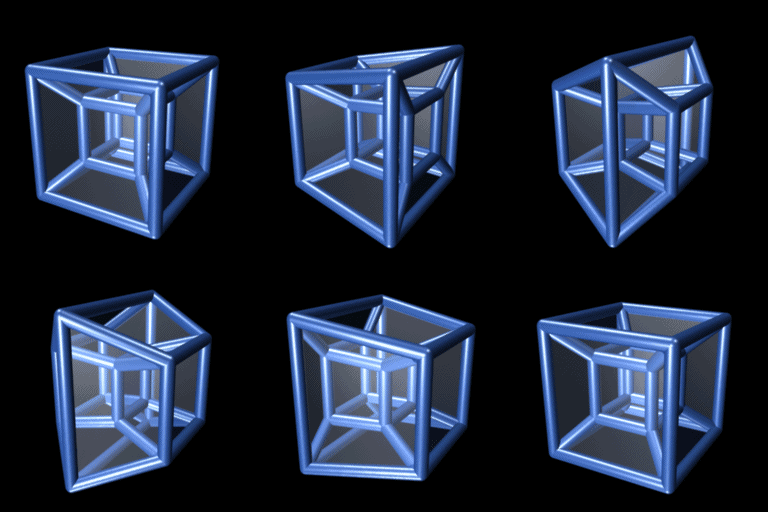
Something similar happens in rhythm as well. In other words, one could say that the key to groove is how many multidimensional interference patterns and geometric patterns can be created within musical rhythm.
Concretely speaking, it takes the form of increasing the number of digits step by step.
Suppose there is a four-beat rhythm like the following.
| 1 | 2 | 3 | 4 |
Suppose this rhythm repeats four times.
| 1 | 2 | 3 | 4 | 2 | 2 | 3 | 4 | 3 | 2 | 3 | 4 | 4 | 2 | 3 | 4 |
At this point, we can think of it as a two-dimensional figure projected into one dimension. The reason is that a pattern repeated four times can be regarded as the same as a square unfolded into one dimension as follows. We can see that by folding it vertically.
| 1 | 2 | 3 | 4 |
| 2 | 2 | 3 | 4 |
| 3 | 2 | 3 | 4 |
| 4 | 2 | 3 | 4 |
When we fold it vertically and rearrange it, we can see that it is a projection of a two-dimensional square onto a one-dimensional line.
Next, let us consider the case where this rhythm repeats four more times.
| 1 | 2 | 3 | 4 | 2 | 2 | 3 | 4 | 3 | 2 | 3 | 4 | 4 | 2 | 3 | 4 |
| 2 | 2 | 3 | 4 | 2 | 2 | 3 | 4 | 3 | 2 | 3 | 4 | 4 | 2 | 3 | 4 |
| 3 | 2 | 3 | 4 | 2 | 2 | 3 | 4 | 3 | 2 | 3 | 4 | 4 | 2 | 3 | 4 |
| 4 | 2 | 3 | 4 | 2 | 2 | 3 | 4 | 3 | 2 | 3 | 4 | 4 | 2 | 3 | 4 |
By arranging it vertically in this way, we can see that what was originally a cube has been rearranged into one dimension.
| 1 | 2 | 3 | 4 |
| 2 | 2 | 3 | 4 |
| 3 | 2 | 3 | 4 |
| 4 | 2 | 3 | 4 |
| 2 | 2 | 3 | 4 |
| 2 | 2 | 3 | 4 |
| 3 | 2 | 3 | 4 |
| 4 | 2 | 3 | 4 |
| 3 | 2 | 3 | 4 |
| 2 | 2 | 3 | 4 |
| 3 | 2 | 3 | 4 |
| 4 | 2 | 3 | 4 |
| 4 | 2 | 3 | 4 |
| 2 | 2 | 3 | 4 |
| 3 | 2 | 3 | 4 |
| 4 | 2 | 3 | 4 |
What Is Division-Space Theory
Division-Space Theory is a theory for expanding the way beats are counted. Up to now, I have explained how to count division (beat = quarter note) and subdivision (sub-beat = tuplet). Division-Space Theory expands division into four division spaces by means of multidimensionalization, making it possible to understand a wide range of groove.
In Division-Space Theory, division and subdivision are treated as one division space.
It then expands this division space through multidimensionalization and defines two new division spaces: macrodivision (measure) and microdivision (timing nuance).
I introduce the concept of a macrodivision division space, which explains what is generally called groove by regarding the measure itself as a beat and applying weak-beat precedence to the measure as well.
Next, I introduce the theory that the expressive nuance created by note displacement, commonly called laid-back, rush, drag, and so on, can be explained rationally by assuming the existence of a finer microdivision (micro-beat) space below the subdivision (sub-beat) represented on the score and by applying weak-beat precedence to it as well.
The expressive nuance created by note displacement can be represented as a weak-beat-precedence rhythm in subdivision when division (beat) is regarded as macrodivision (measure = composite beat) and subdivision (tuplet = sub-beat) is regarded as division. This is the theory I call Division-Space Dimensional Transfer.
Using these theories, it becomes possible to devise concrete practice methods for acquiring groove and to reproduce groove mechanically in a DAW.
Four Division Spaces
Up to now, in Offbeat Count, we have counted beats using the unit in which one quarter note equals one beat. This unit is called division.
And for beats created by subdividing quarter notes, such as eighth notes and triplets, we have counted them not with numbers but by assigning the three symbols/letters & E A.
Here, division and subdivision together are called a division space. In ordinary rhythm theory, there are two such division spaces: division and subdivision.
Division-Space Theory expands these two division spaces by applying the process called multidimensionalization, and defines four division spaces.
- Four Division Spaces
- Macrodivision (measure = composite beat)
- Division (quarter note = beat)
- Subdivision (eighth notes and other smaller note values = sub-beat)
- Microdivision (beats too fine to be written as notes = micro-beat)
Now I will explain the characteristics of these four division spaces.
What Is Division
Up to now, when counting beats, we have repeated the measure as 1 2 3 4, 1 2 3 4 while counting the number of beats within each measure. The numbers produced by dividing the measure in this way are called division.
The following table shows an example of division.
| 1 | 2 | 3 | 4 | 1 | 2 | 3 | 4 | 1 | 2 | 3 | 4 | 1 | 2 | 3 | 4 |
What Is Multidimensionalization
Multidimensionalization means increasing the number of digits used when counting, as in the following example. As in the previous chapter, when counting division (the beat count), if we count the measure number at the same time, it becomes as follows.
| 1 | 2 | 3 | 4 | 2 | 2 | 3 | 4 | 3 | 2 | 3 | 4 | 4 | 2 | 3 | 4 |
When counting beat numbers in a fixed cycle in this way, counting, at the first beat of that cycle, how many times the cycle has come around (that is, the measure count) is called multidimensionalization. Because of the historical development of Offbeat Count, it is also sometimes called counting with measure numbers.
What Is Macrodivision
I will explain macrodivision.
Multidimensionalizing Division
Here, let us consider multidimensionalizing division itself. The following figure is exactly the same division figure we saw in the previous chapter.
| 1 | 2 | 3 | 4 | 1 | 2 | 3 | 4 | 1 | 2 | 3 | 4 | 1 | 2 | 3 | 4 |
When this division is multidimensionalized, it becomes the following figure. This too is exactly the same figure we saw in the previous chapter.
| 1 | 2 | 3 | 4 | 2 | 2 | 3 | 4 | 3 | 2 | 3 | 4 | 4 | 2 | 3 | 4 |
This kind of multidimensionalized division is called macrodivision.
Multidimensionalizing Macrodivision
In this way, when we are counting with measure numbers, if we add one more dimension to count a group of measures of a certain size, it becomes as follows.
| 1 | 2 | 3 | 4 | 2 | 2 | 3 | 4 | 3 | 2 | 3 | 4 | 4 | 2 | 3 | 4 |
| 2 | 2 | 3 | 4 | 2 | 2 | 3 | 4 | 3 | 2 | 3 | 4 | 4 | 2 | 3 | 4 |
| 3 | 2 | 3 | 4 | 2 | 2 | 3 | 4 | 3 | 2 | 3 | 4 | 4 | 2 | 3 | 4 |
| 4 | 2 | 3 | 4 | 2 | 2 | 3 | 4 | 3 | 2 | 3 | 4 | 4 | 2 | 3 | 4 |
Counting in this way is called multidimensionalization of macrodivision. A macrodivision that has been multidimensionalized in this way is also called two-dimensional macrodivision.
Multidimensionalizing an Already Multidimensionalized Macrodivision Once More
It is also possible to multidimensionalize an already multidimensionalized macrodivision further. By adding yet one more dimension as follows, we can construct three-dimensional macrodivision.
| 1 | 2 | 3 | 4 | 2 | 2 | 3 | 4 | 3 | 2 | 3 | 4 | 4 | 2 | 3 | 4 |
| 2 | 2 | 3 | 4 | 2 | 2 | 3 | 4 | 3 | 2 | 3 | 4 | 4 | 2 | 3 | 4 |
| 3 | 2 | 3 | 4 | 2 | 2 | 3 | 4 | 3 | 2 | 3 | 4 | 4 | 2 | 3 | 4 |
| 4 | 2 | 3 | 4 | 2 | 2 | 3 | 4 | 3 | 2 | 3 | 4 | 4 | 2 | 3 | 4 |
| 2 | 2 | 3 | 4 | 2 | 2 | 3 | 4 | 3 | 2 | 3 | 4 | 4 | 2 | 3 | 4 |
| 2 | 2 | 3 | 4 | 2 | 2 | 3 | 4 | 3 | 2 | 3 | 4 | 4 | 2 | 3 | 4 |
| 3 | 2 | 3 | 4 | 2 | 2 | 3 | 4 | 3 | 2 | 3 | 4 | 4 | 2 | 3 | 4 |
| 4 | 2 | 3 | 4 | 2 | 2 | 3 | 4 | 3 | 2 | 3 | 4 | 4 | 2 | 3 | 4 |
| 3 | 2 | 3 | 4 | 2 | 2 | 3 | 4 | 3 | 2 | 3 | 4 | 4 | 2 | 3 | 4 |
| 2 | 2 | 3 | 4 | 2 | 2 | 3 | 4 | 3 | 2 | 3 | 4 | 4 | 2 | 3 | 4 |
| 3 | 2 | 3 | 4 | 2 | 2 | 3 | 4 | 3 | 2 | 3 | 4 | 4 | 2 | 3 | 4 |
| 4 | 2 | 3 | 4 | 2 | 2 | 3 | 4 | 3 | 2 | 3 | 4 | 4 | 2 | 3 | 4 |
| 4 | 2 | 3 | 4 | 2 | 2 | 3 | 4 | 3 | 2 | 3 | 4 | 4 | 2 | 3 | 4 |
| 2 | 2 | 3 | 4 | 2 | 2 | 3 | 4 | 3 | 2 | 3 | 4 | 4 | 2 | 3 | 4 |
| 3 | 2 | 3 | 4 | 2 | 2 | 3 | 4 | 3 | 2 | 3 | 4 | 4 | 2 | 3 | 4 |
| 4 | 2 | 3 | 4 | 2 | 2 | 3 | 4 | 3 | 2 | 3 | 4 | 4 | 2 | 3 | 4 |
How to Name Multidimensionalized Macrodivisions
I will explain how to name the dimensions of multidimensionalized macrodivision.
One-Dimensional Macrodivision = First Dimension
The following way of counting is called one-dimensional macrodivision.
| 1 | 2 | 3 | 4 | 2 | 2 | 3 | 4 | 3 | 2 | 3 | 4 | 4 | 2 | 3 | 4 |
| 1 | 2 | 3 | 4 | 2 | 2 | 3 | 4 | 3 | 2 | 3 | 4 | 4 | 2 | 3 | 4 |
| 1 | 2 | 3 | 4 | 2 | 2 | 3 | 4 | 3 | 2 | 3 | 4 | 4 | 2 | 3 | 4 |
| 1 | 2 | 3 | 4 | 2 | 2 | 3 | 4 | 3 | 2 | 3 | 4 | 4 | 2 | 3 | 4 |
And here, this dimension is called the first dimension.
Two-Dimensional Macrodivision = Second Dimension
The following way of counting is called two-dimensional macrodivision.
| 1 | 2 | 3 | 4 | 2 | 2 | 3 | 4 | 3 | 2 | 3 | 4 | 4 | 2 | 3 | 4 |
| 2 | 2 | 3 | 4 | 2 | 2 | 3 | 4 | 3 | 2 | 3 | 4 | 4 | 2 | 3 | 4 |
| 3 | 2 | 3 | 4 | 2 | 2 | 3 | 4 | 3 | 2 | 3 | 4 | 4 | 2 | 3 | 4 |
| 4 | 2 | 3 | 4 | 2 | 2 | 3 | 4 | 3 | 2 | 3 | 4 | 4 | 2 | 3 | 4 |
And here, this dimension is called the second dimension.
Three-Dimensional Macrodivision = Third Dimension
The following way of counting is called three-dimensional macrodivision.
| 1 | 2 | 3 | 4 | 2 | 2 | 3 | 4 | 3 | 2 | 3 | 4 | 4 | 2 | 3 | 4 |
| 2 | 2 | 3 | 4 | 2 | 2 | 3 | 4 | 3 | 2 | 3 | 4 | 4 | 2 | 3 | 4 |
| 3 | 2 | 3 | 4 | 2 | 2 | 3 | 4 | 3 | 2 | 3 | 4 | 4 | 2 | 3 | 4 |
| 4 | 2 | 3 | 4 | 2 | 2 | 3 | 4 | 3 | 2 | 3 | 4 | 4 | 2 | 3 | 4 |
| 2 | 2 | 3 | 4 | 2 | 2 | 3 | 4 | 3 | 2 | 3 | 4 | 4 | 2 | 3 | 4 |
| 2 | 2 | 3 | 4 | 2 | 2 | 3 | 4 | 3 | 2 | 3 | 4 | 4 | 2 | 3 | 4 |
| 3 | 2 | 3 | 4 | 2 | 2 | 3 | 4 | 3 | 2 | 3 | 4 | 4 | 2 | 3 | 4 |
| 4 | 2 | 3 | 4 | 2 | 2 | 3 | 4 | 3 | 2 | 3 | 4 | 4 | 2 | 3 | 4 |
| 3 | 2 | 3 | 4 | 2 | 2 | 3 | 4 | 3 | 2 | 3 | 4 | 4 | 2 | 3 | 4 |
| 2 | 2 | 3 | 4 | 2 | 2 | 3 | 4 | 3 | 2 | 3 | 4 | 4 | 2 | 3 | 4 |
| 3 | 2 | 3 | 4 | 2 | 2 | 3 | 4 | 3 | 2 | 3 | 4 | 4 | 2 | 3 | 4 |
| 4 | 2 | 3 | 4 | 2 | 2 | 3 | 4 | 3 | 2 | 3 | 4 | 4 | 2 | 3 | 4 |
| 4 | 2 | 3 | 4 | 2 | 2 | 3 | 4 | 3 | 2 | 3 | 4 | 4 | 2 | 3 | 4 |
| 2 | 2 | 3 | 4 | 2 | 2 | 3 | 4 | 3 | 2 | 3 | 4 | 4 | 2 | 3 | 4 |
| 3 | 2 | 3 | 4 | 2 | 2 | 3 | 4 | 3 | 2 | 3 | 4 | 4 | 2 | 3 | 4 |
| 4 | 2 | 3 | 4 | 2 | 2 | 3 | 4 | 3 | 2 | 3 | 4 | 4 | 2 | 3 | 4 |
This third dimension is called the third dimension.
What Is Subdivision
Subdivision means the letters and symbols inserted between the numbers when doing spoken count.
| 1 | e | & | a | 2 | e | & | a | 3 | e | & | a | 4 | e | & | a |
When counting subdivision, we use symbols (&) and letters rather than numbers. The symbols and letters used here are as follows.
- a (ah)
- & (and)
- e (ee)
Here we will multidimensionalize this subdivision.
Multidimensionalizing Subdivision
Multidimensionalizing subdivision means applying to symbols and letters the same multidimensionalization that was previously applied to numbers.
Suppose there is a subdivision as follows.
| 1 | e | & | a |
This ordinary subdivision can be regarded, so to speak, as one-dimensional subdivision.
Multidimensionalizing One-Dimensional Subdivision
By reading this 1 e & a four times and then rotating the leading symbol/letter in the order 1 e & a, we can perform the same process as if the symbols and letters arranged in one dimension were first made two-dimensional and then projected and unfolded back into one dimension.
| 1 | e | & | a |
| e | e | & | a |
| & | e | & | a |
| a | e | & | a |
If we arrange it horizontally, it becomes as follows.
| 1 | e | & | a | e | e | & | a | & | e | & | a | a | e | & | a |
Multidimensionalizing subdivision symbols and letters in this way is called multidimensionalization of subdivision.
Multidimensionalizing an Already Multidimensionalized Subdivision Once More
It is also possible to multidimensionalize an already multidimensionalized subdivision further. By adding yet one more dimension as follows, we can construct three-dimensional subdivision.
| 1 | e | & | a | e | e | & | a | & | e | & | a | a | e | & | a |
| e | e | & | a | e | e | & | a | & | e | & | a | a | e | & | a |
| & | e | & | a | e | e | & | a | & | e | & | a | a | e | & | a |
| a | e | & | a | e | e | & | a | & | e | & | a | a | e | & | a |
If we arrange this table in solid form, it becomes as follows.
| 1 | e | & | a |
| e | e | & | a |
| & | e | & | a |
| a | e | & | a |
| e | e | & | a |
| e | e | & | a |
| & | e | & | a |
| a | e | & | a |
| & | e | & | a |
| e | e | & | a |
| & | e | & | a |
| a | e | & | a |
| a | e | & | a |
| e | e | & | a |
| & | e | & | a |
| a | e | & | a |
How to Name Multidimensionalized Subdivisions
One-Dimensional Subdivision = First Dimension
The following way of counting is called one-dimensional subdivision.
| 1 | e | & | a |
Two-Dimensional Subdivision = Second Dimension
The following way of counting is called two-dimensional subdivision.
| 1 | e | & | a | e | e | & | a | & | e | & | a | a | e | & | a |
Three-Dimensional Subdivision = Third Dimension
The following way of counting is called three-dimensional subdivision.
| 1 | e | & | a | e | e | & | a | & | e | & | a | a | e | & | a |
| e | e | & | a | e | e | & | a | & | e | & | a | a | e | & | a |
| & | e | & | a | e | e | & | a | & | e | & | a | a | e | & | a |
| a | e | & | a | e | e | & | a | & | e | & | a | a | e | & | a |
What Is Microdivision
Microdivision is one of the division spaces that represents the rhythmic-value range finer than subdivision. Fine timing nuances that cannot be written on a score are represented as a hypothetical division space called microdivision.
Microdivision is often what people call pocket, laid-back, rushing, dragging, push, and so on. Because microdivision is too fine, it cannot be counted consciously. Yet it would not be an exaggeration to say that this microdivision holds the key to every nuance in music, and is the most important rhythmic element in music. Microdivision can be called the essence that controls the unconscious movement of both player and listener. Depending on whether microdivision is controlled well or badly, music may resonate with a beauty that seems almost beyond this world, or, regardless of how advanced the compositional technique may be, may miserably produce a discomfort like pouring India ink into the human heart. In that sense, it is no exaggeration to say that microdivision is everything in music.
Definition of Microdivision
Microdivision is too fine to be counted clearly. However, as a working hypothesis, I define microdivision as follows.
- Microdivision can be defined by multidimensionalizing subdivision.
- Microdivision has the same properties as macrodivision and subdivision.
On Division-Space Dimensional Transfer
If subdivision is what results from multidimensionalizing division, and microdivision is what results from multidimensionalizing subdivision, then rhythm should still hold even if we swap them.
- Division -> Macrodivision
- Subdivision -> Division
- Microdivision -> Subdivision (!!!)
In other words:
- If we perform slowly, microdivision becomes subdivision, subdivision becomes division, and division becomes macrodivision, so microdivision too can be counted.
- The sense acquired by becoming familiar with the various complex patterns of multidimensionalization in macrodivision and subdivision can be applied directly to microdivision as well.
- Pocket, in particular, is a Scotch snap in microdivision.
- -> All other nuances created by being late are included here.
- Push, in particular, is an anacrusis in microdivision.
- -> All other nuances created by being early are included here.
In this way, shifting all division spaces by one so that the difficult-to-perceive microdivision division space becomes easier to perceive is what I call Division-Space Dimensional Transfer here.
It is no exaggeration to say that this Division-Space Dimensional Transfer is the most important theory in this Hypergroove Theory.
Table of contents
- Offbeat Count Theory
- Introduction
- What Are the Four Principles of Groove
- Why Are Japanese People Tatenori
- Which Comes First, the Strong Beat or the Weak Beat
- Phonorhythmatology
- A Letter to Mora-Timed Language Speakers
- Split Beat (Schizorhythmos) and Isolated Beat (Solirhythmos)
- What Is Metre
- Multi-Layered Weak-Beat-Oriented Rhythm
- Multidimensional Division Spaces
- Rhythm More Important Than Pronunciation
- The World Is Made of 3⁻ⁿ Metres
- 3⁻ⁿ Groove and 2⁻ⁿ Groove
- Distributed Groove Theory
- Weak-Beat Geocentrism and Strong-Beat Heliocentrism
- Introduction to Offbeat Count
- Rhythmochronic Competence and Sense of Rhythm
- Master English Listening with Offbeat Count
- Etudes for Mora-Timed Language Speakers
- Proper English Pronunciation
- Correct Pronunciation of Offbeat Count
- Multilayer Weak-Beat-Precedence Polyrhythm
- The Elements That Shape Rhythmic Nuance
- The Mechanism by Which Tatenori Arises
- Tatenori and the Perception of Movement
- The Psychological Problems Caused by Tatenori
