Multi-Layered Weak-Beat-Oriented Rhythm
We will see that beats have two kinds, strong beats and weak beats. And we will see that strong beats do not necessarily appear first, and that weak beats are often performed first. Next, we will see that weak beats and strong beats exist not only in quarter notes but in notes of all note values. The strong beats and weak beats of each note value, as a result, produce a multilayered structure in weak beats. We will see that when weak-beat precedence is added to this multilayered structure of weak beats, rhythm shifts from a head-alignment structure to a tail-alignment structure.
What Are Strong Beats and Weak Beats
With Only One Beat, Rhythm Does Not Arise
If there is only one beat there, it does not hold as rhythm. The reason is that the temporal structure called rhythm is a sense that is established on contrast. Let us look at the following example.
リズムには最低二音が必要。一音しかなければそれはリズムとして成立しない。二音あればそこに弱拍と強拍が成立する。それを聴く人はどちらが弱拍かでどちらが強拍かを判定する必要に迫られる。この限られた時間内での判断の必要性がリズムの緊張感の源に存在する。#オフビートで思考する語学 pic.twitter.com/1QiPtCFGzg
— 岡敦/Ats🇯🇵 (@ats4u) July 13, 2025
Waves come crashing in and then pull back. At this time, waves have the two contrastive relationships of “coming in” and “pulling back.” Waves do not hold with only coming in, nor do they hold with only pulling back. The sun quietly rises and sets. The sun does not hold with only rising, nor does it hold with only setting.
If there is only one beat, rhythm does not hold there. The reason is that the temporal structure called rhythm is a sense established on contrastive relationships. For contrast to hold, at least two beats need to exist. And only when a relative functional difference (strong beat and weak beat) arises between those two do we first recognize the temporal structure called rhythm there. That is, rhythm is not merely the “repetition of one sound” but something born by the “perception of relationships.” This phenomenon is here called the “binary opposition of rhythm.” It can be thought that the “binary opposition of rhythm” is the minimum compositional unit for giving semantic and structural roles to rhythm.
What conceptualizes this binary opposition of rhythm can be said to be weak beats / strong beats.
With Only One Beat, Weak Beats / Strong Beats Do Not Arise
Therefore, if there is only one beat there, one cannot determine whether it is a strong beat or a weak beat, and the relationship of strong beat / weak beat does not hold. In other words, strong beats and weak beats can be said to be a relative relationship that holds only when there are first two sounds there. This is here called the weak-strong two-beat unit theory. This weak-strong two-beat unit theory becomes an important keyword when explaining the backbeat characteristic of music such as jazz and funk.
People whose native language is a mora-timed-rhythm language (Japanese) have, in the pronunciation structure of language, the constraint that one mora has only one beat. In other words, rhythm does not exist in mora-timed-rhythm languages.
日本のリズムには1拍しかない。強拍弱拍が成立する為には2拍必要だが日本語は1拍しか持たないので強拍弱拍という概念自体が存在しない ── 日本文化には動きのない美しさ…雅楽の笙(しょう)の様に無限に続く様な世界観がある。#オフビートで思考する語学 pic.twitter.com/wJklGwmWN3
— 岡敦/Ats🇯🇵 (@ats4u) July 23, 2025
People who perform music of stress-timed-rhythm languages and syllable-timed-rhythm languages, even when performing as though there is only one beat there, unconsciously divide that beat in their minds and perform it as two beats. In other words, even if there is only one beat, they recognize that beat as a weak beat, or they recognize that even if there is only one beat, there is a weak-beat rest before it. This is the weak-strong two-beat unit theory.
People whose native language is a mora-timed-rhythm language have the blind spot that, because of the constraints of language recognition, they cannot recognize the weak-strong two-beat unit theory.
Weak Beats / Strong Beats Are the Essence of Rhythm
In this way, the binary opposition of rhythm functions as the minimum unit for establishing “contrast” in time. The expression symbolizing that function is the relationship of strong beats / weak beats. In other words, strong beats and weak beats do not represent merely differences in sound volume; they themselves are the foundational relationship that makes the structure called rhythm hold.
The fact that we perceive rhythm means that we go through a process of judging within a fixed time which part is taken as principal and which part is taken as subsidiary. This process of judgment, that is, the perceptual act of finding a structural difference in meaning between beats, is exactly the essence of rhythm.
Therefore, the structure of strong beats / weak beats should be understood not as an ornamental property added from outside rhythm, but as an indispensable immanent structure for rhythm to hold as rhythm. Standing on this viewpoint, “strong beats / weak beats” are not merely directions for performance or sensory differences in strength, but a cognitive mechanism for segmenting temporal structure semantically, and as a result the meaning of rhythm is born.
Therefore, strong beats / weak beats can be said to be the essential structure of rhythm itself.
Weak Is the Rise and Strong Is the Conclusion
The sun rises and sets. When this is expressed in weak beats / strong beats, which is the weak beat and which is the strong beat? Surely you thought that the sun rises on the strong beat, and the sun sets on the weak beat. This recognition of order is greatly influenced by the recognition of the language a person speaks as their native language. In particular, people whose native language is a mora-timed-rhythm language such as Japanese have a large difference from the recognition of people who speak other languages. Explaining this difference in recognition is also one of the large goals of this book.
People whose native language is a language other than mora timing often have the opposite recognition. In other words, speakers of syllable-timed languages and stress-timed languages often recognize that the sun rises on the weak beat, and the sun sets on the strong beat. Likewise, “waves come crashing in and then pull back” is also often recognized as the waves come crashing in on the weak beat, and the waves pull back on the strong beat.
Weak beats are often called “upbeats” in English. This is an expression likened to a conductor’s baton. When a conductor conducts on stage, the baton is raised on the weak beat and brought down on the strong beat. By analogy with this movement, weak beats are called “upbeats” in English. For people whose native language is Japanese, a mora-timed-rhythm language, this recognition often becomes the reverse. In other words, they will recognize it as raising the baton on the strong beat and bringing the baton down on the weak beat.
This mechanism by which the order recognition of mora-timed-rhythm languages becomes reversed is called the Rhythmic Maximal Onset Principle (RMOP = Rhythmic Maximal Onset Principle). As for the Rhythmic Maximal Onset Principle, it was explained in The Positional Relationship Between the Syllable Nucleus and Onset Consonant Determines Recognition of the Order of Strong and Weak Beats.
Definition of Weak Beats and Strong Beats
Let us look back at the definitions of strong beats and weak beats. When there are two or more notes, the odd-numbered notes appearing in the measure are called strong beats, and the even-numbered notes appearing in the measure are called weak beats.
Each note value has its own strong beats and weak beats.
For example, if we look at strong beats and weak beats on quarter notes, it becomes as follows.

If we look at strong beats and weak beats on eighth notes, it becomes as follows.

If we look at strong beats and weak beats on half notes, it becomes as follows.

What Are Layered Beats
Weak Beats Divide Strong Beats
Let us consider, taking as an example, a half note and two quarter notes.
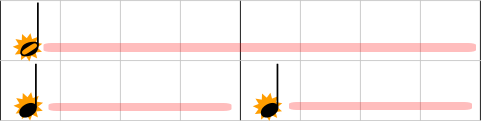
In this figure, the orange stars represent attacks. The red lines represent sustained sounds. The essence of the difference between half notes and quarter notes is the length of the note, but when we think about this again, we can see that there are two elements there: the length of the sound and the distance between attack points.
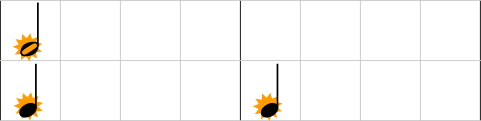
If we think here focusing only on the attack points, we can see that the attack position of the strong beat of the quarter note is the same as the attack position of the half note.
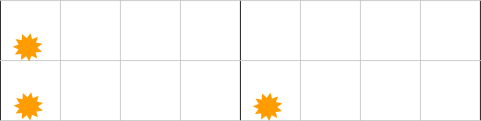
If one thinks only about the attack sound, performing the strong beat of a quarter note and performing a half note can be said to be exactly the same thing. Conversely, it can be said that the weak beat is exactly the feature of the quarter note that makes its difference from the half note stand out, and is the beat that most has quarter-note-ness.
If one were to liken this to dorayaki, the dorayaki would be the half note and the weak beat would be the quarter note.
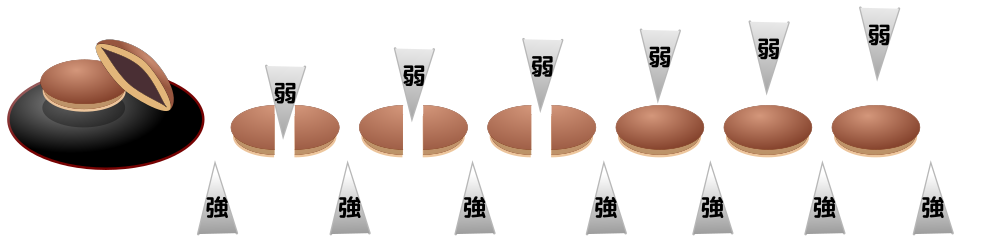
Strong beats can be said to be the boundaries between beats. And weak beats are in the center of that beat. In other words, weak beats divide the beat of that note value.
The same can be said of quarter notes and eighth notes.
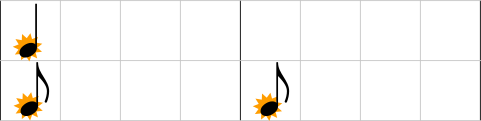
If we think here focusing only on the attack points, we can see that the attack position of the strong beat of the eighth note is the same as the attack position of the quarter note.
This can be said for notes of all note values.
- The strong beat of a half note is a whole note.
- The strong beat of a quarter note is a half note.
- The strong beat of an eighth note is a quarter note.
- The strong beat of a sixteenth note is an eighth note.
- The strong beat of a thirty-second note is a sixteenth note.
- … and so on
Let us look at this in a figure.
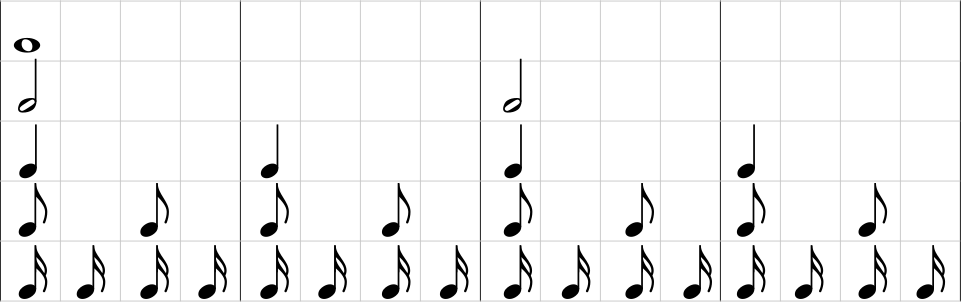
In other words, one can see that the strong beat of a note of every note value always collides with a note whose length is twice that note value.
Strong Beats and Weak Beats Can Be Expressed as Fractions
The positions of notes are obtained by dividing a measure by fixed ratios, so they can be expressed as distances from the head of the measure with fractions. In music theory, explanations are given using ordinals that count the beat at the head of the measure as beat 1, but here let us line them up using cardinal numbers like a mathematical number line, with the head beat as beat 0.
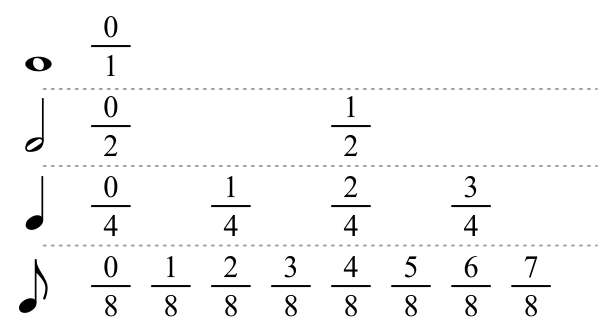
From here, we can find an interesting law.
Strong Beats Can Be Reduced
In these note rows, the notes in even-numbered positions counting from the left (0th, 2nd, 4th …) become strong beats. And the odd-numbered positions (1st, 3rd, 5th …) become weak beats. Then one can see that all strong beats can be reduced.
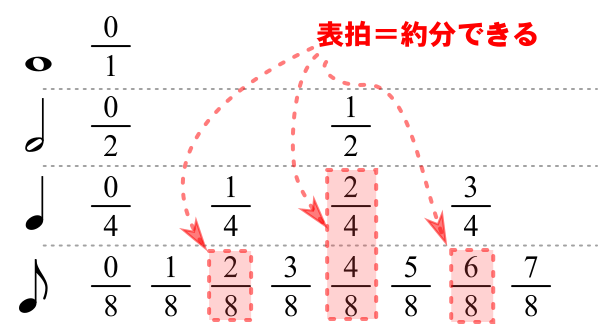
Weak Beats Cannot Be Reduced
Furthermore, one can see that all weak beats are fractions that cannot be reduced, that is, irreducible fractions.
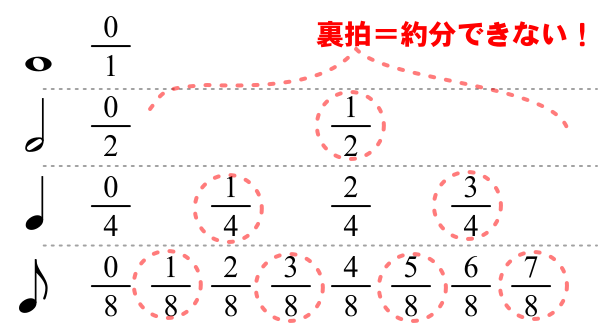
There are multiple ways of writing fractions when expressing one number, but fractions such as 2/8 and 2/4 can be reduced. In other words, they can be expressed by combinations of other smaller numbers.
Optimization of Strong Beats and Weak Beats
In other words, a strong beat is a beat located at a point expressed by a fraction that can be reduced. The strong beat of a certain note value (a certain denominator) always has the weak beat of a note of a note value whose denominator is a number reduced by the greatest common divisor of that denominator. And unless that note value is the smallest note value in the music, there is always a beat of another note value (denominator), that is, a strong beat. In other words, in a given piece of music, a sound placed on a strong beat at a certain note value always overlaps with a sound placed on a strong beat or weak beat at another note value.
Reinterpreting a certain strong beat as the weak beat of the largest note value is called here the optimization of strong beats and weak beats.
The Head Beat Is Always a Strong Beat, but It Is Reduced at a Larger Note Value and Becomes a Weak Beat
Also, one can see that the beat at the head of the measure always becomes a strong beat at every note value.
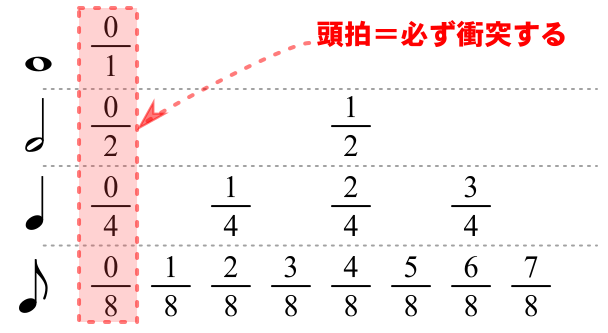
However, just because the beat at the head of the measure is a strong beat does not mean that no weak beat exists. In this case too, it can be interpreted as a weak beat by performing the optimization of strong beats and weak beats mentioned above. For example, if there were two of these measures, there would also be two whole notes. In other words, the second whole note becomes the weak beat. Thus, when one thinks on the premise of repetition, all strong beats come to have corresponding weak beats of larger note values.
Optimization of Strong and Weak Beats and Tail Alignment
As a result, this way of thinking produces the habit, when listening to music, of always going back toward the front and reinterpreting the rhythm. When composing, one comes to think by first deciding the position of the strong beat that should be resolved at the end, and from there setting the positions of the weak beats so as to go backward. Also, even when listening to music, one comes to interpret on the premise that the beat heard first is a weak beat, while guessing what note value’s weak beat that beat was. This is called tail alignment. As for this, we will look at it in detail later.
Strong Beats Do Not Exist, and All Beats Are Weak Beats
If one proceeds thinking as above, one can see that the strong beat of a certain note value always corresponds to the weak beat of a note value larger than that note value. In other words, if one performs only weak beats at all note values, one can see that all beats avoid colliding with each other and are arranged in alternating positions. Let us look at this using a graph.
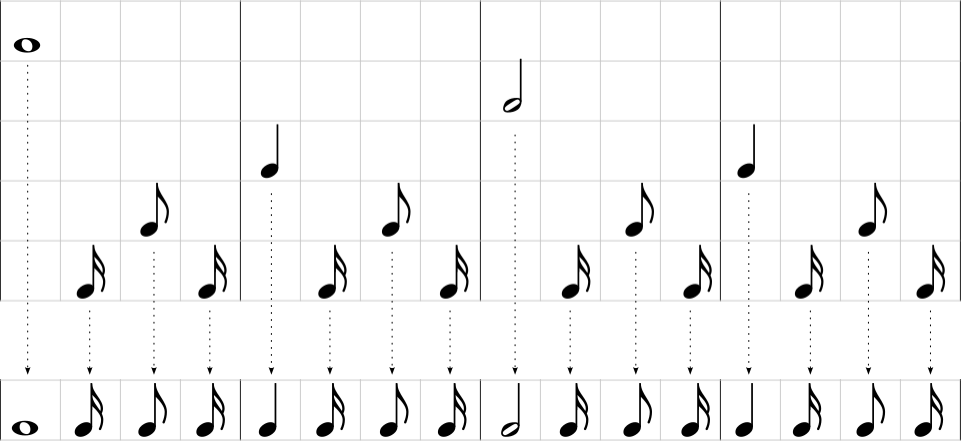
Multilayered Nature of Weak Beats
At this time, the collection of weak beats of each note value (quarter notes, eighth notes, sixteenth notes… / half notes, whole notes, double whole notes…) is called here a beat layer.
In jazz, improvisation is often performed among performers who recognize that all beats are weak beats. At this time, if performer A plays only half notes, there is the habit of enjoying flexible responses such as performer B playing only quarter notes, or if A suddenly switches without warning and plays quarter notes, B quickly switching to half notes and playing.
Switching to a different beat layer is called here changing beat layers.
Weak-Beat-Centered Rhythm
Playing Only Weak Beats
As one technique during improvisational performance in jazz and the like, there is a method of performing under the constraint that each part plays only weak beats. For example, in rock-style band performance, the bass guitar plays the weak beats of quarter notes, the guitar plays the weak beats of eighth notes, the drums’ hi-hat plays the weak beats of sixteenth notes, and the keyboard plays the weak beats of whole notes. In this way, the weak beats of each note value are played by different instruments. Then, because there are no strong beats at all, the sounds of the instruments are always played without overlapping, and they become easier to hear as if each sound stood out. When this technique is used, it even feels as though the volume of the whole band has increased. In reality, however, the overall volume has gone down, and it has the effect of reducing pain to the ears.
The following graph is the graph when all strong beats and weak beats are performed without using the weak-beat-axis performance technique.
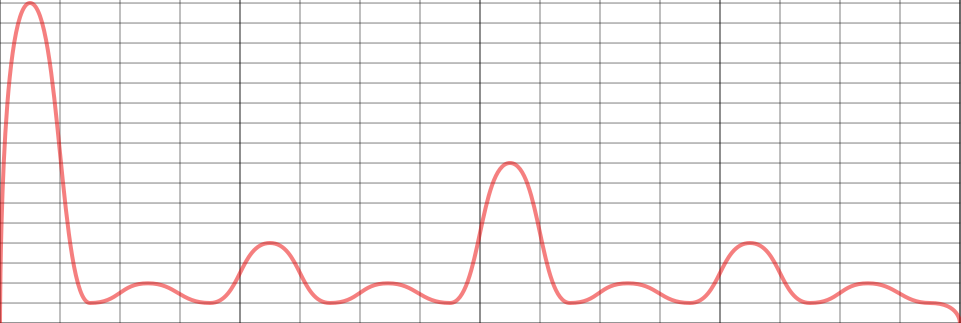
In this way, one can see that the instantaneous volume of the ensemble rises because the strong beats overlap. This overlapping of sounds becomes the cause of muddiness of sound. In addition, it becomes the cause that each performer can no longer hear their own sound clearly during performance, and they come unconsciously to play with still more volume, causing the listener’s ears to become easier to hurt.
The amount of speed feeling in music lies in the fineness of the number of beat divisions (subdivisions). Because places where sounds overlap are always in the positions of strong beats of note values larger than them, the more beats overlap, the more the strong beats of note values larger than the minimum subdivided beat are emphasized as a result. This becomes the largest cause of damaging the speed feeling of music.
To prevent this from happening, one should avoid playing strong beats and play only weak beats. The following figure is the graph when only weak beats are played.
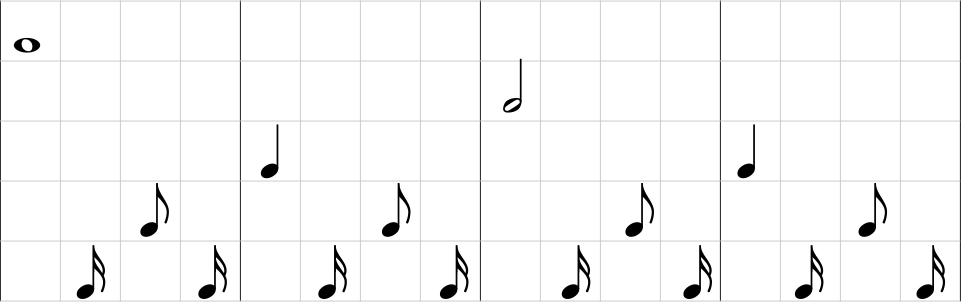
At all note values, beats sound as single tones without overlapping. Because there is no overlap, all beats are kept at a fixed volume. In this way, when each beat is separated without overlap, even if the sound of each instrument part is loud, each sound becomes easier to hear separately. The phenomenon in which one’s own sound cannot be heard and the volume rises unconsciously disappears, and muddiness of sound can be reduced.
Usefulness of Weak Beats
We have seen that beats stop overlapping by refraining from playing strong beats. Let us summarize the merits of beats not overlapping.
- Sound overlap becomes an obstacle to expressing the fineness of the number of divisions (the feeling of speed).
- The volume of the whole band goes down, and the volume balance of each instrument becomes better.
- The average volume during performance goes down, and the dynamic range of the whole band becomes larger = the drop in volume change when sounds are intentionally overlapped becomes larger, and contrast is added to the performance.
- It becomes easier to express the nuance of beats by timing change. Even if the timing of beats is shifted, sounds do not collide.
- Separation of sound within the band becomes better. Each note when a melody is played becomes clearly heard, and subtle changes in tone become easier for the listener to hear.
Strong Beats and Weak Beats Include the Concept of Alternation
Strong beats and weak beats include the concept of “alternation.” If person A is striking the strong beat, person B strikes the weak beat. And if person B is striking the strong beat, person A strikes the weak beat. In this way, by cooperating and striking beats alternately, it becomes possible to perform note values twice as fine. In this book, performing fine note values by multiple people clapping alternately in this way is called cooperative groove.
Cooperative groove is an everyday habit for people whose native language is a stress-timed-rhythm language or syllable-timed-rhythm language, and most people are not even conscious of its existence. This is because cooperative groove includes, in the rhythm concept possessed by language itself, the basic sense of striking alternately.
However, for people whose native language is mora-timed rhythm (Japanese), cooperative groove is an unfamiliar habit. The reason is that, because mora-timed rhythm has no final consonants, it does not have the Rhythmic Maximal Onset Principle (RMOP) reference. Instead, mora-timed languages include the basic sense of striking simultaneously.
The opposing concepts of simultaneous and alternating at the level of language rhythm sense lie between mora-timed rhythm (Japanese) and the stress-timed rhythm (English) and syllable-timed rhythm (French) other than it.
It is known that switching this rhythm sense of simultaneous and alternating is extremely difficult. There exist mathematical properties there that are completely different in principle. Even people who are already able to switch may, by some chance, switch wrongly or become confused and unable to switch. Rather, that is an everyday occurrence. Even for people who acquired both English and Japanese as native languages, it is by no means rare to leave a strong accent in one of the languages. If it was acquired later in life through learning and not natively, it is all the more necessary to pass through a high difficulty.
To become bilingual in Japanese and English, switching this language-rhythm sense becomes an important keyword.
What Is the Order of Strong Beats and Weak Beats
If sounds were sounded twice as follows, how would you place those notes on the score?
この様に2つの音が連続して並んでいるリズムをスコッチスナップと呼びます。一説では英語の元となったゲール語に起源があり、ゲール語由来の英語の主要単語にしばしば見られるリズムです。body billy money nitty gritty bitter dinner uncle Philip 等々 #オフビートで思考する語学 v2 pic.twitter.com/LXyKij07J6
— 岡敦/Ats🇯🇵 (@ats4u) June 26, 2025
At this time, there are two ways of arranging it.
【音が2つ鳴った時のリズムの前後関係の認識の違い】 モーラ拍リズム(日本語)リズム認識では強拍の後ろに弱拍が追随していると認識する。(第二版) #オフビートで思考する語学 pic.twitter.com/beMyPDhY7L
— 岡敦/Ats🇯🇵 (@ats4u) June 8, 2025
Perhaps you may have felt this arrangement to be the most natural. However, it is also possible to interpret it as follows.
【音が2つ鳴った時のリズムの前後関係の認識の違い】 ストレス拍リズム(英語)のリズム認識では弱拍が強拍に先駆けているという順序認識になる。(第二版) #オフビートで思考する語学 pic.twitter.com/rPiPqopgN4
— 岡敦/Ats🇯🇵 (@ats4u) June 8, 2025
Interpreting it in this way is by no means wrong.
This can be summarized into the question, when two sounds are sounded, of which one is recognized as the strong beat and which one is recognized as the weak beat.
Strong-Beat Precedence = Strong-Weak
【音が2つ鳴った時のリズムの前後関係の認識の違い】 モーラ拍リズム(日本語)リズム認識では強拍の後ろに弱拍が追随していると認識する。(第二版) #オフビートで思考する語学 pic.twitter.com/beMyPDhY7L
— 岡敦/Ats🇯🇵 (@ats4u) June 8, 2025
When interpreted in this way, it can be seen that the weak beat is arranged behind the strong beat. In this case, the order is “strong-weak.”
Weak-Beat Precedence = Weak-Strong
Conversely,
【音が2つ鳴った時のリズムの前後関係の認識の違い】 ストレス拍リズム(英語)のリズム認識では弱拍が強拍に先駆けているという順序認識になる。(第二版) #オフビートで思考する語学 pic.twitter.com/rPiPqopgN4
— 岡敦/Ats🇯🇵 (@ats4u) June 8, 2025
When interpreted in this way, it can be seen that the weak beat is arranged before the strong beat. In this case, the order is “weak-strong.”
What Is Anacrusis
As we have seen up to here, beats have two kinds, strong beats and weak beats. Strong beats and weak beats are always arranged in the order strong-weak, strong-weak within a measure. However, in actual music, strong beats are not necessarily placed first, and music may be composed in a form in which weak beats are placed first. Rhythm in which weak beats are placed first is called anacrusis.
The Importance of Anacrusis
Recognition of this anacrusis is greatly influenced by the language a person speaks as their native language. Looking around music in the whole world, one notices that the frequency with which anacrusis occurs is very high. Depending on the kind of music, the frequency of anacrusis is extremely high, and there are even cases where anacrusis is necessarily performed almost every time. If one investigates the frequency of anacrusis even further, one will in fact instead notice that only Japan hardly uses anacrusis in composition and improvisation. One can see that Japan has the very rare habit of not using anacrusis in music. There is a reason for this. This is because it is a phenomenon caused by the rhythm recognition called mora-timed rhythm that Japanese has.
Multi-Layered Weak-Beat-Oriented Rhythm and Tail Alignment
Weak beats have multilayered nature. And when weak-beat precedence occurs on multilayered beat layers, a very interesting rhythmic phenomenon called tail alignment occurs. This tail alignment is the true identity of musical groove. In this section, we will first look at what multilayered nature is, what tail alignment is, and the mechanism of why tail alignment occurs.
Tail Alignment and Head Alignment
Here, the rhythm recognition of mora-timed rhythm is called head alignment, and the rhythm recognition of stress-timed rhythm is called tail alignment.
Tail Alignment
In overseas music, such as jazz, R&B, and rock, often the starting point of the melody is not clearly fixed, and the melody begins vaguely from an arbitrary point. The starting point is not clearly fixed, but the ending point is always fixed, and a method is often used of putting an accent there with a large sound. This rhythm structure is here called tail alignment.
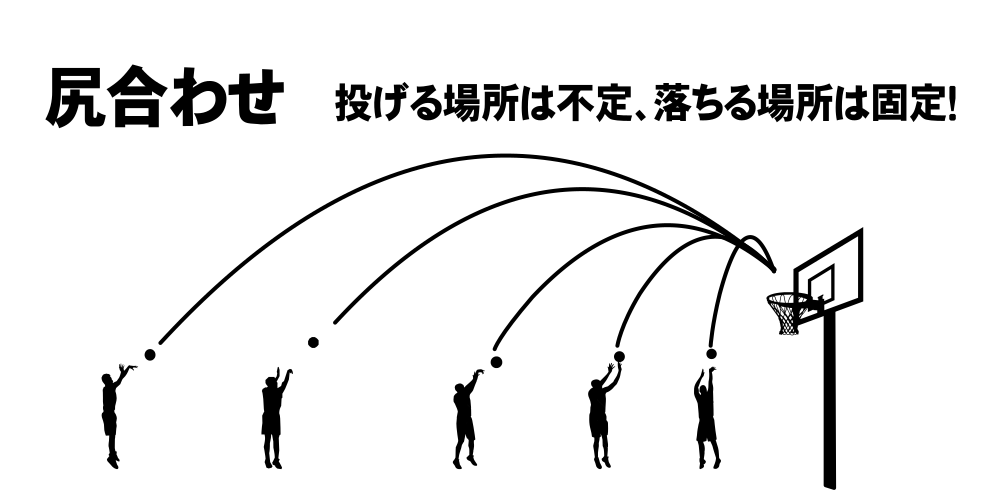
In the tail-alignment rhythm structure, the performance order of quarter notes is often not 1-2-3-4 but the order 2-3-4-1. In this way, the melody is always arranged so that 1 comes last. In sixteen-beat songs, it is common to count in eighth notes, and in this case as well the melody is arranged so that 1 always comes last, as in 2-3-4-5-6-7-8-1.
This is the true identity of what is called groove. It can be said that the fact that this tail alignment is occurring simultaneously at all note values is the essence of the rhythmic phenomenon called groove.
Head Alignment
In traditional Chinese music and in the music of countries such as Japan and Iran, whose native languages are mora-timed languages, the starting point of the melody is often clearly fixed within repetition, and a method is often used of putting an accent there with a large sound. In most cases, the ending point is not clearly fixed, and the melody ends vaguely. This rhythm structure is here called head alignment.
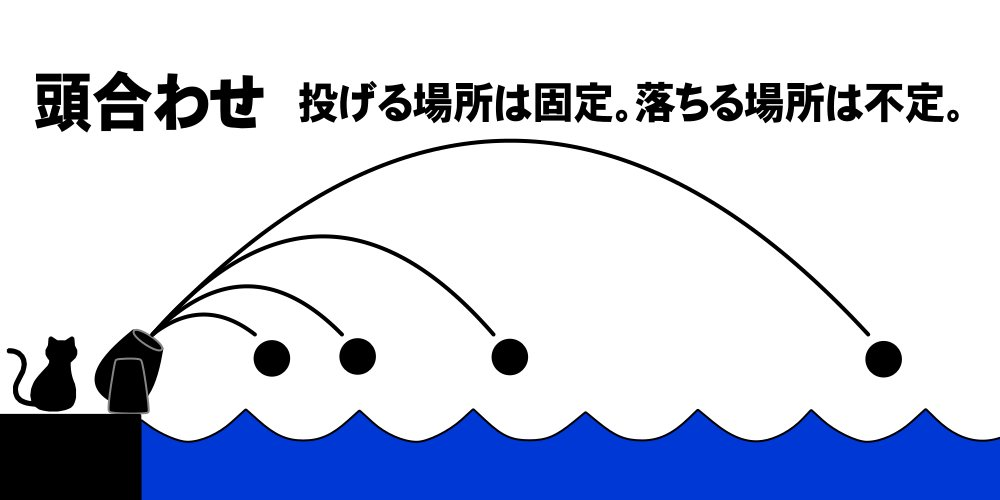
In the head-alignment rhythm structure, the performance order of quarter notes is often performed in the order 1-2-3-rest. At this time, 4 is often not performed and a rest is performed. In sixteen-beat songs, forms transformed from 1-2-3-rest are maintained, such as “1-2-3-rest 4-5-6-rest” (repeating 1-2-3-rest twice) and “1-2-3-4-5-6-rest-rest” (extending 1-2-3-rest to twice its length).
Strong-Beat Precedence in Multilayer Beat Structure
There is a clear reason why head-alignment and tail-alignment rhythm structures are born. Whether the rhythm structure of a melody becomes head alignment or tail alignment is determined by whether the rhythm is weak-beat precedence or strong-beat precedence.
Below, let us look at the mechanism by which head alignment and tail alignment occur.
Suppose that, as follows, there are four quarter notes in one measure. Here, divide the notes into groups of two each, and define the one that appears first as the strong beat and the one that appears later as the weak beat.
| Position | Beat 1 | Beat 2 | Beat 3 | Beat 4 |
|---|---|---|---|---|
| Quarter notes | ◯ | ◯ | ◯ | ◯ |
If strong beats and weak beats are assigned to this in order from the beginning, it becomes as follows.
| Position | Beat 1 | Beat 2 | Beat 3 | Beat 4 |
|---|---|---|---|---|
| Quarter notes | ◯ | ◯ | ◯ | ◯ |
| Strong/weak | Strong | Weak | Strong | Weak |
In the same way, strong beats and weak beats can be assigned to all note values. Here, they are assigned for half notes, quarter notes, eighth notes, and sixteenth notes. The result becomes as follows.
| Position | Beat 1 | Beat 2 |
|---|---|---|
| Half notes | ◯ | ◯ |
| Strong/weak | Strong | Weak |
| Position | Beat 1 | Beat 2 | Beat 3 | Beat 4 |
|---|---|---|---|---|
| Quarter notes | ◯ | ◯ | ◯ | ◯ |
| Strong/weak | Strong | Weak | Strong | Weak |
| Position | 1 | 2 | 3 | 4 | 5 | 6 | 7 | 8 |
|---|---|---|---|---|---|---|---|---|
| Eighth notes | ◯ | ◯ | ◯ | ◯ | ◯ | ◯ | ◯ | ◯ |
| Strong/weak | Strong | Weak | Strong | Weak | Strong | Weak | Strong | Weak |
| Position | 1 | 2 | 3 | 4 | 5 | 6 | 7 | 8 | 9 | 10 | 11 | 12 | 13 | 14 | 15 | 16 |
|---|---|---|---|---|---|---|---|---|---|---|---|---|---|---|---|---|
| Sixteenth notes | ◯ | ◯ | ◯ | ◯ | ◯ | ◯ | ◯ | ◯ | ◯ | ◯ | ◯ | ◯ | ◯ | ◯ | ◯ | ◯ |
| Strong/weak | Strong | Weak | Strong | Weak | Strong | Weak | Strong | Weak | Strong | Weak | Strong | Weak | Strong | Weak | Strong | Weak |
Applying the RMOP Principle and Putting Weak Beats in Front
In the previous section, I introduced the principle called the Rhythmic Maximal Onset Principle (RMOP = Rhythmic Maximal Onset Principle), by which the Maximum Onset Principle (MOP = Maximum Onset Principle) of language phonology is also applied to musical rhythm. Here we will look at what happens when this Rhythmic Maximal Onset Principle (RMOP = Rhythmic Maximal Onset Principle) is applied to multilayered beat layers.
The Basics of Weak-Beat Precedence
Let us look in order from a simple example at what happens when weak-beat precedence occurs with respect to beats on a measure.
Suppose there are quarter notes as follows.
| Position | Beat 1 | Beat 2 | Beat 3 | Beat 4 |
|---|---|---|---|---|
| Quarter notes | ◯ | ◯ | ◯ | ◯ |
| Strong/weak | Strong | Weak | Strong | Weak |
If one applies RMOP to this and resyllabifies it using the law that weak beats come in front, it becomes as follows.
| Position | Beat 4 | Beat 1 | Beat 2 | Beat 3 |
|---|---|---|---|---|
| Quarter notes | ◯ | ◯ | ◯ | ◯ |
| Strong/weak | Weak | Strong | Weak | Strong |
In this way, beat 4 comes to be performed first, and the order changes from 1-2-3-4 to 4-1-2-3.
This is called the precedence of weak beats.
Let us confirm this with score and sound.
Performance Without Quarter-Note Weak-Beat Precedence
| Position | Beat 1 | Beat 2 | Beat 3 | Beat 4 |
|---|---|---|---|---|
| Quarter notes | ◯ | ◯ | ◯ | ◯ |
| Strong/weak | Strong | Weak | Strong | Weak |
Performance With Quarter-Note Weak-Beat Precedence
| Position | Beat 4 | Beat 1 | Beat 2 | Beat 3 |
|---|---|---|---|---|
| Quarter notes | ◯ | ◯ | ◯ | ◯ |
| Strong/weak | Weak | Strong | Weak | Strong |
Summary
This is the basis of weak-beat precedence. From now on, we will see that this process called weak-beat precedence spreads one after another to other note values.
Weak-Beat Precedence Has Multiple Layers
In the previous section, we surveyed graphically the case in which, in quarter notes, weak beats are played before strong beats as an example of rhythm with weak-beat precedence. This precedence of weak beats occurs simultaneously at multiple note values. Let us look at half notes, for example.
In the Case of Half Notes
Suppose there are half notes as follows.
| Position | Beat 1 | Beat 2 |
|---|---|---|
| Half notes | ◯ | ◯ |
| Strong/weak | Strong | Weak |
As mentioned earlier, half notes, like quarter notes, also undergo weak-beat precedence. When weak-beat precedence occurs in half notes, it becomes as follows.
| Position | Beat 2 | Beat 1 |
|---|---|---|
| Half notes | ◯ | ◯ |
| Strong/weak | Weak | Strong |
In this way, even in half notes, weak beats come to be played first, with strong beats played after them. The precedence of weak beats occurs in the same way at all other note values as well, such as eighth notes and sixteenth notes.
Let us confirm this with notation and sound.
💡 Example = Half-Note Weak-Beat Precedence Absent
| Position | Beat 1 | Beat 2 |
|---|---|---|
| Half notes | ◯ | ◯ |
| Strong/weak | Strong | Weak |
💡 Example = Half-Note Weak-Beat Precedence Present
| Position | Beat 2 | Beat 1 |
|---|---|---|
| Half notes | ◯ | ◯ |
| Strong/weak | Weak | Strong |
And the precedence of weak beats always occurs simultaneously across multiple note values.
In the Case of Quarter Notes
In the previous section, we saw a graph of weak-beat precedence in quarter notes. If we superimpose on that graph the half-note graph corresponding to each quarter note, we can see something interesting.
First, let us once again look at the state in which there are quarter notes as follows.
| Position | Beat 1 | Beat 2 | Beat 3 | Beat 4 |
|---|---|---|---|---|
| Quarter notes | ◯ | ◯ | ◯ | ◯ |
| Strong/weak | Strong | Weak | Strong | Weak |
When these quarter notes are made into weak-beat precedence, they become as follows.
| Position | Beat 4 | Beat 1 | Beat 2 | Beat 3 |
|---|---|---|---|---|
| Quarter notes | ◯ | ◯ | ◯ | ◯ |
| Strong/weak | Weak | Strong | Weak | Strong |
With this, the weak beats of the quarter notes now precede.
Let us confirm this with notation and sound.
💡 Example = Quarter-Note Weak-Beat Precedence Absent
| Position | Beat 1 | Beat 2 | Beat 3 | Beat 4 |
|---|---|---|---|---|
| Quarter notes | ◯ | ◯ | ◯ | ◯ |
| Strong/weak | Strong | Weak | Strong | Weak |
💡 Example = Quarter-Note Weak-Beat Precedence Present
| Position | Beat 4 | Beat 1 | Beat 2 | Beat 3 |
|---|---|---|---|---|
| Quarter notes | ◯ | ◯ | ◯ | ◯ |
| Strong/weak | Weak | Strong | Weak | Strong |
Multi-Layered Weak-Beat Precedence in Quarter Notes
However, weak-beat precedence in quarter notes alone does not yet make a complete yokonori rhythm. If we superimpose the corresponding half-note graph above it, we can see that, when viewed in half notes, strong beats still precede. Please look at the following graph.
| Position | Beat 1 | Beat 2 |
|---|---|---|
| Half notes | ◯ | ◯ |
| Strong/weak | Strong | Weak |
| Position | Beat 4 | Beat 1 | Beat 2 | Beat 3 |
|---|---|---|---|---|
| Quarter notes | ◯ | ◯ | ◯ | ◯ |
| Strong/weak | Weak | Strong | Weak | Strong |
Even if the weak beats are inverted in quarter notes, when viewed in half notes the strong beats still come first. What would happen if we also caused this inversion of weak beats in half notes?
| Position | Beat 2 | Beat 1 |
|---|---|---|
| Half notes | ◯ | ◯ |
| Strong/weak | Weak | Strong |
| Position | Beat 2 | Beat 3 | Beat 4 | Beat 1 |
|---|---|---|---|---|
| Quarter notes | ◯ | ◯ | ◯ | ◯ |
| Strong/weak | Weak | Strong | Weak | Strong |
The order of the quarter notes has completed a full rotation. This rhythm is called 2341 rhythm. This is the way numbers are counted in the world of yokonori rhythm. In the world of yokonori rhythm, the order of quarter notes rotates within the measure and completes a full cycle so that 1 comes at the ending point.
Let us confirm this with notation and sound.
💡 Example = Quarter-Note Weak-Beat Precedence Present, Half-Note Weak-Beat Precedence Absent
| Position | Beat 1 | Beat 2 |
|---|---|---|
| Half notes | ◯ | ◯ |
| Strong/weak | Strong | Weak |
| Position | Beat 4 | Beat 1 | Beat 2 | Beat 3 |
|---|---|---|---|---|
| Quarter notes | ◯ | ◯ | ◯ | ◯ |
| Strong/weak | Weak | Strong | Weak | Strong |
💡 Example = Quarter-Note Weak-Beat Precedence Present, Half-Note Weak-Beat Precedence Present
| Position | Beat 2 | Beat 1 |
|---|---|---|
| Half notes | ◯ | ◯ |
| Strong/weak | Weak | Strong |
| Position | Beat 2 | Beat 3 | Beat 4 | Beat 1 |
|---|---|---|---|---|
| Quarter notes | ◯ | ◯ | ◯ | ◯ |
| Strong/weak | Weak | Strong | Weak | Strong |
Summary: Tail-Alignment Rhythm in Quarter Notes
In this way, when weak beats precede at all note values, the ordinal sequences of notes at all note values rotate so that 1 always comes last. This is the mechanism by which weak-beat precedence constructs tail alignment. This is the mechanism by which 2341 rhythm is produced.
A rhythm that begins with 1 changes, by the precedence of weak beats, into a rhythm that ends with 1. This rhythm, whose starting point is indeterminate and which ends with 1, is called tail-alignment rhythm. In contrast, a rhythm that begins with 1 and has no ending is called head-alignment rhythm.
- When beats 1 to n exist
- Played in the order beginning with 1 and ending with n -> head alignment
- Played in the order beginning with 2 and ending with 1 -> tail alignment
When understood in this way, this phenomenon occurs not only in half notes and quarter notes but in all conceivable note values, including whole notes and double whole notes. Next, let us look at eighth notes.
Multi-Layered Weak-Beat Precedence in Eighth Notes
When we think about weak-beat precedence in eighth notes, just as in the case of quarter notes, if weak beats precede at the smallest note value, it becomes as follows.
Consider the case in which eight eighth notes are arranged as follows.
💡 Example = Eighth-Note Weak-Beat Precedence Absent
8分音符の弱拍先行=なし
— 岡敦/Ats🇯🇵 (@ats4u) July 31, 2025
4分音符の弱拍先行=なし#グルーヴは弱拍が先 pic.twitter.com/ASYOxNChGr
| Position | 1 | 2 | 3 | 4 | 5 | 6 | 7 | 8 |
|---|---|---|---|---|---|---|---|---|
| Eighth notes | ◯ | ◯ | ◯ | ◯ | ◯ | ◯ | ◯ | ◯ |
| Strong/weak | Strong | Weak | Strong | Weak | Strong | Weak | Strong | Weak |
Let us rearrange these so that the weak beats of the eighth notes come first. It then becomes as follows.
💡 Example = Eighth-Note Weak-Beat Precedence Present
8分音符先行=あり #グルーヴは弱拍が先 pic.twitter.com/oHAMPjSVv9
— 岡敦/Ats🇯🇵 (@ats4u) August 1, 2025
| Position | 8 | 1 | 2 | 3 | 4 | 5 | 6 | 7 |
|---|---|---|---|---|---|---|---|---|
| Eighth notes | ◯ | ◯ | ◯ | ◯ | ◯ | ◯ | ◯ | ◯ |
| Strong/weak | Weak | Strong | Weak | Strong | Weak | Strong | Weak | Strong |
Now the weak beats precede. However, if we superimpose quarter notes, a different aspect becomes visible.
💡 Example = Eighth-Note Weak-Beat Precedence Present, Quarter-Note Weak-Beat Precedence Absent
8分音符の弱拍先行=あり
— 岡敦/Ats🇯🇵 (@ats4u) July 31, 2025
4分音符の弱拍先行=なし#グルーヴは弱拍が先 pic.twitter.com/iiSAX6NKMm
| Position | Beat 1 | Beat 2 | Beat 3 | Beat 4 |
|---|---|---|---|---|
| Quarter notes | ◯ | ◯ | ◯ | ◯ |
| Strong/weak | Strong | Weak | Strong | Weak |
| Position | 8 | 1 | 2 | 3 | 4 | 5 | 6 | 7 |
|---|---|---|---|---|---|---|---|---|
| Eighth notes | ◯ | ◯ | ◯ | ◯ | ◯ | ◯ | ◯ | ◯ |
| Strong/weak | Weak | Strong | Weak | Strong | Weak | Strong | Weak | Strong |
When we look at it this way, we can see that the quarter notes are still in strong-beat precedence. In other words, unless they are also made weak-beat precedence when viewed as quarter notes, it cannot be said that weak-beat precedence holds at all note values. Next, let us look at a version in which the weak beats are also arranged to precede in quarter notes.
💡 Example = Eighth-Note Weak-Beat Precedence Present, Quarter-Note Weak-Beat Precedence Present
8分音符の弱拍先行=あり
— 岡敦/Ats🇯🇵 (@ats4u) July 31, 2025
4分音符の弱拍先行=あり#グルーヴは弱拍が先 pic.twitter.com/BFqRR2dANP
| Position | Beat 4 | Beat 1 | Beat 2 | Beat 3 |
|---|---|---|---|---|
| Quarter notes | ◯ | ◯ | ◯ | ◯ |
| Strong/weak | Weak | Strong | Weak | Strong |
| Position | 6 | 7 | 8 | 1 | 2 | 3 | 4 | 5 |
|---|---|---|---|---|---|---|---|---|
| Eighth notes | ◯ | ◯ | ◯ | ◯ | ◯ | ◯ | ◯ | ◯ |
| Strong/weak | Weak | Strong | Weak | Strong | Weak | Strong | Weak | Strong |
Now the quarter notes too have become weak-beat precedence. However, if we again superimpose half notes, we can see that these too are in fact still strong-beat precedence.
💡 Example = Eighth-Note Weak-Beat Precedence Present, Quarter-Note Weak-Beat Precedence Present, Half-Note Weak-Beat Precedence Absent
8分音符先行=あり
— 岡敦/Ats🇯🇵 (@ats4u) August 1, 2025
4分音符先行=あり
2分音符先行=なし#グルーヴは弱拍が先 pic.twitter.com/Ls3K4Mrst3
| Position | Beat 1 | Beat 2 |
|---|---|---|
| Half notes | ◯ | ◯ |
| Strong/weak | Strong | Weak |
| Position | Beat 4 | Beat 1 | Beat 2 | Beat 3 |
|---|---|---|---|---|
| Quarter notes | ◯ | ◯ | ◯ | ◯ |
| Strong/weak | Weak | Strong | Weak | Strong |
| Position | 6 | 7 | 8 | 1 | 2 | 3 | 4 | 5 |
|---|---|---|---|---|---|---|---|---|
| Eighth notes | ◯ | ◯ | ◯ | ◯ | ◯ | ◯ | ◯ | ◯ |
| Strong/weak | Weak | Strong | Weak | Strong | Weak | Strong | Weak | Strong |
Here, let us also rearrange the half notes so that their weak beats precede.
💡 Example = Eighth-Note Weak-Beat Precedence Present, Quarter-Note Weak-Beat Precedence Present, Half-Note Weak-Beat Precedence Present
8分音符の弱拍先行=あり
— 岡敦/Ats🇯🇵 (@ats4u) July 31, 2025
4分音符の弱拍先行=あり
2分音符の弱拍先行=あり#グルーヴは弱拍が先 pic.twitter.com/DLIJh2aeHC
| Position | Beat 2 | Beat 1 |
|---|---|---|
| Half notes | ◯ | ◯ |
| Strong/weak | Weak | Strong |
| Position | Beat 2 | Beat 3 | Beat 4 | Beat 1 |
|---|---|---|---|---|
| Quarter notes | ◯ | ◯ | ◯ | ◯ |
| Strong/weak | Weak | Strong | Weak | Strong |
| Position | 2 | 3 | 4 | 5 | 6 | 7 | 8 | 1 |
|---|---|---|---|---|---|---|---|---|
| Eighth notes | ◯ | ◯ | ◯ | ◯ | ◯ | ◯ | ◯ | ◯ |
| Strong/weak | Weak | Strong | Weak | Strong | Weak | Strong | Weak | Strong |
Summary: Tail-Alignment Rhythm in Eighth Notes
Now all note values within the measure have become weak-beat precedence. As a result, we can see that the eighth notes that had originally been arranged as 12345678 are rearranged so that 1 comes last, as 23456781. This is 23456781 rhythm. This is the way eighth notes are counted in the world of yokonori rhythm. In this world too, the order of eighth notes rotates within the measure and completes a full cycle so that 1 comes at the ending point.
In this way, when weak beats precede at all note values, the ordinal sequences of notes at all note values rotate so that 1 always comes last. This is the mechanism by which weak-beat precedence constructs tail alignment. This is the mechanism by which 23456781 rhythm is produced.
Multi-Layered Weak-Beat Precedence in Sixteenth Notes
Exactly the same thing can be said for sixteenth notes as for eighth notes, quarter notes, and half notes.
💡 Example = No Weak-Beat Precedence at Any Note Value
First, let us consider the case in which sixteenth notes are arranged as follows.
16分音符先行=なし
— 岡敦/Ats🇯🇵 (@ats4u) August 1, 2025
8分音符先行=なし
4分音符先行=なし#グルーヴは弱拍が先 pic.twitter.com/FoCovKTkMf
| Position | 1 | 2 | 3 | 4 | 5 | 6 | 7 | 8 | 9 | 10 | 11 | 12 | 13 | 14 | 15 | 16 |
|---|---|---|---|---|---|---|---|---|---|---|---|---|---|---|---|---|
| Sixteenth notes | ◯ | ◯ | ◯ | ◯ | ◯ | ◯ | ◯ | ◯ | ◯ | ◯ | ◯ | ◯ | ◯ | ◯ | ◯ | ◯ |
| Strong/weak | Strong | Weak | Strong | Weak | Strong | Weak | Strong | Weak | Strong | Weak | Strong | Weak | Strong | Weak | Strong | Weak |
Let us rearrange these while focusing on the sixteenth notes so that they become weak-beat precedence.
💡 Example = Sixteenth-Note Weak-Beat Precedence Present
16分音符先行=あり
— 岡敦/Ats🇯🇵 (@ats4u) August 1, 2025
8分音符先行=なし
4分音符先行=なし#グルーヴは弱拍が先 pic.twitter.com/aKsMKJEqCf
| Position | 16 | 1 | 2 | 3 | 4 | 5 | 6 | 7 | 8 | 9 | 10 | 11 | 12 | 13 | 14 | 15 |
|---|---|---|---|---|---|---|---|---|---|---|---|---|---|---|---|---|
| Sixteenth notes | ◯ | ◯ | ◯ | ◯ | ◯ | ◯ | ◯ | ◯ | ◯ | ◯ | ◯ | ◯ | ◯ | ◯ | ◯ | ◯ |
| Strong/weak | Weak | Strong | Weak | Strong | Weak | Strong | Weak | Strong | Weak | Strong | Weak | Strong | Weak | Strong | Weak | Strong |
💡 Example = Sixteenth-Note Weak-Beat Precedence Present, Eighth-Note Weak-Beat Precedence Absent
However, in this case too, if we look from the perspective of the eighth notes, which are one layer larger in note value than the sixteenth notes, we can see that in fact the eighth notes are still in strong-beat precedence.
16分音符先行=あり
— 岡敦/Ats🇯🇵 (@ats4u) August 1, 2025
8分音符先行=なし
4分音符先行=なし#グルーヴは弱拍が先 pic.twitter.com/aKsMKJEqCf
| Position | 1 | 2 | 3 | 4 | 5 | 6 | 7 | 8 |
|---|---|---|---|---|---|---|---|---|
| Eighth notes | ◯ | ◯ | ◯ | ◯ | ◯ | ◯ | ◯ | ◯ |
| Strong/weak | Strong | Weak | Strong | Weak | Strong | Weak | Strong | Weak |
| Position | 16 | 1 | 2 | 3 | 4 | 5 | 6 | 7 | 8 | 9 | 10 | 11 | 12 | 13 | 14 | 15 |
|---|---|---|---|---|---|---|---|---|---|---|---|---|---|---|---|---|
| Sixteenth notes | ◯ | ◯ | ◯ | ◯ | ◯ | ◯ | ◯ | ◯ | ◯ | ◯ | ◯ | ◯ | ◯ | ◯ | ◯ | ◯ |
| Strong/weak | Weak | Strong | Weak | Strong | Weak | Strong | Weak | Strong | Weak | Strong | Weak | Strong | Weak | Strong | Weak | Strong |
💡 Example = Sixteenth-Note Weak-Beat Precedence Present, Eighth-Note Weak-Beat Precedence Present
As with the quarter-note case, let us rearrange these in eighth-note weak-beat precedence.
16分音符先行=あり
— 岡敦/Ats🇯🇵 (@ats4u) August 1, 2025
8分音符先行=あり
4分音符先行=なし#グルーヴは弱拍が先 pic.twitter.com/PVU4PZNGTG
| Position | 8 | 1 | 2 | 3 | 4 | 5 | 6 | 7 |
|---|---|---|---|---|---|---|---|---|
| Eighth notes | ◯ | ◯ | ◯ | ◯ | ◯ | ◯ | ◯ | ◯ |
| Strong/weak | Weak | Strong | Weak | Strong | Weak | Strong | Weak | Strong |
| Position | 14 | 15 | 16 | 1 | 2 | 3 | 4 | 5 | 6 | 7 | 8 | 9 | 10 | 11 | 12 | 13 |
|---|---|---|---|---|---|---|---|---|---|---|---|---|---|---|---|---|
| Sixteenth notes | ◯ | ◯ | ◯ | ◯ | ◯ | ◯ | ◯ | ◯ | ◯ | ◯ | ◯ | ◯ | ◯ | ◯ | ◯ | ◯ |
| Strong/weak | Weak | Strong | Weak | Strong | Weak | Strong | Weak | Strong | Weak | Strong | Weak | Strong | Weak | Strong | Weak | Strong |
💡 Example = Sixteenth-Note Weak-Beat Precedence Present, Eighth-Note Weak-Beat Precedence Present, Quarter-Note Weak-Beat Precedence Absent
Now both the eighth notes and the sixteenth notes have become weak-beat precedence.
However, when viewed from the world of quarter notes, we can see that they are still in strong-beat precedence.
16分音符先行=あり
— 岡敦/Ats🇯🇵 (@ats4u) August 1, 2025
8分音符先行=あり
4分音符先行=なし#グルーヴは弱拍が先 pic.twitter.com/PVU4PZNGTG
| Position | Beat 1 | Beat 2 | Beat 3 | Beat 4 |
|---|---|---|---|---|
| Quarter notes | ◯ | ◯ | ◯ | ◯ |
| Strong/weak | Strong | Weak | Strong | Weak |
| Position | 8 | 1 | 2 | 3 | 4 | 5 | 6 | 7 |
|---|---|---|---|---|---|---|---|---|
| Eighth notes | ◯ | ◯ | ◯ | ◯ | ◯ | ◯ | ◯ | ◯ |
| Strong/weak | Weak | Strong | Weak | Strong | Weak | Strong | Weak | Strong |
| Position | 14 | 15 | 16 | 1 | 2 | 3 | 4 | 5 | 6 | 7 | 8 | 9 | 10 | 11 | 12 | 13 |
|---|---|---|---|---|---|---|---|---|---|---|---|---|---|---|---|---|
| Sixteenth notes | ◯ | ◯ | ◯ | ◯ | ◯ | ◯ | ◯ | ◯ | ◯ | ◯ | ◯ | ◯ | ◯ | ◯ | ◯ | ◯ |
| Strong/weak | Weak | Strong | Weak | Strong | Weak | Strong | Weak | Strong | Weak | Strong | Weak | Strong | Weak | Strong | Weak | Strong |
💡 Example = Sixteenth-Note Weak-Beat Precedence Present, Eighth-Note Weak-Beat Precedence Present, Quarter-Note Weak-Beat Precedence Present
Even though they are in weak-beat precedence when viewed in eighth notes and sixteenth notes, we can see that they are in strong-beat precedence in quarter notes. So let us also rearrange the quarter notes as weak-beat precedence.
16分音符の弱拍先行=あり
— 岡敦/Ats🇯🇵 (@ats4u) July 31, 2025
8分音符の弱拍先行=あり
4分音符の弱拍先行=あり#グルーヴは弱拍が先 pic.twitter.com/Sn26EvIqtp
| Position | Beat 4 | Beat 1 | Beat 2 | Beat 3 |
|---|---|---|---|---|
| Quarter notes | ◯ | ◯ | ◯ | ◯ |
| Strong/weak | Weak | Strong | Weak | Strong |
| Position | 6 | 7 | 8 | 1 | 2 | 3 | 4 | 5 |
|---|---|---|---|---|---|---|---|---|
| Eighth notes | ◯ | ◯ | ◯ | ◯ | ◯ | ◯ | ◯ | ◯ |
| Strong/weak | Weak | Strong | Weak | Strong | Weak | Strong | Weak | Strong |
| Position | 10 | 11 | 12 | 13 | 14 | 15 | 16 | 1 | 2 | 3 | 4 | 5 | 6 | 7 | 8 | 9 |
|---|---|---|---|---|---|---|---|---|---|---|---|---|---|---|---|---|
| Sixteenth notes | ◯ | ◯ | ◯ | ◯ | ◯ | ◯ | ◯ | ◯ | ◯ | ◯ | ◯ | ◯ | ◯ | ◯ | ◯ | ◯ |
| Strong/weak | Weak | Strong | Weak | Strong | Weak | Strong | Weak | Strong | Weak | Strong | Weak | Strong | Weak | Strong | Weak | Strong |
💡 Example = Sixteenth-Note Weak-Beat Precedence Present, Eighth-Note Weak-Beat Precedence Present, Quarter-Note Weak-Beat Precedence Present, Half-Note Weak-Beat Precedence Absent
Now the quarter notes too have become weak-beat precedence. However, as before, when viewed in half notes we can see that they are still in strong-beat precedence. Please look at the following table.
16分音符の弱拍先行=あり
— 岡敦/Ats🇯🇵 (@ats4u) July 31, 2025
8分音符の弱拍先行=あり
4分音符の弱拍先行=あり#グルーヴは弱拍が先 pic.twitter.com/Sn26EvIqtp
| Position | Beat 1 | Beat 2 |
|---|---|---|
| Half notes | ◯ | ◯ |
| Strong/weak | Strong | Weak |
| Position | Beat 4 | Beat 1 | Beat 2 | Beat 3 |
|---|---|---|---|---|
| Quarter notes | ◯ | ◯ | ◯ | ◯ |
| Strong/weak | Weak | Strong | Weak | Strong |
| Position | 6 | 7 | 8 | 1 | 2 | 3 | 4 | 5 |
|---|---|---|---|---|---|---|---|---|
| Eighth notes | ◯ | ◯ | ◯ | ◯ | ◯ | ◯ | ◯ | ◯ |
| Strong/weak | Weak | Strong | Weak | Strong | Weak | Strong | Weak | Strong |
| Position | 10 | 11 | 12 | 13 | 14 | 15 | 16 | 1 | 2 | 3 | 4 | 5 | 6 | 7 | 8 | 9 |
|---|---|---|---|---|---|---|---|---|---|---|---|---|---|---|---|---|
| Sixteenth notes | ◯ | ◯ | ◯ | ◯ | ◯ | ◯ | ◯ | ◯ | ◯ | ◯ | ◯ | ◯ | ◯ | ◯ | ◯ | ◯ |
| Strong/weak | Weak | Strong | Weak | Strong | Weak | Strong | Weak | Strong | Weak | Strong | Weak | Strong | Weak | Strong | Weak | Strong |
💡 Example = Sixteenth-Note Weak-Beat Precedence Present, Eighth-Note Weak-Beat Precedence Present, Quarter-Note Weak-Beat Precedence Present, Half-Note Weak-Beat Precedence Present
If we rearrange the half notes too as weak-beat precedence, it becomes as follows.
※ 実験的に作った四重弱拍先行の実例
— 岡敦/Ats🇯🇵 (@ats4u) August 1, 2025
16分音符先行=あり
8分音符先行=あり
4分音符先行=あり
2分音符先行=あり#グルーヴは弱拍が先 pic.twitter.com/kq7hVkJznw
| Position | Beat 2 | Beat 1 |
|---|---|---|
| Half notes | ◯ | ◯ |
| Strong/weak | Weak | Strong |
| Position | Beat 2 | Beat 3 | Beat 4 | Beat 1 |
|---|---|---|---|---|
| Quarter notes | ◯ | ◯ | ◯ | ◯ |
| Strong/weak | Weak | Strong | Weak | Strong |
| Position | 2 | 3 | 4 | 5 | 6 | 7 | 8 | 1 |
|---|---|---|---|---|---|---|---|---|
| Eighth notes | ◯ | ◯ | ◯ | ◯ | ◯ | ◯ | ◯ | ◯ |
| Strong/weak | Weak | Strong | Weak | Strong | Weak | Strong | Weak | Strong |
| Position | 2 | 3 | 4 | 5 | 6 | 7 | 8 | 9 | 10 | 11 | 12 | 13 | 14 | 15 | 16 | 1 |
|---|---|---|---|---|---|---|---|---|---|---|---|---|---|---|---|---|
| Sixteenth notes | ◯ | ◯ | ◯ | ◯ | ◯ | ◯ | ◯ | ◯ | ◯ | ◯ | ◯ | ◯ | ◯ | ◯ | ◯ | ◯ |
| Strong/weak | Weak | Strong | Weak | Strong | Weak | Strong | Weak | Strong | Weak | Strong | Weak | Strong | Weak | Strong | Weak | Strong |
Summary: Multi-Layered Weak-Beat Precedence in Sixteenth Notes
Now all note values within the measure have become weak-beat precedence. As a result, we can see that the sixteenth notes originally arranged as [ 1,2,3,4,5,6,7,8,9,10,11,12,13,14,15,16 ] are rearranged so that 1 comes last, as [ 2,3,4,5,6,7,8,9,10,11,12,13,14,15,16,1 ]. In this way, when weak beats precede at all note values, the ordinal sequences of notes at all note values rotate so that 1 always comes last. This is the mechanism by which weak-beat precedence constructs tail alignment. This is the way sixteenth notes are counted in the world of yokonori rhythm. In this world too, the order of sixteenth notes rotates within the measure and completes a full cycle so that 1 comes at the ending point.
What Is Tail-Alignment Rhythm Structure
In this way, when weak beats precede at all note values, as a result, the ordinal sequences of notes of all note values rotate so that 1 always comes last. This is the mechanism by which tail alignment is constructed by weak-beat precedence.
Up to now, we have seen that a rhythm that had begun with 1 by strong-beat precedence at all note values changes, by shifting to weak-beat precedence, into a rhythm that ends with 1. This rhythm that has no beginning and ends with 1 is tail-alignment rhythm. In contrast, the rhythm that begins with 1 and has no end is head-alignment rhythm.
- When beats 1 to n exist
- Played in the order beginning with 1 and ending with n -> head alignment
- Played in the order beginning with 2 and ending with 1 -> tail alignment
Up to now, we have called these things 2341 rhythm for quarter notes and 23456781 rhythm for eighth notes, but there is the problem that for sixteenth notes, calling it a 2,3,4,5,6,7,8,9,10,11,12,13,14,15,1 rhythm is long and hard to read.
Furthermore, this rhythm structure has the length of the measure. It may also extend across multiple measures. Or it may also occur with fine notes that are not written in the score.
Therefore, this rhythm structure that is played in the order beginning with 2 and ending with 1 is called the tail-alignment rhythm structure.
Determining the Note Value to Which a Weak Beat Belongs
If the beats of rhythm did not have the two kinds of weak beats and strong beats, there would be only one kind of the beat heard first, and there would be no need to judge anything. However, in music composed of Schizorhythmos, beats are distinguished into the two kinds of weak beats and strong beats. At this time, if one judges it to be a strong beat, there is only one possibility. But if one judges that beat to be a weak beat, it becomes necessary to distinguish and judge which note value’s weak beat that weak beat is. In other words, precisely because music presupposes weak beats, the person who hears that music has the need, within a fixed time, to determine the note value to which that weak beat belongs. This lies beneath the essence of the interestingness of rhythm.
At this time, it is known that there are two kinds of people: those who feel “of course it is a strong beat,” and those who feel “of course it is a weak beat.” As for why there is a split between people who feel “of course it is a strong beat” and people who feel “of course it is a weak beat,” we have seen up to now that it is because their sense of taking weak-beat precedence as natural is greatly influenced by the language they speak as their native language.
Here, rather than the reason why the feeling splits, I would like to explain why music in which weak beats precede sounds more effective. Why is American music accepted globally? Up to now, has that reason not often been spoken of in connection with American hegemony? Why does music originate from America? It is because the rhythm of American music is based on stress timing, which is more complex than syllable timing, and further because American English became more complex under the influence of various languages of Africa, South America, and Asia, so that the entertainment performance of the rhythm possessed by the language itself is high. This can be explained from a phonological viewpoint.
Why is rhythm interesting? Here we will consider this in more detail.
An Algorithm for Determining the Note Value of Weak Beats
In the previous chapter, we saw that weak beats and strong beats appear with respect to quarter notes.
Suppose, as in the following figure, that there are four quarter notes in one measure.

At this time, we explained that quarter notes are divided into strong beats and weak beats as in the following figure.
Here one large problem arises. If beats have the two kinds of strong beats and weak beats, then is a certain “first beat” suddenly heard in music a weak beat, or is it a strong beat?
If one thinks that strong beats precede, the interpretation will be as follows.

If one thinks that weak beats precede, the interpretation will be as follows.

In this way, the result transcribed by a person who thinks that “strong beats naturally precede” and the result transcribed by a person who thinks that “weak beats naturally precede” differ greatly.
- In a song with tempo, it is impossible that there is only one beat.
- The reason is that if there were only one beat, it would not hold as rhythm and tempo would not exist either.
- -> If it is a song with tempo, there are always at least two beats.
- -> About those two beats, it is necessary to think what the note value (length) is and which numbered beat they are on.
- -> This lies in the essence of the difficulty when there are two beats.
- -> About those two beats, it is necessary to think what the note value (length) is and which numbered beat they are on.
- -> If it is a song with tempo, there are always at least two beats.
- Think about the difficulty when there are two sounds
- -> If there are two beats, one of them always becomes a weak beat.
- -> Consider respectively the case where the first sound was a strong beat and the case where it was a weak beat.
- -> If one assumes that the first sound was a strong beat, it can only be the strong beat of beat 1. Why?
- -> If it were beats 2 and 4, that would mean weak beats.
- -> If it were the strong beat of the third quarter note, that would mean the weak beat of a half note.
- -> If one assumes that the first sound was a weak beat, it may be the weak beat of whole notes, half notes, quarter notes, eighth notes, sixteenth notes, in other words the weak beat of all note values.
- -> If one assumes that the first sound was a strong beat, it can only be the strong beat of beat 1. Why?
- -> Consider respectively the case where the first sound was a strong beat and the case where it was a weak beat.
- Conclusion
- -> When there are two beats, to understand that rhythm it is necessary to determine the note values of those two beats. For that purpose, it is necessary to verify all possibilities: the possibility that those two beats are weak beats of every note value (quarter notes, eighth notes, sixteenth notes … nth notes, and quarter notes, half notes, whole notes, double whole notes … nth whole notes), and the possibility that they are strong beats.
- -> The necessity of carrying out this verification work within a fixed time lies at the source that produces the tension of rhythm.
There Are Always Two Sounds
When thinking about this, to simplify the problem, let us consider the case where there are two notes. The reason is that when there is only one note, it does not hold as rhythm. Let us look once again at the video we also saw in the previous chapter.
リズムには最低二音が必要。一音しかなければそれはリズムとして成立しない。二音あればそこに弱拍と強拍が成立する。それを聴く人はどちらが弱拍かでどちらが強拍かを判定する必要に迫られる。この限られた時間内での判断の必要性がリズムの緊張感の源に存在する。#オフビートで思考する語学 pic.twitter.com/1QiPtCFGzg
— 岡敦/Ats🇯🇵 (@ats4u) July 13, 2025
In this way, when there is only one sound, it is excluded from consideration because it does not hold as rhythm. Let us consider the case of two sounds, which is the minimum number for notes to hold as rhythm.
If There Are Two Sounds, Strong Beats and Weak Beats Are Always Formed
When there are two sounds, one of them always becomes a weak beat and one of them always becomes a strong beat. If the preceding beat is a weak beat, the following beat is a strong beat. If the preceding beat is a strong beat, the following beat is a weak beat.
If the Preceding Beat Was a Strong Beat, It Can Only Be the Strong Beat of Beat 1
- As an example, think of the case where the notes are quarter notes.
- If that beat were beat 2 or beat 4, then it would be a weak beat, so it is excluded here.
- If it were the strong beat of the third quarter note, then it would be the weak beat of a half note.
- In other words, if that beat was a strong beat, it always means the strong beat of beat 1.
- This holds not only for quarter notes but for notes of all note values.





💡 If a strong beat was not beat 1, it can always be reduced as a weak beat. In other words, it is always a weak beat. Reference: Strong Beats and Weak Beats Can Be Expressed as Fractions
If the Preceding Beat Was a Weak Beat, It Is Necessary to Judge the Note Value to Which That Weak Beat Belongs
If the preceding beat was not a strong beat, then it is necessarily a weak beat. The point that can be considered as the position of that weak beat changes, unlike strong beats, according to the note value to which that weak beat belongs.





If that beat was a weak beat, that note may be the weak beat of a quarter note, or it may be the weak beat of an eighth note. It may be the weak beat of finer note values such as sixteenth notes. Or it may be the weak beat of longer notes such as half notes, whole notes, or double whole notes. There are infinitely many notes that can be considered as possibilities. In order to distinguish which note’s weak beat it is among infinitely many possibilities, prediction and correction are necessary. First one forms a prediction, then listens to the music for a while, distinguishes it from the surrounding context, corrects the prediction, and needs to identify the actual note value.
Preceding Weak Beats Produce Tension
In this way, a listener hearing preceding weak beats is forced, within a limited time, to determine which is the weak beat and which is the strong beat. The difficulty of this work lies at the source of rhythmic tension.
Preceding Strong Beats Produce Stability
Conversely, preceding strong beats, because their possibility is always limited only to the strong beat of beat 1, result in greatly reducing the number of possibilities that need to be considered. By this, preceding strong beats bring a sense of stability to the listener.
The Longer the Preceding Weak Beat Is, the Greater the Sense of Dynamism Becomes
In the rhythm of that music, there is the aspect that the longer the preceding weak beat is, the greater the sense of dynamism becomes. This is one of the important properties of anacrusis (weak-beat precedence).
As the length of the preceding weak beat becomes longer, as eighth notes, quarter notes, half notes, and so on, performance becomes more difficult. Especially in order to perform long anacrusis in improvisation, it becomes necessary to perform while well understanding the overall structure of the piece, predicting what will happen in the future, and correcting those predictions while taking into account unexpected events that actually occur. The longer the anacrusis becomes, the more advanced compositional ability including the structural power required for improvisation becomes necessary.
The methodology of musical recognition created in order to accurately grasp the fine anacrusis existing in the details of the piece while grasping the overall structure of the piece is spoken Offbeat Count.
If Preceding Weak Beats Completely Disappear, the Sense of Dynamism Completely Disappears from Music
If anacrusis were to disappear completely from that music, the sense of dynamism would be lost from that music. This too is one of the important properties of anacrusis (weak-beat precedence).
Sense of dynamism is a basic element of music required not only for dance music but for all music, such as ballads and middle tempo. If the sense of dynamism is lost from music, it not only loses its function as dance music, but also loses the emotional feeling and calm space possessed by ballads, and also loses the quiet pleasure with movement possessed by middle-tempo music.
In other words, in music with tempo, anacrusis always exists and never disappears. The complete disappearance of anacrusis means musical death.
The Shorter the Preceding Weak Beat Is, the Greater the Sense of Oppression Becomes
In the rhythm of that music, there is the element that the shorter the preceding weak beat is, the more a strong oppressive tension increases.
In the previous section, I stated that the complete disappearance of anacrusis is musical death. In other words, as the preceding weak beat becomes shorter and shorter, that music comes to face musical death, and there arises an oppressive feeling accompanied by an extremely high tension in which even a momentary relaxation directly connects to musical death.
To continue maintaining the existence of that slight anacrusis while performing music requires high concentration.
The methodology of musical recognition devised to continue certainly and reliably recognizing the existence of such minute anacrusis existing in music is spoken Offbeat Count.
Summary = The Difficulty of Understanding Music in Which Weak Beats Precede
If one cannot determine the note value to which a weak beat belongs, one can no longer understand the overall picture of the rhythm that the music possesses. Determining the note value to which a weak beat belongs lies at the root of the difficulty of understanding music in which weak beats precede. In other words, by training oneself to quickly determine the note value to which a weak beat belongs, one can improve understanding and performance of music in which weak beats precede.
The method devised as training for determining the note value to which a weak beat belongs is the spoken Offbeat Count practice method.
Summary
Ba Dum Tss Is Two-Layer Weak-Beat-Precedence Recognition
Up to now, we have looked at the meaning of weak-beat precedence, the multilayered nature of weak-beat precedence, and the reasons for the difficulty of hearing apart multilayered weak-beat precedence. Here, it can be said that we have finally reached the state where the necessary weapons for understanding ba dum tss are in place.
バダムツー(英語での「ちゃんちゃん」のような効果音) Credit : https://t.co/1pMfDuY1S3 pic.twitter.com/qdcGm8P81M
— 岡敦/Ats🇯🇵 (@ats4u) May 31, 2025
This is because the ba dum tss introduced in There Are Differences by Language in the Interpretation of Musical Rhythm requires a simultaneous two-layer weak-strong interpretation in which quarter notes are also interpreted as weak-strong and eighth notes are also interpreted as weak-strong.
Interpretation of Ba Dum Tss = No Eighth-Note Weak-Beat Precedence, No Quarter-Note Weak-Beat Precedence
If one interprets this sound on the premise that there is no weak-beat precedence at any note value, it becomes as follows.

This interpretation can be said to be a rhythm interpretation premised on no quarter-note weak-beat precedence and no eighth-note weak-beat precedence. We also explained in There Are Differences by Language in the Interpretation of Musical Rhythm that this interpretation is not correct.
| Position | Beat 1 | Beat 2 | Beat 3 | Beat 4 |
|---|---|---|---|---|
| Quarter notes | ◯ | ◯ | ◯ | ◯ |
| Strong/weak | Strong | Weak | Strong | Weak |
| Position | 1 | 2 | 3 | 4 | 5 | 6 | 7 | 8 |
|---|---|---|---|---|---|---|---|---|
| Eighth notes | ◯ | ◯ | ◯ | ◯ | ◯ | ◯ | ◯ | ◯ |
| Strong/weak | Strong | Weak | Strong | Weak | Strong | Weak | Strong | Weak |
Interpretation of Ba Dum Tss = Eighth-Note Weak-Beat Precedence Present, Quarter-Note Weak-Beat Precedence Absent
Let us look at the following interpretation.
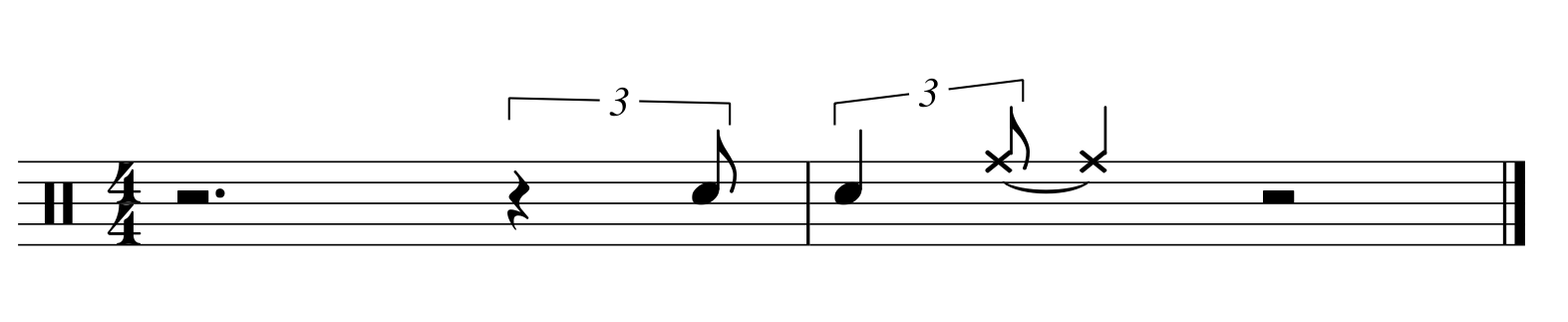
This interpretation can be said to be interpreting on the premise that eighth-note weak-beat precedence exists. However, because quarter-note weak-beat precedence is regarded as absent, one can observe that it is recognized in a form shifted by one.
| Position | Beat 1 | Beat 2 | Beat 3 | Beat 4 |
|---|---|---|---|---|
| Quarter notes | ◯ | ◯ | ◯ | ◯ |
| Strong/weak | Strong | Weak | Strong | Weak |
| Position | Beat 8 | Beat 1 | Beat 2 | Beat 3 | Beat 4 | Beat 5 | Beat 6 | Beat 7 |
|---|---|---|---|---|---|---|---|---|
| Eighth notes | ◯ | ◯ | ◯ | ◯ | ◯ | ◯ | ◯ | ◯ |
| Strong/weak | Weak | Strong | Weak | Strong | Weak | Strong | Weak | Strong |
Interpretation of Ba Dum Tss = Eighth-Note Weak-Beat Precedence Present, Quarter-Note Weak-Beat Precedence Present
Let us look at the following interpretation.

One can see that this interpretation is interpreting on the premise that eighth-note weak-beat precedence exists, and at the same time on the premise that quarter-note weak-beat precedence also exists.
| Position | Beat 4 | Beat 1 | Beat 2 | Beat 3 |
|---|---|---|---|---|
| Quarter notes | ◯ | ◯ | ◯ | ◯ |
| Strong/weak | Weak | Strong | Weak | Strong |
| Position | Beat 6 | Beat 7 | Beat 8 | Beat 1 | Beat 2 | Beat 3 | Beat 4 | Beat 5 |
|---|---|---|---|---|---|---|---|---|
| Eighth notes | ◯ | ◯ | ◯ | ◯ | ◯ | ◯ | ◯ | ◯ |
| Strong/weak | Weak | Strong | Weak | Strong | Weak | Strong | Weak | Strong |
Difference of Multilayer Level by Language
The recognition of multilayer weak-beat precedence that we have seen up to now is influenced by the beat rhythm of the language that person speaks as their native language. In other words, according to the beat rhythm of the language, differences arise such as which note value’s weak-beat precedence is easy to recognize, or whether multilayer weak-beat precedence is easy or hard to recognize. A list of those tendencies is shown below.
| Beat rhythm | Weak-beat precedence eighth notes | Weak-beat precedence quarter notes | Multilayer level |
|---|---|---|---|
| Syllable-timed rhythm | yes | no | 1 |
| Stress-timed rhythm | yes | yes | 2 |
| Mora-timed rhythm | no | no | 0 |
Here, one hypothesis arises.
In syllable-timed rhythm, we saw the law that consonants precede as much as possible by the Maximum Onset Principle (MOP = Maximum Onset Principle). In other words, this can be seen as weak-beat precedence in eighth notes.
Next, in stress-timed rhythm, in addition to the Maximum Onset Principle (MOP = Maximum Onset Principle) of syllable-timed rhythm, the Maximal Prosodic Onset Principle (MPOP) is applied. In other words, this can be interpreted as meaning that, in addition to weak-beat precedence in eighth notes, weak-beat precedence in quarter notes becomes effective at the same time.
It is possible to interpret that syllable-timed rhythm is single-layer weak-beat precedence, and stress-timed rhythm is two-layer weak-beat precedence.
And to mora-timed rhythm, the Minimum Onset Principle (MiOP = Minimum Onset Principle), which is the exact opposite of stress-timed rhythm and syllable-timed rhythm, is applied. In other words, it can be said that not only weak beats but also strong beats do not exist. In other words, all beats are isolated without being divided, and it is possible to interpret that there are no layers.
In other words, mora-timed rhythm can be interpreted as layerless rhythm.
The Multilayer Level Increases as Time Passes
Music in which double weak-beat precedence appears, such as Four performed by Miles Davis, exists only in America.
As time passes, this double weak-beat precedence advances into greater multilayering.
In Herbie Hancock’s Actual Proof, there appears, in sixteen beats, a rhythm in which weak beats precede simultaneously in half notes, quarter notes, eighth notes, and sixteenth notes.
This multilayering of weak-beat precedence evolves even further.
In this piece, in addition to a rhythm in which weak beats precede simultaneously in sixteenth notes, eighth notes, quarter notes, and half notes, there appears a double-whole-note weak-beat precedence in which the melody is placed only in the latter two measures of an eight-measure unit. It can be said to be fivefold weak-beat precedence in total.
Only American music has this kind of multilayer weak-beat-precedence rhythm.
High Performance as the Entertainment Performance of Stress-Timed Music
Assume that the more complex rhythm is, the higher its entertainment performance is. Up to now, we have seen that multilayer weak-beat precedence is a rhythm produced by the linguistic rhythm unique to English and German called stress-timed rhythm. It can also be said that, by stress-timed rhythm mixing in America with various ethnic musics of South America and Africa and becoming still more complex and developed, the performance of rhythm as entertainment became high. The high entertainment performance of American music born from stress-timed rhythm can be explained phonologically.
Why is American music listened to all over the world? Since the internet spread, things are no longer as unipolar toward America as they once were, with Mundian’s Bach Ke becoming globally popular and so on. But in the past there were many criticisms asking, “Why is only American music celebrated all over the world?” That was often spoken of in connection with the strong political power called American hegemony.
However, is not the reason American music is excellent absolutely not due to political power and economic hegemonic power, but rather in the overwhelmingly high entertainment performance of rhythm produced by developing highly multilayered weak-beat-precedence rhythm by tolerantly accepting the diversity of global ethnic musics of Southeast Asia, India, the Middle East, and so on on the basis of stress-timed rhythm?
As an actual example, even Mundian’s Bach Ke mentioned above is absorbed as American music by Jay-Z’s Bach Ke remix.
Jazz Is the Ultimate World Music
Not only did it take in all the past methods beginning from the music of circle-of-fourths progression created by Bach, marches, rondo, minuet, Impressionism, Romanticism, and so on, but jazz, which absorbed all rhythms from around the world such as Gaelic folk music, African folk music, Latin American rhythms, and so on, is, so to speak, the ultimate world music, and it may be concluded that the overwhelmingly high entertainment performance it boasts can be explained not by political power but strictly by phonology.
This can be said to be a development that was possible precisely because it was stress-timed rhythm born as a developed form of syllable-timed rhythm.
A Methodology for Anyone to Groove
It was a development that was possible precisely because it was stress-timed rhythm born as a developed form of syllable-timed rhythm. And mora-timed rhythm is a singularity and has properties exactly opposite to stress timing and syllable timing. It bears the fate of not being able to enter this world of syllable timing and stress timing.
That this mora-timed rhythm does not mix can be clearly shown when viewed phonologically. In syllable-timed rhythm and stress-timed rhythm there is the Maximum Onset Principle (MOP = Maximum Onset Principle), while in Japanese mora-timed rhythm there is the exact opposite property, the Minimum Onset Principle (MiOP = Minimum Onset Principle). This fundamental incompatibility lies at the root of Japanese and all the languages surrounding it.
Japan, which speaks Japanese, a mora-timed-rhythm language like that, is the country with the largest population performing jazz in the world. Yet no one in the world listens to the jazz abundantly produced there. There is nowhere in the world where people listen to jazz whose multilayer degree of weak-beat precedence is zero and which has no value at all as rhythmic entertainment performance. Such Japanese jazz is even said globally to be the world’s greatest musical tragedy.
What was devised as a methodology by which Japanese people, who speak Japanese, a mora-timed-rhythm language having properties completely opposite to groove, can certainly acquire multilayer weak-beat precedence even if it takes time and can surely become able to groove, is the Offbeat Count method.
Rhythmpedia prays that this Offbeat Count method will reach all musicians of the world, and that it will fuse the music of the world at a higher level and produce music with still higher entertainment performance.
In the chapters that follow, by learning the Offbeat Count method and applying metadivision theory on the basis of Offbeat Count, we will look at the methodology for acquiring strong groove by raising the multilayer degree of weak-beat precedence.
- Metadivision theory
- Distributed groove theory
- Offbeat Count theory
- Weak-beat geocentrism and strong-beat heliocentrism
- The mechanism of tatenori
Table of contents
- Offbeat Count Theory
- Introduction
- What Are the Four Principles of Groove
- Why Are Japanese People Tatenori
- Which Comes First, the Strong Beat or the Weak Beat
- Phonorhythmatology
- A Letter to Mora-Timed Language Speakers
- Split Beat (Schizorhythmos) and Isolated Beat (Solirhythmos)
- What Is Metre
- Multi-Layered Weak-Beat-Oriented Rhythm
- Multidimensional Division Spaces
- Rhythm More Important Than Pronunciation
- The World Is Made of 3⁻ⁿ Metres
- 3⁻ⁿ Groove and 2⁻ⁿ Groove
- Distributed Groove Theory
- Weak-Beat Geocentrism and Strong-Beat Heliocentrism
- Introduction to Offbeat Count
- Rhythmochronic Competence and Sense of Rhythm
- Master English Listening with Offbeat Count
- Etudes for Mora-Timed Language Speakers
- Proper English Pronunciation
- Correct Pronunciation of Offbeat Count
- Multilayer Weak-Beat-Precedence Polyrhythm
- The Elements That Shape Rhythmic Nuance
- The Mechanism by Which Tatenori Arises
- Tatenori and the Perception of Movement
- The Psychological Problems Caused by Tatenori
