A Letter to Mora-Timed Language Speakers
Differences in language rhythm are often a very severe reality, hard to face directly, for people whose native language is a mora-timed-rhythm language. The rhythm of Japanese is special. Adaptation to the overseas world for Japanese people begins from accepting the unreasonable fact that all habits up to that point are denied without exception. Moreover, this huge handicap is also a problem peculiar only to people whose native language is Japanese.
For such people whose native language is Japanese, special training specialized only for people whose native language is Japanese is necessary. That training is indispensable not only for English but for acquiring all languages other than Japanese.
This chapter explains the mechanism of the special nature of Japanese, the attitude necessary to overcome the special nature of Japanese, the theory for building bridging training, and its method of practice.
If There Are No Weak Beats, There Are No Strong Beats Either
Music always has weak beats and strong beats. However, this view is not necessarily correct. The reason is that Japanese music traditionally does not have strong beats and weak beats. It is said that Western music was officially introduced into Japan in the Meiji era, but it is also said that Western music had come to Japan even before that together with the arrival of Christianity and so on. It is thought that Japanese music before that had no weak beats and strong beats.
That there is no concept of weak beats and strong beats in the sense of Japanese people can also be confirmed relatively easily by observing present-day Japanese music. Or it can also be confirmed by conducting a simple experiment.
The concept of strong beats and weak beats is a concept deeply rooted in the division of time. When someone is clapping regularly, in order to clap at a position that alternates with that person, it is necessary to measure the interval of the beats the other person is clapping and clap at the midpoint. This is the division of time. The speed of human clapping is not constant, and some fluctuation always occurs. Therefore, it is necessary to decide the position at which to clap one’s own hands while predicting the position of the other person’s clap. It will also be necessary to recognize the position of the hand one clapped, and when the other person actually claps next, instantly judge whether that was earlier or later than one’s prediction, and correct the position of one’s next clap. This too is one important task included in the whole work called the division of time.
People other than Japanese speakers can clap alternately without accompanying much difficulty. However, when Japanese people try to do this, it accompanies surprising difficulty. Sometimes it is by no means rare that they cannot do it even after a long period of years or even decades. This is one piece of evidence that Japanese people do not have the concept of the division of time.
Please look at the following figure.
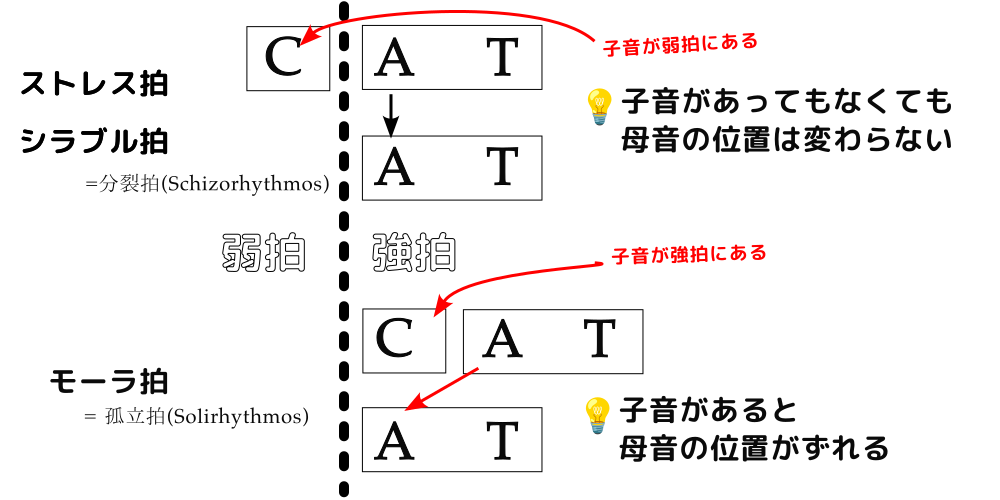
In this way, most languages around the world have the habit of placing consonants before the strong beat (rime). However, Japanese has the very special characteristic, in this point, of having the habit of placing consonants behind the strong beat (rime). Therefore, it has the characteristic that the position of the vowel changes depending on whether there is a consonant or not. This correction of vowel position is done completely unconsciously for Japanese people, and they cannot at all be conscious that they are correcting vowel position. And there is the very large characteristic that they unconsciously ignore beats that occur before the strong beat as noise, and cannot even recognize that a beat existing there is present.
Here, the hypothesis that in stress timing and syllable timing the feeling of dividing time is included in the pronunciation structure itself, while in mora timing there is no feeling of dividing time, and instead of division there is a time concept of “continuation,” in which pronunciation is continuously connected a fixed time after hearing the trigger (strong beat) is established.
The correctness of this hypothesis can be verified by observing the misunderstandings that we, who are actually Japanese, feel when listening to music.
For example, it can be confirmed by looking at the following video.
【日本人のリズムの盲点】映画ハイスクール・ミュージカルの音楽にはオフビートから始まるリズムが現れます。
— 岡敦/Ats🇯🇵 (@ats4u) May 25, 2023
日本人には1拍目表拍から文章を解釈しその前にある音を全て無視するという性質がある為、そこに音があることに気付きません。
その地点を見える化しました。#オフビートで思考する語学 pic.twitter.com/qpvR56b6tG
At the beginning there is a part saying “we’re.” However, because this exists at a weak-beat position, it cannot be recognized by people whose native language is a mora-timed-rhythm language (Japanese). This too is one piece of evidence that Japanese people do not have the concept of the division of time.
Please look at the next video. It is a famous song by Michael Jackson.
ママセイママサーママクサというのは、マイケルジャクソンのアルバム・スリラーの1曲目に収録されている Wanna Be Startin' Somethin' の後半部分に現れる有名なリフの歌詞です。 https://t.co/p6WtrMQLJO pic.twitter.com/N06WFGr8YX
— 岡敦/Ats🇯🇵 (@ats4u) April 14, 2023
People whose native language is a mora-timed-rhythm language often do not notice the existence of the first “mama” in the lyrics “mama say mama sa ma ma ku sa” of this song. Because it exists at an anacrusis position.
There are many examples like this. In African American music such as jazz, R&B, and hip-hop, in almost all songs one finds rhythm types that people whose native language is a mora-timed-rhythm language cannot hear. For people whose native language is a mora-timed-rhythm language, there exist many rhythm types they cannot hear.
In the lyrics of the chorus of the famous Carpenters song “Superstar,” the lyric “You said you’d be coming back this way again, baby♪” begins with many words from weak beats. With lyrics sung in this kind of rhythm, the phenomenon occurs that almost all of it is missed.
You said you'd be coming back this way again, baby♪
— 岡敦/Ats🇯🇵 (@ats4u) October 15, 2023
─── の部分が何度聴いても聴き取れない縦乗り脳な私。 全部オフビートから1つずつずれて単語が始まっている日本人が一番苦手なパターンがここにあります。#オフビートで思考する語学
Credit : https://t.co/1BfCPxCqqN pic.twitter.com/riVn1DdcHf
The following video indicates by subtitles the rhythm positions that are easy for a person whose native language is a mora-timed-rhythm language to miss.
【日本人はオフビートが聴き取れない】 日本人が英語が聴き取れない理由は音楽のリズムの認識の違いと深い関係があります。
— 岡敦/Ats🇯🇵 (@ats4u) April 1, 2023
日本人がリズム上聴き取れない部位を見える化しました。#オフビートで思考する語学
Credit: Tape Machine の Boomerang Feauturing MIa Pfirrman
https://t.co/6GtW6DqEX4 pic.twitter.com/QzFHwUtoJm
This is a Lao (northeastern Thailand) folk song. Because Lao folk songs sing the lyrics on beats 2, 3, and 4, Japanese people miss many beats. Also, often they cannot even recognize the fact that they are missing all of the beats. This can be confirmed by listening to the music while counting the number of beats.
【タイ東北の民謡・モーラム】タイ東北方言(ラオ/イサーン語)を習得したことが、私のリズム開眼のきっかけになりました。
— 岡敦/Ats🇯🇵 (@ats4u) June 18, 2023
ラオ民謡はメロディーが全て弱起になっており、弱起のない部分がありません。日中韓と真逆のリズム構成になっています。
Credit :… pic.twitter.com/N8etpUVFY9
This is an English teacher teaching native kindergarten children by reading the base form, comparative, and superlative of adjectives in order, and one can see that the teacher puts the before the superlative. Native English speakers unconsciously put the definite article the before the superlative. That is because reading the superlative itself without the definite article feels strange. That is why the teacher reads it with the, but this too is in a weak-beat position that Japanese people cannot hear, so they do not even notice that a beat exists there.
fat fatter fattest と暗記させられたが、最上級の前に the を入れろと言った先生を私の日本人の人生で一人も見た事がない。こんなに酷い間違いを堂々と全員やる国って何なのか。しかもやらないと成績が悪くなって社会に適応できなくなるし。 pic.twitter.com/zePi4c92s0
— 岡敦/Ats🇯🇵 (@ats4u) July 22, 2025
The music of Japan (mora-timed rhythm) has a rhythm structure completely different from the music of the West (stress-timed rhythm / syllable-timed rhythm).
A rhythm that starts moving without preparatory motion. A rhythm that gradually becomes faster. A breath that switches from stillness to movement. All rhythm concepts are constituted by concepts completely different from those of stress-timed rhythm and syllable-timed rhythm.
There are three large problems faced when people whose native language is mora-timed rhythm perform music of stress timing and syllable timing.
- Mora-timed rhythm has rhythms that cannot be recognized.
- It is difficult to notice the very fact that there are rhythms that cannot be recognized.
- It is fundamentally difficult to recognize the existence of something that cannot be recognized.
After acquiring it, many problems still occur.
- Even after one acquires recognition of stress-timed rhythm and syllable-timed rhythm later in life, as soon as one comes into contact with mora-timed rhythm (hears it or speaks it), the senses immediately return to mora-timed rhythm.
- There is difficulty in returning from a state in the mode of mora-timed rhythm to the mode of stress timing and syllable timing. Even after acquiring stress timing and syllable timing, it is very difficult to switch instantly while one is in the state of speaking mora-timed rhythm.
- There are problems even after acquiring switching. There is difficulty in living in Japan while remaining switched to the mode of stress-timed rhythm and syllable-timed rhythm. Often one ends up causing unexpectedly large problems in human relationships.
Unable to hear weak beats, not even noticing the very fact that one cannot hear them, and finding it difficult even to recognize that there is sound there: people whose native language is a mora-timed-rhythm language will read onward from this section in this state.
Knowing the existence of what one had not recognized has an intense shock that cannot be avoided no matter what. It is like the shock at the moment one notices that, in fact, there is a large famous store right in the middle of the familiar main street one had been passing through as a matter of course until now.
The shock of learning that it was there in that place one passed every day. The shock toward oneself for not having noticed until now that it was there. And the shock when one notices that in fact many people other than oneself had already known that there was that famous store. Furthermore, the shock when one notices that everyone other than oneself had in fact already known that one was not noticing that existence. And the shock when one notices that no one told one of that existence.
The feelings brought by that shock are not necessarily only positive ones. It often calls up strong negative feelings. When people notice the existence of weak beats, they feel embarrassment, humiliation, and anger.
What had not existed there until now suddenly appears there. An encounter with something unknown that suddenly appears in one’s senses always brings about a large drama.
Surely those reading this book too, while continuing to read this book, will encounter many shocks and feel emotions they have never experienced before. However, this is also a road that everyone passes through.
However, this book provides weapons (theory and practice methods) for facing the existence called weak beats, which has many mysteries. In you too lies the talent to acquire real improvisational ability in jazz, real performance ability in classical music, and true international communication ability. By working carefully step by step, anyone can acquire it.
I hope you will by all means read on from this section onward without giving up and with persistence. Surely you will be able to obtain results beyond your expectations.
Table of contents
- Offbeat Count Theory
- Introduction
- What Are the Four Principles of Groove
- Why Are Japanese People Tatenori
- Which Comes First, the Strong Beat or the Weak Beat
- Phonorhythmatology
- A Letter to Mora-Timed Language Speakers
- Split Beat (Schizorhythmos) and Isolated Beat (Solirhythmos)
- What Is Metre
- Multi-Layered Weak-Beat-Oriented Rhythm
- Multidimensional Division Spaces
- Rhythm More Important Than Pronunciation
- The World Is Made of 3⁻ⁿ Metres
- 3⁻ⁿ Groove and 2⁻ⁿ Groove
- Distributed Groove Theory
- Weak-Beat Geocentrism and Strong-Beat Heliocentrism
- Introduction to Offbeat Count
- Rhythmochronic Competence and Sense of Rhythm
- Master English Listening with Offbeat Count
- Etudes for Mora-Timed Language Speakers
- Proper English Pronunciation
- Correct Pronunciation of Offbeat Count
- Multilayer Weak-Beat-Precedence Polyrhythm
- The Elements That Shape Rhythmic Nuance
- The Mechanism by Which Tatenori Arises
- Tatenori and the Perception of Movement
- The Psychological Problems Caused by Tatenori
