Which Comes First, the Strong Beat or the Weak Beat
Recognition of the order of strong beats and weak beats differs greatly depending on the rhythm possessed by the language that person has as their native language.
Musical Rhythm Interpretation Differs by Language
Please listen to the following rhythm.
バダムツー(英語での「ちゃんちゃん」のような効果音) Credit : https://t.co/1pMfDuY1S3 pic.twitter.com/qdcGm8P81M
— 岡敦/Ats🇯🇵 (@ats4u) May 31, 2025
This is a rhythmic sound effect overseas that has the same meaning as Japanese “chan-chan.” It is performed as a punchline sound effect when something funny happens. This sound is generally expressed with the onomatopoeia ba dum tss and spelled ba dum tss. As for this ba dum tss, it was explained in detail in Tatenori Theory#What Is Ba Dum Tss.
When one expresses this rhythm in notation, one notices that there are several different ways of writing it. What do you think, you who read this?
Perhaps you may have interpreted it as follows.

Did ba dum tss really come from music of this rhythm? — One may understand by actually trying it. Let us make music using this rhythm interpretation and actually listen to it.
バダムツーの縦乗りでの解釈 #オフビートで思考する語学 https://t.co/KN5gMaKMdE pic.twitter.com/TCvZoJEMqw
— 岡敦/Ats🇯🇵 (@ats4u) May 29, 2025
Is this correct? — At least to me, the author, it does not feel like this. The music was probably the following kind of music.
バダムツーの横乗りでの解釈 #オフビートで思考する語学 https://t.co/KN5gMaKMdE pic.twitter.com/C5x0FYgXLk
— 岡敦/Ats🇯🇵 (@ats4u) May 29, 2025
If the above rhythm interpretation is expressed as notation, it will probably become the following.

What on earth is the difference existing here? — This is recognition of the order of strong beats and weak beats.
From now on, in order to understand this ba dum tss, we will look in order at the knowledge that becomes the necessary premise = what weak-beat precedence is, the phonological principle existing behind weak-beat precedence, the multilayered nature of weak-beat precedence, and the difficulty of hearing multi-layered weak-beat precedence. And as for how to interpret this ba dum tss, it is explained in more detail in Ba Dum Tss Is a Touchstone of Double Weak-Beat-Precedence Recognition.
Difference in Recognition of the Order of Strong Beats and Weak Beats in Music
What does the order of strong beats and weak beats mean? Please watch the following video.【モーラ拍リズムの言語(日本語)を母語として話す人が聴き取れないリズム】 16分音符1つが弱起として入っている基本リフパターン ─── マイケル・ジャクソンのヒューマン・ネイチャー Live at Wembley 1988 Credit : https://t.co/eQ1e6WjElH pic.twitter.com/mBAaWxTeSj
— 岡敦/Ats🇯🇵 (@ats4u) May 31, 2025
This song is Michael Jackson’s hit song “Human Nature.” At the beginning of this song Michael Jackson sings “chiichiki chiichiki,” but how did all of you reading this article hear this rhythm?
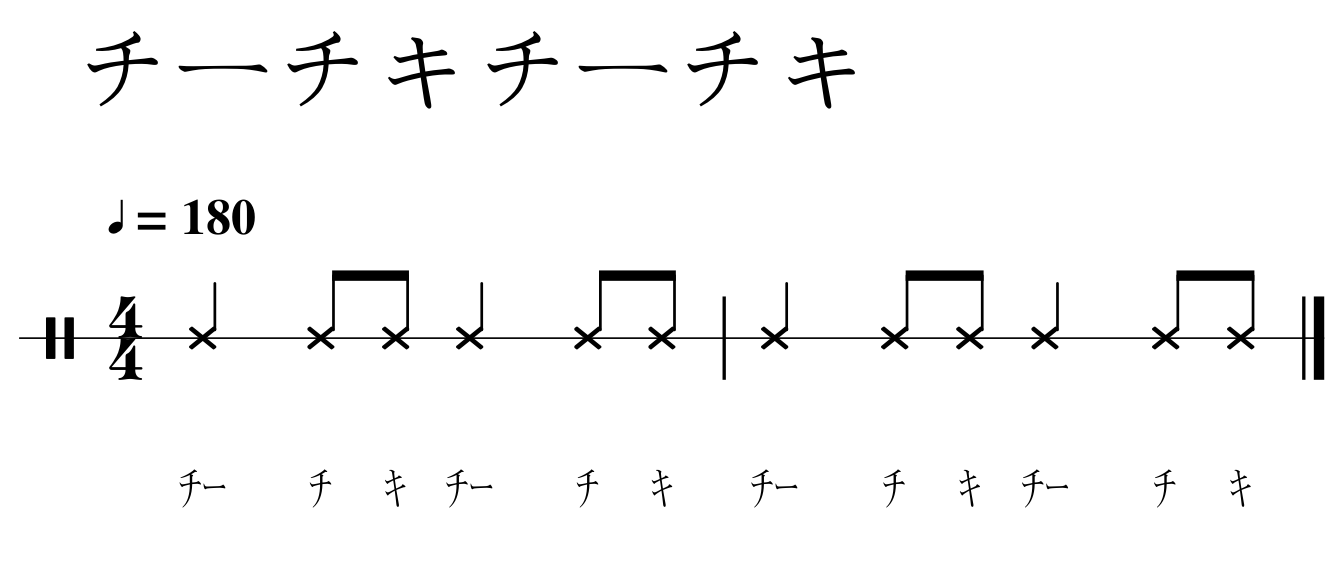
Was it not interpreted like this? However, soon after the song begins, it becomes clear that this interpretation is wrong — in fact it is as follows.
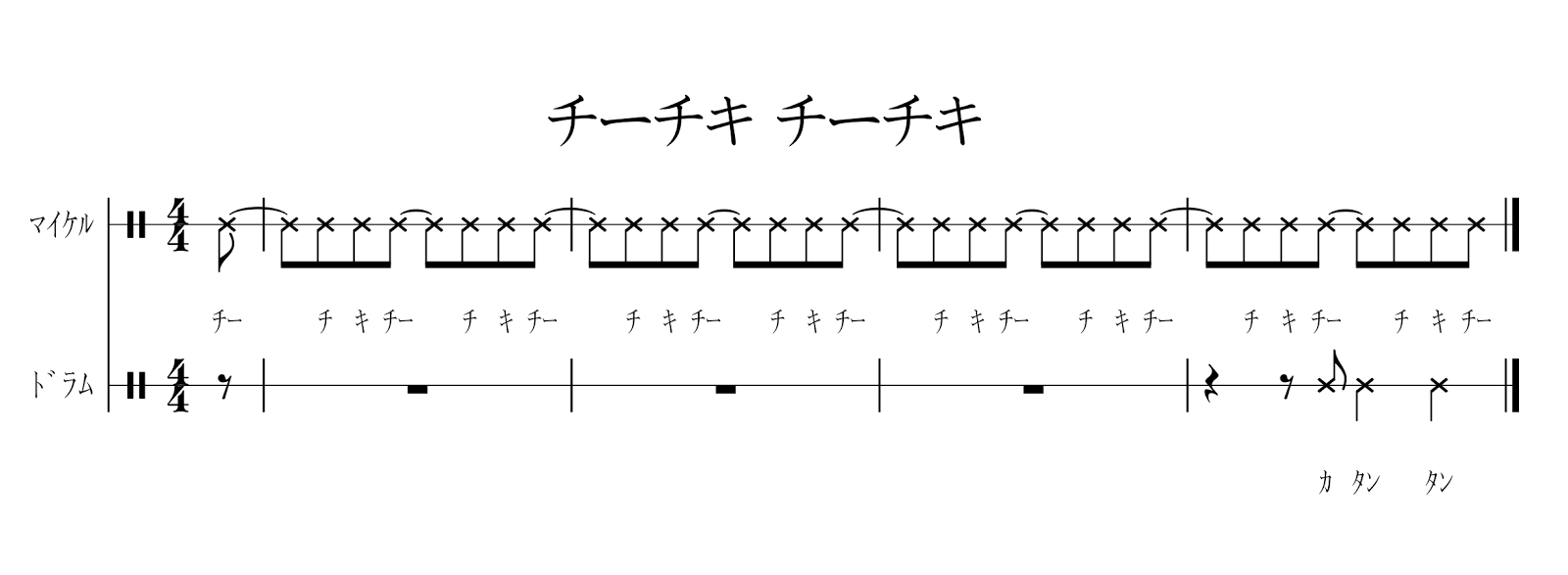
In this way, the rhythm begins in a form shifted by one eighth note. — What can be understood from here is that where Japanese people naturally recognize a sound as the strong beat of an eighth note the moment they hear it, people other than Japanese naturally recognize it as the weak beat of an eighth note.
This is the difference in recognition of the order of strong beats and weak beats.
This “difference in rhythm interpretation” — I, the author, went on a language warrior-training journey in remote areas overseas and in 12 years learned four languages (dialects of English, Thai, Lao, and Chinese). This “difference in rhythm interpretation” was always in my mind in the process of leaving Japanese. That a person’s native language greatly affects the way music sounds too — I think that this may be the biggest of the many causes of why Japanese people are poor at foreign languages.
Are all Asians poor at English? — It does not necessarily seem so. The Asians I saw during my wandering … for example, Thai people, Lao people, Vietnamese people, and Chinese people often come to speak some degree of English without studying very much. Asians other than Japanese, no matter how deep in the interior they live, can speak some English by imitation. English is not originally such a difficult language to acquire. However, for some reason only Japanese people cannot acquire English by imitation. Japanese people seemed to be particularly exceptionally extremely poor at English among Asians.
Why are only Japanese people poor at English? — the cause is this recognition of the order of strong beats and weak beats.
Difference in Recognition of the Order of Strong Beats and Weak Beats in Language
Let us look at the following video as a concrete example.
【リエゾン】前後の子音が全て繋がることをリエゾンといいます。
— 岡敦/Ats🇯🇵 (@ats4u) November 25, 2022
LMFAO
エルエムエフエイオー
⇩⇩⇩⇩
エェレッメッフェィヨゥ!
Credit : https://t.co/FL5wMtgC4l pic.twitter.com/v0mkyrsnW4
Appearing in this video is a vocal unit called LMFAO that took the world by storm around 2011. Their “L-M-F-A-O” pronounced in stress-timed rhythm is recognized in mora-timed-rhythm recognition as “e-re-me-fei-you.”
This occurs because the rhythm recognition of beat order = weak-strong in syllable-timed-rhythm and stress-timed-rhythm languages is wrongly recognized with the rhythm recognition of beat order = strong-weak in a mora-timed-rhythm language.
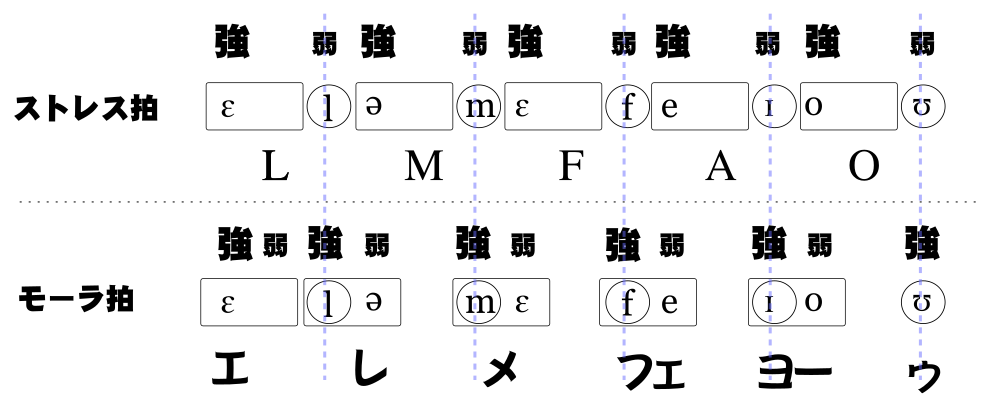
The above is a schematic representation of the state when a pronunciation in stress-timed interpretation is misinterpreted in mora-timed-rhythm interpretation.
In English, accent is placed on vowels, and consonants are pronounced as if attached before them. If one compares this to strong beats and weak beats in music, one notices that it is as though there is the same element as musical anacrusis. By performing as if attaching the anacrusis first and then performing the strong beat, a springing rhythmic atmosphere is brewed.
In overseas phonology, the tendency to perform the weak beat first as much as possible in this way is called the Maximize Onset Principle (MOP=Maximize Onset Principle). This Maximize Onset Principle will be looked at in more detail in later sections.
In Japanese, accent is placed on consonants and vowels are pronounced after the accent. Therefore, when one hears a weakly pronounced consonant in syllable-timed rhythm, one cannot predict that a still larger strong beat will come next, and the phenomenon occurs in which the consonant is mistaken for the strong beat as it is. This is called the syndrome in which the first sound heard sounds like the strong beat of beat 1.
When Japanese people hear English by the syndrome in which the first sound heard sounds like the strong beat of beat 1, it is observed as a result that the boundaries of words are imaged in the mind completely shifted by one.
Strong-Beat-Precedence Japanese Rhythm
People whose native language is Japanese have a bias of recognition in which they naturally feel strong-weak and feel weak-strong as unnatural. Also, in the order of beats of music performed in Japanese, only the pattern of “strong-weak” appears. If one is born in Japan and only listens to Japanese music, there is no opportunity at all to notice this rhythm bias. Therefore, most Japanese speakers pass their days without noticing this rhythm bias at all. This rhythm bias is a large blind spot of Japanese society. This blind spot continues to exist secretly in society without being noticed by people at all.
— Why do Japanese people not groove? … The reason is Japanese strong-weak rhythm.
— At the same time, why can Japanese people not hear English? … The reason is also Japanese strong-weak rhythm.
In phonology, Japanese is classified as a language of mora-timed rhythm.
This mora-timed rhythm exists at the foundation of the mechanism by which this strong-weak rhythm recognition occurs. We will look at this mora-timed rhythm in the following sections.
Weak-Beat-Precedence Rhythm of French, Spanish, and English
People whose native language is English do not have the bias of recognition in which they naturally feel strong-weak and feel weak-strong as unnatural. They feel both weak-strong and strong-weak as natural, and in music too both patterns of “weak-strong” and “strong-weak” appear.
In phonology, French, Spanish, and Portuguese are classified as syllable-timed rhythm. English, German, and Russian are classified as stress-timed rhythm.
What It Means for a Beat to Be Heard First
Until now I have explained that a beat is heard first or a beat is heard later. A large element related to this is “whether the next beat is being predicted.” This includes the difference between Proactive and Reactive.
The statement “the weak beat is heard first” suggests that the person is predicting the position of the strong beat that is coming next. Because the position of the strong beat that should come next is in mind, it becomes recognition that the weak beat is before that.
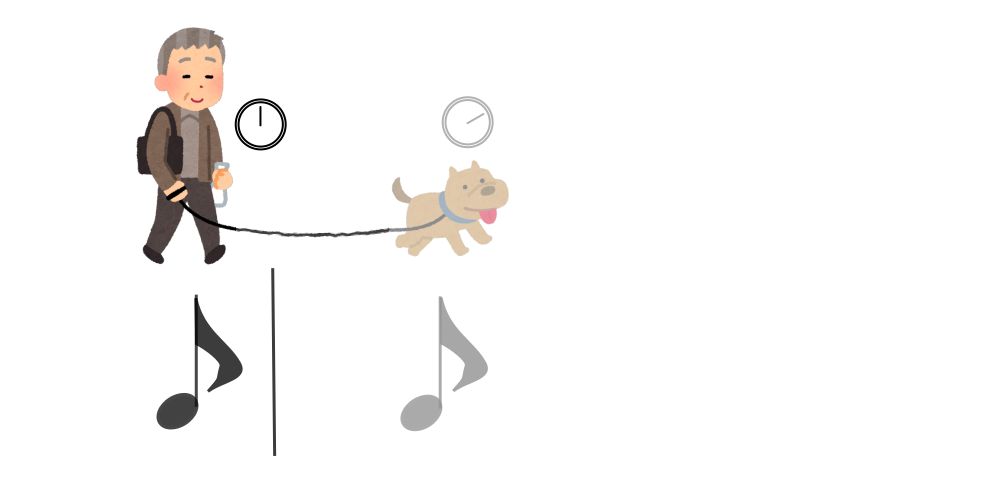
On the other hand, the statement “the weak beat is heard later” suggests that the person is not predicting the position of the strong beat that is coming next. Because he thinks that if the strong beat is heard then he should clap the weak beat, it becomes recognition that the weak beat is behind that.
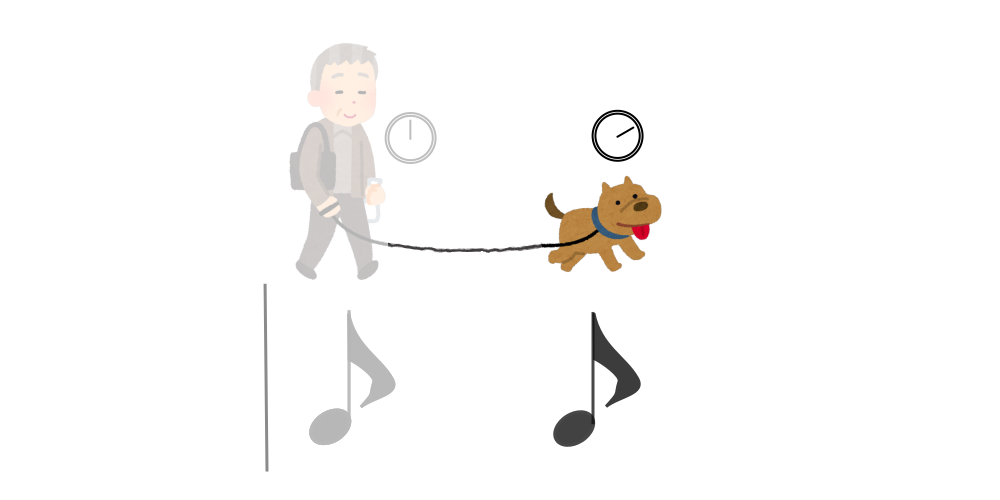
Thinking on the basis of a point predicted in advance is called Proactive. And thinking on the basis of some event that has already happened without predicting it is called Reactive.
As for Proactive and Reactive, we will look in detail at Split Beat (Schizorhythmos) and Isolated Beat (Solirhythmos).
This also has a large influence on the behavioral principles of Japanese people. This is discussed in detail in The Influence of Japanese on Action Cognition.
Summary
We will look at this syllable-timed rhythm and stress-timed rhythm in the following sections.
Table of contents
- Offbeat Count Theory
- Introduction
- What Are the Four Principles of Groove
- Why Are Japanese People Tatenori
- Which Comes First, the Strong Beat or the Weak Beat
- Phonorhythmatology
- A Letter to Mora-Timed Language Speakers
- Split Beat (Schizorhythmos) and Isolated Beat (Solirhythmos)
- What Is Metre
- Multi-Layered Weak-Beat-Oriented Rhythm
- Multidimensional Division Spaces
- Rhythm More Important Than Pronunciation
- The World Is Made of 3⁻ⁿ Metres
- 3⁻ⁿ Groove and 2⁻ⁿ Groove
- Distributed Groove Theory
- Weak-Beat Geocentrism and Strong-Beat Heliocentrism
- Introduction to Offbeat Count
- Rhythmochronic Competence and Sense of Rhythm
- Master English Listening with Offbeat Count
- Etudes for Mora-Timed Language Speakers
- Proper English Pronunciation
- Correct Pronunciation of Offbeat Count
- Multilayer Weak-Beat-Precedence Polyrhythm
- The Elements That Shape Rhythmic Nuance
- The Mechanism by Which Tatenori Arises
- Tatenori and the Perception of Movement
- The Psychological Problems Caused by Tatenori
